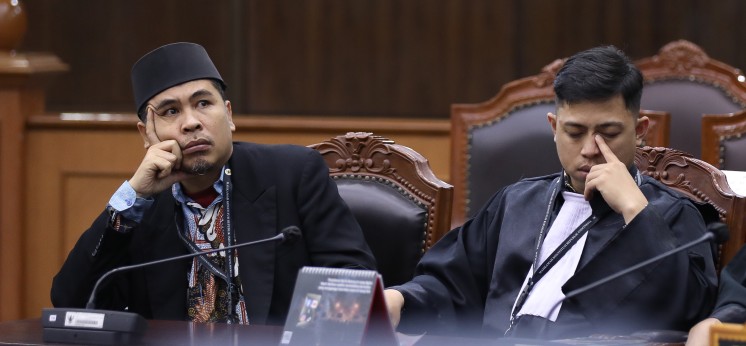
Petitioner Endang Samsul Arifin attending the Decision Pronouncement Hearing on the judicial review of Law No. 14 of 2025 on the Organization of Hajj and Umrah on Monday (16/3) at the Courtroom. Photo by MKRI/Ifa.
Jakarta (MKRI) - The allocation of regular hajj quotas is carried out systematically through a deliberative, joint approval process between the government and the DPR, placing quota policy within a stronger ecosystem of political oversight. This oversight is explicitly addressed in Article 9 of Law No. 14 of 2025 on the Third Amendment to Law No. 8 of 2019 on the Organization of Hajj and Umrah (Hajj and Umrah Law) regarding the granting of additional hajj quotas.
These considerations were delivered by Justice Arsul Sani when reading the Constitutional Court’s legal reasoning in Decision No. 237/PUU-XXIII/2025 at the pronouncement hearing on Monday, March 16, 2026. In reviewing the petition against the Hajj and Umrah Law, the Court explained that distribution of regular hajj quotas is inherently tied to the quota allocated by the Government of the Kingdom of Saudi Arabia, constantly changing waiting lists, dynamic inter-regional registration patterns, and the need to correct disparities in waiting times identified through annual evaluations. The Court held that controlled flexibility in quota-setting is therefore needed as a policy instrument to preserve fair legal certainty amid such dynamics.
The Court emphasized that the challenged norm must be understood as granting limited and measurable flexibility, so that the law can still adapt to evolving realities. Accordingly, the Court found unfounded the Petitioner’s claim that Article 13 paragraph (2) of the Law represents a step backward that creates legal uncertainty.
“Thus, based on these legal considerations, the Court holds that the Petitioner’s argument questioning the constitutionality of the phrase ‘and/or’ in Article 13 paragraph (2) letter a of Law 14/2025 as contradicting Article 28D paragraph (1) of the 1945 Constitution is without legal merit,” Justice Arsul said, reading the Court’s reasoning.
Choosing variables in a limited way
The Court noted that detailed policy on the distribution and determination of hajj quotas is regulated by ministerial regulation, so the minister may not allocate quotas arbitrarily or without clear grounds.
“In other words, the phrase ‘and/or’ in the challenged article does not create unlimited room, but limits the set of permissible variables to be used in policy-making, namely, whether to base it on the proportion of the Muslim population across provinces, on the proportion of hajj waiting lists across provinces, or on both. These three methods can all be used to determine the distribution of regular hajj quotas,” Justice Arsul explained.
Principle of proportionality
Regarding the minister’s authority to allocate regular hajj quotas, the Court linked it to Article 8 paragraph (5) of the Hajj and Umrah Law, which requires that Indonesia’s hajj quota be set transparently, and to Article 12 paragraph (2), which stipulates that quotas must be determined transparently, proportionally, and fairly.
Of these principles, only transparency is defined in the Law, as the open administration of hajj and umrah that facilitates public access to information on implementation and on the management of finances and assets. For proportionality in quota allocation, the Court held that distribution must rest on careful and prudent consideration of both the proportion of the Muslim population and the proportion of the waiting list, including the proportion of elderly pilgrims who must be prioritized.
“This determination must be made fairly so as not to create bias or arbitrariness. Therefore, although the minister is given room to choose one variable or a combination of two, in the Court’s view that choice must still be justifiable under these three principles,” Justice Arsul said.
Involving the DPR
The Court further stressed that ministerial discretion over hajj quotas is inseparable from Article 8 paragraph (2) of the Hajj and Umrah Law, which requires that Indonesia’s hajj quota be set by the minister after discussion and joint approval with the DPR. With the DPR’s involvement, the Court observed, the post-amendment statutory design does not leave all quota-allocation decisions to the executive alone, but instead incorporates the DPR as the institution representing the people’s will.
“In this context, the ‘regular hajj quota’ referred to is the quota for regular pilgrims, for regional hajj officers, and for hajj and umrah guidance groups,” Justice Arsul added.
Distribution of additional quotas
The Court also addressed the treatment of additional quotas. If, after the initial setting of regular hajj quotas, Indonesia receives additional quotas from the Government of the Kingdom of Saudi Arabia, the minister must discuss them with the DPR to designate them as additional hajj quotas. Additional quota, therefore, may not be treated as a free policy space that the government can allocate at will, because Article 9 paragraph (3) of the Hajj and Umrah Law explicitly requires that additional quotas be filled for regular and special hajj quotas proportionately and that this be announced online and on a regular basis.
The Court held that the phrase “in proportion” carries a firm normative meaning that additional hajj quotas must be distributed fairly on the basis of an accountable composition that respects the proportions laid down in the Law, and not arbitrarily or in a way that benefits one type of hajj administration over another.
“Accordingly, in the Court’s view, additional quotas may not be manipulated, misused, or distributed irresponsibly, including by turning them into transactional objects or into a means of trading access to hajj departures that benefits certain parties at the expense of regular hajj candidates. Such practices clearly violate the regulatory design of Law 14/2025, which emphasizes transparency, proportionality, and fairness in the allocation of regular hajj quotas,” Justice Arsul said.
Time limits and legal limits
The Court highlighted that Article 9 paragraph (2) of the Hajj and Umrah Law strictly sets a deadline for the minister to determine additional quotas no later than seven days from receipt of additional hajj quotas from the Government of the Kingdom of Saudi Arabia. This time limit, it said, is a new norm that must be seen not as a mere administrative rule but as a binding legal limit to guarantee fair legal certainty, speed, and accountability in managing additional quotas in the interests of regular pilgrims.
As the Law defines “day” as a calendar day, the seven-day period must be calculated concretely and may not be extended arbitrarily through administrative delay. Under this legal construction, once additional quotas are received, the minister may not postpone setting them without valid grounds, as such a delay would create uncertainty for regular pilgrims, disrupt quota filling, and open opportunities for abuse of power.
“Thus, in the Court’s view, Article 9 of the Hajj and Umrah Law and related provisions on additional quotas function as a preventive mechanism against corruption and abuse of authority. Additional quotas must be managed swiftly and accurately under proper oversight so that the purpose of their allocation is not transformed into an irresponsible exercise of discretion that undermines transparency, proportionality, and fairness in the distribution of regular hajj quotas,” Justice Arsul said.
Limited flexibility space
In the distribution of regular hajj quotas based on comparative regional data, the Court observed that the number of Muslims does not always move in tandem with the length of waiting lists, suggesting that a single variable may fail to meet real needs in all circumstances. The presence of the phrase “and/or” in Article 13 paragraph (2) letter a thus allows the law to respond to objective realities by equipping policymakers with tools that prevent them from being trapped in formulae that may appear unjust when circumstances change, and must be understood as a grant of limited, carefully circumscribed flexibility so that the law can continue to adapt to evolving concrete realities.
“Therefore, if Article 13 paragraph (2) of the Hajj and Umrah Law is interpreted as a step backward that creates uncertainty, as alleged by the Petitioner, that argument is unfounded. In light of these legal considerations, the Court concludes that the Petitioner’s claim that the phrase ‘and/or’ in Article 13 paragraph (2) letter a of Law 14/2025 conflicts with Article 28D paragraph (1) of the 1945 Constitution is without legal merit,” Justice Arsul stated.
Based on this reasoning, the Court, in the verdict read by Chief Justice Suhartoyo, rejected the petition in its entirety.
Also read:
Uncertain Departure Schedule, Regular Hajj Quota Distribution Rules Put to the Test
Emphasizing Constitutional Losses Due to Uncertain Regular Hajj Departure Schedule Regulations
New Formula for Hajj Quota Allocation, Waiting Period Standardized at 26 Years
Government Explains Policy Tools for Adjusting Hajj Quota Allocation
Minister’s Discretionary Power on Regular Hajj Quota Deemed Consistent with Legal Certainty Principle
During the preliminary hearing on Tuesday, December 9, 2025, the petitioner explained that, in the 2025 hajj season, the Minister of Religious Affairs allocated regular hajj quotas based on the proportion of the Muslim population across provinces. However, during the 2026 hajj season, the Minister allocated based on the provincial hajj waiting-list proportions.
According to the petitioner, this clause in Article 13 paragraph (2) results in the absence of a clear and definitive regulation governing the quota allocation mechanism for regular pilgrims. Consequently, prospective pilgrims cannot anticipate which allocation basis will apply from year to year, creating uncertainty about their year of departure.
The petitioner also argued that pilgrims initially projected to depart the following year, based on the previous year’s quota calculations, might lose their opportunity if their provincial quota suddenly changes. Conversely, pilgrims who were not previously expected to depart may be required to do so if quotas shift.
The petitioner asserted that the norm in Article 13 paragraph (2) would ensure fair legal certainty and align with the principles of Article 28D paragraph (1) of the 1945 Constitution only if it explicitly stipulated that quota allocations must be determined through a fair and balanced combination of the two criteria. These two quota distribution mechanisms, the petitioner argued, should not be treated as alternatives but rather integrated equitably.
Therefore, the petitioner requested the Court to declare that Article 13 paragraph (2) of Law No. 14 of 2025 on the Third Amendment to Law No. 8 of 2019 on the Organization of Hajj and Umrah contravenes the 1945 Constitution and has no binding legal force unless interpreted to mean that “the allocation of regular hajj quotas as referred to in paragraph (1) shall be based on both the proportion of the Muslim population and the proportion of waiting lists across provinces, implemented in a fair and balanced manner.”
Decision No. 237/PUU-XXIII/2025 (in Indonesian)
Author: Sri Pujianti
Editor: Lulu Anjarsari P.
PR: Adriana Airlia Y.
Translator: Rizky Kurnia Chaesario
Disclaimer: The original version of the news is in Indonesian. In case of any differences between the English and the Indonesian versions, the Indonesian version will prevail.
Monday, March 16, 2026 | 11:38 WIB 132