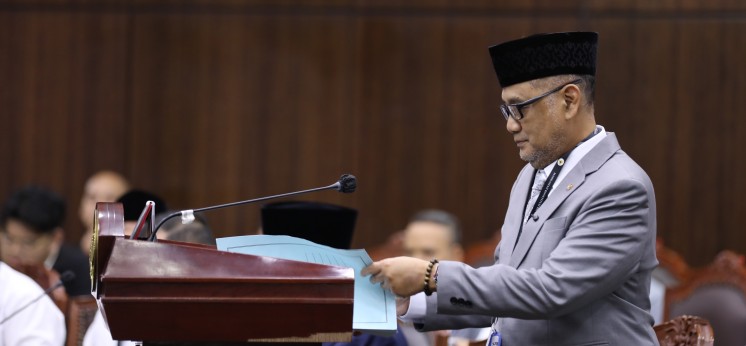
Minister of Hajj and Umrah, Mohammad Irfan Yusuf, representing the government delivering his testimony during the judicial review hearing of Law No. 14 of 2025 on the Organization of Hajj and Umrah, Monday (09/02). Photo by MKRI/Ifa.
Jakarta (MKRI) - Basing quota distribution on the proportion of the Muslim population between provinces and the size of each province’s waiting list would shift the nature of the rule from a policy framework into an imperative, formula-based norm. It would also weaken the waiting list's role as a corrective mechanism for queuing fairness.
“From a public policy perspective, mandating the combined scheme directly affects pilgrims’ waiting time. If the combined scheme is made compulsory, fragmented waiting periods between regions may re-emerge, making the goal of equalizing waiting times difficult to achieve,” said Minister of Hajj and Umrah Mohammad Irfan Yusuf, representing the Government at a hearing on Monday, February 9, 2026.
Petition No. 237/PUU-XXIII/2025 was filed by lecturer Endang Samsul Arifin. The fourth hearing in the material judicial review of Law No. 14 of 2025 on the Third Amendment to Law No. 8 of 2019 on the Organization of Hajj and Umrah was scheduled to hear the Government/President’s explanation.
Irfan went on to explain that the use of the phrase “and/or” in Article 13 paragraph (2) of the Hajj and Umrah Law is not intended to create legal uncertainty, but rather serves as a policy tool that allows the Government to adjust quota allocations to factual and dynamic conditions in each hajj season, including the quota set by the Government of the Kingdom of Saudi Arabia.
Regarding the Petitioner’s arguments against Article 13 paragraph (2), the Government takes the view that the petition of the norm in question provides certainty for the state in managing the organization of hajj. This applies from preparation through to implementation, for a defined policy period, and is evaluated periodically and against measurable criteria based on actual conditions encountered in the organization of hajj in Indonesia.
Preparation of Hajj Organization
In preparing the administration of hajj each year, Irfan continued, the Government of the Republic of Indonesia undertakes a series of steps. First, after the national hajj quota is set by the Government of Saudi Arabia, the Government, through the Minister of Hajj and Umrah, allocates the quota to provinces in a proportional and equitable manner. Second, the Government determines the list of pilgrims eligible to depart, including the process of settling the Hajj Travel Expenses (BPIH), managing hajj funds through the Hajj Financial Management Agency (BPKH), and updating pilgrims’ data via the integrated hajj information system.
Third, the Government prepares technical and operational arrangements for departure, including air and ground transportation, accommodation, catering, health services, and hajj guidance and rituals training for pilgrims. Fourth, during the implementation of hajj in Saudi Arabia, the Government, through Hajj Organizing Officers (PPIH), provides services, protection, and supervision for pilgrims, including accommodation, transportation, catering, health services, and religious guidance while in the Holy Land. Fifth, once the hajj rituals are completed, the Government repatriates pilgrims in stages according to their flight groups (kloter) and embarkation points.
“The series of preparations, implementation, and repatriation of hajj pilgrims is carried out in an integrated and continuous manner by the Government, as an expression of the state’s responsibility to guarantee services, protection, and guidance for hajj as mandated by legislation,” Irfan said.
Irfan further explained that if the norm were drafted cumulatively using only the word “and,” as requested by the Petitioner, removing the word “or” from Article 13 paragraph (2) would mean quotas could be determined only on the basis of fixed considerations without regard to factual dynamics in hajj administration, and would close off the Government’s ability to adapt its policies. This, he warned, could lead to unequal waiting times across provinces.
Also read:
Uncertain Departure Schedule, Regular Hajj Quota Distribution Rules Put to the Test
Emphasizing Constitutional Losses Due to Uncertain Regular Hajj Departure Schedule Regulations
New Formula for Hajj Quota Allocation, Waiting Period Standardized at 26 Years
During the preliminary hearing on Tuesday, December 9, 2025, the petitioner explained that, in the 2025 hajj season, the Minister of Religious Affairs allocated regular hajj quotas based on the proportion of the Muslim population across provinces. However, during the 2026 hajj season, the Minister allocated based on the provincial hajj waiting-list proportions.
According to the petitioner, this clause in Article 13 paragraph (2) results in the absence of a clear and definitive regulation governing the quota allocation mechanism for regular pilgrims. Consequently, prospective pilgrims cannot anticipate which allocation basis will apply from year to year, creating uncertainty about their year of departure.
The petitioner also argued that pilgrims initially projected to depart the following year, based on the previous year’s quota calculations, might lose their opportunity if their provincial quota suddenly changes. Conversely, pilgrims who were not previously expected to depart may be required to do so if quotas shift.
The petitioner asserted that the norm in Article 13 paragraph (2) would ensure fair legal certainty and align with the principles of Article 28D paragraph (1) of the 1945 Constitution only if it explicitly stipulated that quota allocations must be determined through a fair and balanced combination of the two criteria. These two quota distribution mechanisms, the petitioner argued, should not be treated as alternatives but rather integrated equitably.
Therefore, the petitioner requested the Court to declare that Article 13 paragraph (2) of Law No. 14 of 2025 on the Third Amendment to Law No. 8 of 2019 on the Organization of Hajj and Umrah contravenes the 1945 Constitution and has no binding legal force unless interpreted to mean that “the allocation of regular hajj quotas as referred to in paragraph (1) shall be based on both the proportion of the Muslim population and the proportion of waiting lists across provinces, implemented in a fair and balanced manner.”
Case tracking: Petition No. 237/PUU-XXIII/2025 (in Indonesian)
Author: Sri Pujianti
Editor: Lulu Anjarsari P.
PR: Adriana Airlia Y.
Translator: Rizky Kurnia Chaesario
Disclaimer: The original version of the news is in Indonesian. In case of any differences between the English and the Indonesian versions, the Indonesian version will prevail.
Monday, February 09, 2026 | 14:52 WIB 135