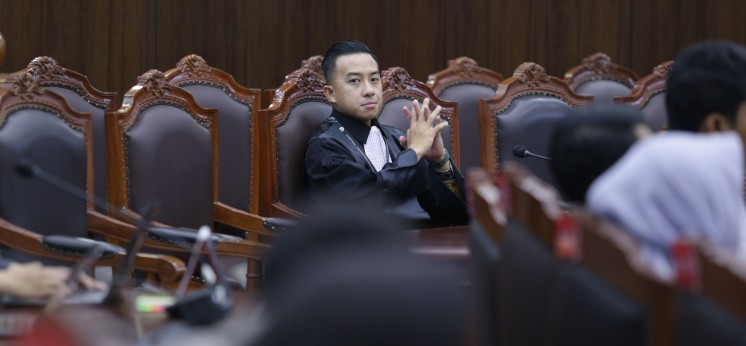
Petitioners’ legal counsel attending the ruling hearing for Case No. 172/PUU-XXIII/2025 on the material judicial review of the Corruption Eradication Law and the Prosecution Law, Monday (3/16/2026). Photo by MKRI/Bayu.
JAKARTA (MKRI) — The Constitutional Court (MK) rejected in its entirety a petition for material judicial review of Law No. 31 of 1999 on the Eradication of Corruption Crimes and Law No. 11 of 2021 amending Law No. 16 of 2004 on the Prosecutor’s Office of the Republic of Indonesia. The petition was filed by PT Sinergi Megah Internusa Tbk and PT Pondok Solo Permai. Decision No. 172/PUU-XXIII/2025 was read out at a ruling hearing held at Court on Monday, March 16, 2026, chaired by Chief Justice Suhartoyo alongside the other constitutional justices.
In Court’s legal consideration, delivered by Constitutional Justice Enny Nurbaningsih, the Court held that Article 30A of Law No. 11 of 2021, challenged by the Petitioners, introduces a new provision on prosecutors’ authority in asset recovery. The provision authorizes prosecutors to trace, confiscate, and return proceeds of crime and other assets to the state, victims, or other rightful parties.
The Court found that the provision is intended to accommodate evolving legal needs and the public sense of justice while strengthening the institutional role of the Prosecutor’s Office in law enforcement. In criminal cases, asset recovery serves to restore the rights of the state, victims, or other injured parties, including through the payment of replacement money to the state.
Asset return also includes the settlement of assets at the request of ministries, institutions, regional governments, village governments, state-owned enterprises, and regional-owned enterprises. These include assets controlled by unauthorized parties, assets whose whereabouts are unknown, and assets with unclear origins.
The Court further held that the Petitioners’ concerns over potential losses suffered by good-faith third parties are unfounded. The law already provides an objection mechanism when a third party’s property is included in a seizure carried out to satisfy payment of replacement money.
The Court also explained that the return of assets derived from criminal acts is carried out only after a court decision has become final and binding. Therefore, prosecutors’ acts of tracing, confiscating, and returning assets form part of the execution of a criminal judgment and do not require an additional order from the chair of a district court.
According to the Court, such executorial authority is directly vested by law in prosecutors as executors of criminal judgments that have become final and binding, as stipulated in Article 54 paragraph (1) of Law No. 48 of 2009 on Judicial Power.
With respect to the review of Article 30C letter g of Law No. 11 of 2021, which governs prosecutors’ authority to carry out execution seizure for the payment of fines and replacement money, Court held that the provision forms part of the institutional strengthening of the Prosecutor’s Office in carrying out law enforcement functions.
The Court also stated that the provision complements the rules on execution seizure already regulated elsewhere, including Article 18 paragraph (2) of Law No. 31 of 1999 on the Eradication of Corruption Crimes. Such execution seizure may be carried out by prosecutors only after a court decision has become final and binding.
As for the Petitioners’ argument that the provision creates legal uncertainty, Court found it unfounded. The legal reasoning the Court has previously given on execution seizure also applies to the review of Article 30C letter g of Law No. 11 of 2021.
“With that, the Petitioners’ claim that Article 30A and Article 30C letter g of Law No. 11 of 2021 are contrary to the 1945 Constitution is legally unfounded,” Justice Nurbaningsih said.
Read also:
Two Companies Seek Legal Certainty on Asset Execution Rules in Corruption and AGO Laws
Two Companies Revise Petition on Asset Seizure in Anti-Corruption, Prosecution Laws
Legal Protection for Third Parties in Corruption Asset Confiscation
Government: Asset Confiscation for Execution under the Anti-Corruption Law Has a Strong Legal Basis
Expert: Asset Seizure Triggers Legal Uncertainty
Yunus Husein: Money Laundering Crimes Are Often Carried Out Through Corporations
For context, the two companies, PT Sinergi Megah Internusa Tbk and PT Pondok Solo Permai, filed a judicial review of several provisions of the Corruption Eradication Law and the Prosecution Law with the Court. In Petition No. 172/PUU-XXIII/2025, they challenged Article 18 paragraph (2) of the Corruption Eradication Law as well as Article 30A and Article 30C letter g of the Prosecution Law. They argued that these provisions are contrary to Article 28D paragraph (1) of the 1945 Constitution, which guarantees fair legal certainty for every citizen.
At the preliminary hearing before the Court on Thursday, October 9, 2025, the Petitioners’ legal counsel, Genesius Anugerah, argued that the regulation on payment of replacement money in corruption cases fails to provide legal certainty because it is applied differently in court decisions.
He cited, for example, the case involving PT Asuransi Jiwasraya and defendant Benny Tjokrosaputro, in which the court imposed an additional penalty of Rp6.07 trillion in replacement money without taking into account evidence that had already been seized. By contrast, in the case involving PT ASABRI (Persero) and defendant Teddy Tjokrosaputro, the court counted seized evidence valued at Rp20.83 billion as part of the replacement money payment. According to the Petitioners, this disparity shows inconsistent application of the law and creates legal uncertainty for parties involved in corruption cases.
Challenge to Prosecutors’ Authority
Petitioners also challenged the authority of the Attorney General’s Office under Article 30A and Article 30C letter g of the Prosecution Law, which authorizes prosecutors to carry out execution seizure of a convict’s assets. In their view, the provisions do not clearly regulate the limits and oversight mechanism for execution seizure. As a result, they argued, the provisions create potential for abuse of power and losses for third parties not involved in the criminal case.
Petitioners pointed to a case in which assets belonging to PT Sinergi Megah Internusa Tbk, which had previously been ordered returned under a final and binding court decision, were later seized again and auctioned by prosecutors to satisfy payment of replacement money in another case.
They further argued that, in practice, prosecutors do not have a clear and comprehensive legal basis when pursuing recovery of state financial losses caused by corruption. As a result, multiple interpretations arise, including which assets of suspects, defendants, or convicts may be seized by prosecutors acting as executors, whether all of their assets may be seized, or whether seizure is limited only to assets connected to the time frame of the offense.
In their petitums, Petitioners asked Court to declare Article 18 paragraph (2) of the Corruption Eradication Law as well as Article 30A and Article 30C letter g of the Prosecution Law not legally binding insofar as execution seizure of assets is carried out without a stipulation or decision from a corruption court.
Author: Utami Argawati
Editor: N. Rosi
PR: Raisa Ayuditha M.
Translator: Siti Rosmalina Nurhayati (SRN)
The full decision can be accessed at the following link: Decision for Case No. 172/PUU-XXIII/2025.
Disclaimer: The original version of the news is in Indonesian. In case of any difference between the English and the Indonesian versions, the Indonesian version will prevail.
Monday, March 16, 2026 | 11:58 WIB 89