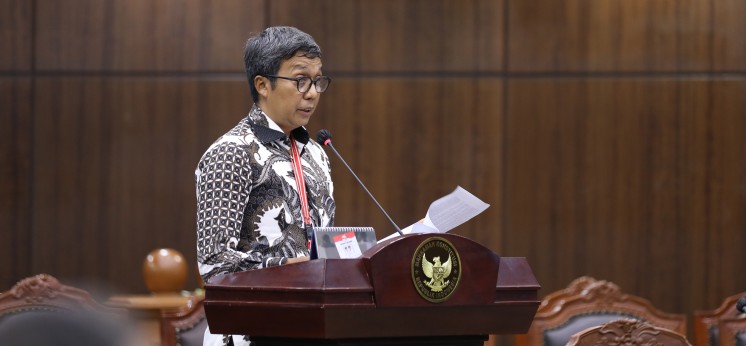
Ahmad Sofian, the Petitioners’ expert, delivering his testimony at a continued hearing on the judicial review of Law No. 31 of 1999 on the Eradication of Corruption Crimes, Tuesday (12/2/2025). Photo by MKRI/Ifa.
JAKARTA (MKRI) — The Constitutional Court (MK) held another hearing on the judicial review of Law No. 31 of 1999 on the Eradication of Corruption Crimes (the Anti-Corruption Law) and Law No. 11 of 2021 amending Law No. 16 of 2004 on the Office of the Attorney General of the Republic of Indonesia, on Tuesday, December 2, 2025, in the Plenary Courtroom of the Court. The agenda included hearing testimony from the Petitioners’ expert, statements from Relevant Party Agus Djoeniadi, and the examination of witnesses presented by the Petitioners.
Criminal law expert Ahmad Sofian, testifying as the Petitioners’ expert, explained before the Court that the practice of seizing assets belonging to corruption suspects or defendants, followed by forfeiture and auction to satisfy replacement money penalties without taking into account the rights of good-faith third parties, has generated legal uncertainty. He emphasized that asset seizure or forfeiture conducted without regard to such third-party rights constitutes a violation of human rights.
Accordingly, Ahmad argued that legal norms which do not prohibit the seizure or forfeiture of assets belonging to suspects, defendants, or convicts without considering the rights of good-faith third parties should be declared inconsistent with the 1945 Constitution.
Shareholders’ Expectations
Meanwhile, legal counsel for the Relevant Party, Steven Frederik, explained that his client is a public shareholder of PT Sinergi Megah Internusa Tbk (Petitioner I), holding 2,394,100 shares. He stated that the losses suffered by his client stemmed from the application of Article 18 paragraph (2) of the Anti-Corruption Law as well as Articles 30A and 30C letter g of the Attorney General’s Law, which served as the legal basis for the seizure of Petitioner I’s securities account.
According to Steven, although these provisions were initially intended to safeguard state finances, in practice they have caused losses to good-faith third parties, including public shareholders. He stressed that his client has no connection whatsoever to the criminal acts committed by the convict in the related case.
The Relevant Party welcomed the filing of the judicial review petition, considering it a source of hope for public shareholders seeking legal certainty regarding the impact of the suspension of Nusa shares on the Indonesia Stock Exchange (IDX). Steven added that although only one shareholder was named during the hearing, many other individual investors have also been adversely affected by the ambiguity of the contested norms.
He further highlighted the practice of asset seizure that often targets assets not owned by the convict due to the absence of clear limits on prosecutors’ authority in carrying out execution seizures. This legal vacuum, Steven argued, resulted in the seizure of assets belonging to Petitioner I without an adequate legal basis, thereby harming both the company and its shareholders.
“The seizure led to the suspension of Petitioner I’s shares by the IDX. As a result, the shares held by the Relevant Party and other public shareholders could not be traded, depriving them of opportunities to trade shares or receive dividends,” Steven said.
During the hearing, the Relevant Party also asserted that these losses directly infringed constitutional rights as guaranteed under Article 28D paragraph (1) and Article 28G paragraph (1) of the 1945 Constitution, particularly with respect to legal certainty, protection of property, and citizens’ economic rights.
The Relevant Party stated that the decision to invest in Petitioner I was based on the perceived credibility of the company’s management, which was considered professional and transparent. He expressed hope that the Court would declare Article 18 paragraph (2) of the Anti-Corruption Law as well as Articles 30A and 30C letter g of the Attorney General’s Law unconstitutional, as they fail to provide clear limitations in their application and have the potential to harm third parties not involved in criminal cases.
Also read:
Government: Asset Confiscation for Execution under the Anti-Corruption Law Has a Strong Legal Basis
Legal Protection for Third Parties in Corruption Asset Confiscation
Two Companies Revise Petition on Asset Seizure in Anti-Corruption, Prosecution Laws
Two Companies Seek Legal Certainty on Asset Execution Rules in Corruption and AGO Laws
PT Sinergi Megah Internusa Tbk and PT Pondok Solo Permai, filed a judicial review petition against several provisions of the Anti-Corruption Law and the Attorney General’s Law with the Constitutional Court. In Petition No. 172/PUU-XXIII/2025, the Petitioners challenge Article 18 paragraph (2) of the Anti-Corruption Law as well as Articles 30A and 30C letter g of the Attorney General’s Law. They argue that these provisions contravene Article 28D paragraph (1) of the 1945 Constitution, which guarantees fair legal certainty for every citizen.
At the preliminary hearing held on Thursday, October 9, 2025, the Petitioners’ legal counsel, Genesius Anugerah, stated that the regulation on the payment of replacement money in corruption cases lacks legal certainty, as its application varies across court decisions.
By way of illustration, in the PT Asuransi Jiwasraya case involving defendant Benny Tjokrosaputro, the court imposed an additional penalty of replacement money amounting to Rp6.07 trillion without taking into account seized evidence. In contrast, in the PT ASABRI (Persero) case involving defendant Teddy Tjokrosaputro, the court considered seized evidence valued at Rp20.83 billion as part of the replacement money payment. According to the Petitioners, this disparity reflects inconsistent law enforcement practices that create uncertainty for parties involved in corruption cases.
Criticism of the Attorney General’s Authority
The Petitioners also challenged the authority of the Attorney General’s Office as regulated under Articles 30A and 30C letter g of the Attorney General’s Law, which grant prosecutors the power to carry out execution seizures of convicts’ assets. They argued that these provisions do not clearly regulate the limits of authority or oversight mechanisms for such execution seizures, thereby creating the potential for abuse of power and losses for third parties uninvolved in criminal cases.
The Petitioners cited cases in which assets belonging to PT Sinergi Megah Internusa Tbk, which had previously been ordered to be returned under a final and binding court decision, were again seized and auctioned by prosecutors to fulfill replacement money obligations in another case.
They asserted that prevailing practices indicate that prosecutors, in seeking to recover state financial losses resulting from corruption crimes, lack a clear and comprehensive legal framework. This has led to multiple interpretations, raising questions as to which assets of suspects, defendants, or convicts may be seized by prosecutors acting as executors, whether all of their assets may be seized, or whether seizures should be limited only to assets acquired within the tempus delicti.
In their petitum, the Petitioners requested the Court to declare Article 18 paragraph (2) of the Anti-Corruption Law as well as Articles 30A and 30C letter g of the Attorney General’s Law to have no binding legal force insofar as execution seizures of assets are carried out without a determination or ruling by a corruption court.
Explore the case: Case No. 172/PUU-XXIII/2025 (in Bahasa Indonesia)
Author : Utami Argawati
Editor : N. Rosi
PR : Raisa Ayuditha M.
Translator : Yuanna Sisilia
Disclaimer: The original version of the news is in Indonesian. In case of any differences between the English and the Indonesian versions, the Indonesian version will prevail.
Tuesday, December 02, 2025 | 15:35 WIB 96