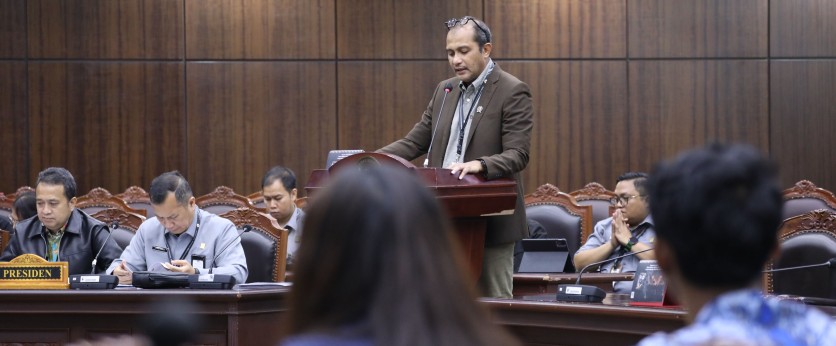
Deputy Minister of Law, Edward Omar Sharif Hiariej, representing the government to deliver the President/Government’s testimony during the judicial review hearing of the Criminal Code on Monday (9/3) at the Plenary Courtroom.
Jakarta (MKRI) - Article 302 paragraph (2) of the Criminal Code (KUHP) no longer concerns incitement but coercion using violence or threats of violence, including verbal violence. Meanwhile, Article 302 paragraph (1) of the Criminal Code regulates incitement aimed at making someone become non-religious or abandon a belief recognized in Indonesia, subject to several elements: any person; in public; incites; with intent; and so that someone becomes non-religious or abandons a belief recognized in Indonesia.
This explanation from the Government/President was delivered by Deputy Minister of Law Eddy O.S. Hiariej at a continued hearing in the judicial review of Law No. 1 of 2023 on the Criminal Code on Monday, March 9, 2026. The third hearing in the petition filed by Zico Leonard Djagardo Simanjuntak was scheduled to hear statements from the DPR and the President/Government, but the DPR requested a postponement of its presentation.
In relation to Petition No. 29/PUU-XXIV/2026, which challenges Article 100 paragraphs (1) and (4), Article 218 paragraph (1), Article 219, Article 240 paragraph (1), Article 241 paragraph (1), Article 237 letters b and c, Article 256, Article 302 paragraph (1), Article 411 paragraph (2), Article 433 paragraph (3), Article 434 paragraph (2), and Article 509 letters a and b of the Criminal Code, the Government provided several further clarifications.
Incitement with threats
The mental element in Article 302 paragraph (1) of the Criminal Code is intent in the sense of purpose. Eddy noted that the term “inciting” appears in several international human rights instruments, including the International Covenant on Civil and Political Rights and the Convention on the Elimination of All Forms of Racial Discrimination.
Incitement, he explained, specifically refers to efforts to influence others to engage in something, including criminal conduct, through advocacy or threats, whether explicitly or implicitly, for example, by displaying racist symbols or disseminating certain materials or words.
“Thus, incitement is not merely influencing others through an exchange of ideas, but influencing through advocacy and threats,” Eddy said.
Defamation and complaint offence
With regard to Article 434 paragraph (2) of the Criminal Code on defamation, Eddy explained that the provision concerns what is known as “laster” or defamation. By way of illustration, he said that if C accuses D of embezzling social assistance funds and C is then unable to prove in court that D committed corruption, C can be punished for defamation. The judge will ask C to substantiate the allegation, because the accusation is treated as having been made in self-defence, in the public interest, or against D as a public official.
“This is what is meant in Article 434 paragraph (2) of the Criminal Code. It is expressly stated that defamation is a complaint-based offence in Article 434 paragraph (3),” Eddy said.
False statements in legal proceedings
Turning to Article 509 letters a and b of the Criminal Code, the Government clarified that Article 509 sets out criminal sanctions for parties who provide false statements in the context of legal proceedings, particularly in relation to statements in statements of claim, divorce petitions, or bankruptcy petitions.
The provision distinguishes between several legal subjects in three points, including targeting advocates who intentionally submit or cause to be submitted incorrect information about the residence or domicile of a defendant or debtor in legal documents, underscoring that advocates bear a significant responsibility to ensure the accuracy of information used in cases they handle.
Another part, Eddy explained, imposes sanctions on husbands or wives who give false information to advocates in the context of filing lawsuits or divorce petitions, highlighting the importance of honesty and transparency in divorce proceedings so that court decisions rest on accurate facts.
“This provision also targets creditors who provide false information about debtors in bankruptcy petitions, meaning that not only defendants or debtors must be honest, but creditors too must present truthful information so that legal proceedings run fairly and reflect reality. Overall, the article places strong emphasis on integrity and honesty in legal processes,” Eddy explained.
Also read:
Students Challenge Articles on Corruption on Criminal Code
Arguments on Inconsistency of Several Provisions in Criminal Code Refined
During the preliminary hearing on Monday, January 26, 2026, the Petitioner, represented by legal counsel Priskila Oktaviani, argued that Article 100 of the Criminal Code, as a unified norm, fails to meet the requirements of clarity and precision mandated by Article 28J paragraph (2) of the 1945 Constitution. The a quo provision uses phrases that are not normatively defined, namely “sense of remorse”, “hope for self-improvement”, and “commendable conduct and behaviour”, without providing conceptual boundaries, objective indicators, or measurable assessment mechanisms.
The lack of clarity, she said, renders the resulting restriction of rights incalculable and unpredictable. In the context of limiting a right that touches on the right to life, this vagueness constitutes a serious constitutional defect because it opens the door to arbitrary and discriminatory interpretation. She added that, even in technical regulations that should comprehensively govern the evaluation mechanism for the behaviour of death-row inmates during the probation period, the Criminal Code provides only a general framework, without operational guidance on behavioural indicators, assessment criteria, or the authority responsible for carrying out the evaluation. This uncertainty risks inconsistent implementation and creates room for subjectivity that could harm either the convict or the public.
Consequently, Article 100 of the Criminal Code as a whole does not satisfy the requirement of being “prescribed by law in clear terms” as required by Article 28J paragraph (2) of the 1945 Constitution, and thus the rights-restricting effect of the a quo norm lacks constitutional legitimacy.
Case tracking: Petition No. 29/PUU-XXIV/2026 (in Indonesian)
Author: Sri Pujianti
Editor: Lulu Anjarsari P.
PR: Andhini S.F.
Translator: Rizky Kurnia Chaesario
Disclaimer: The original version of the news is in Indonesian. In case of any differences between the English and the Indonesian versions, the Indonesian version will prevail.
Monday, March 09, 2026 | 11:01 WIB 155