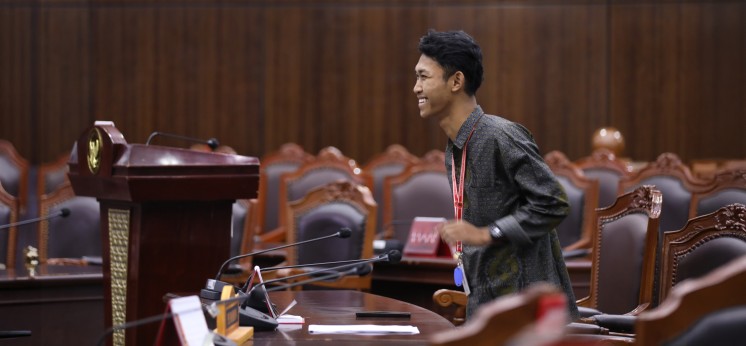
Petitioners’ legal counsel, Vendy Setiawan, attending the panel preliminary hearing on the material judicial review of Law No. 1 of 2023 on the Criminal Code, Monday (26/1). Photo by MKRI/Ifa.
Jakarta (MKRI) - Bernita Matondang and Vendy Setiawan, both university students, have filed a petition for a material judicial review of Articles 603 and 604 of Law No. 1 of 2023 on the Criminal Code (New Criminal Code) to the Constitutional Court (MK). The case, registered as Petition No. 28/PUU-XXIV/2026, was filed because the two provisions are alleged to contradict the 1945 Constitution of the Republic of Indonesia.
At the preliminary hearing held on Monday, January 26, 2026, Petitioners’ legal counsel, Vendy Setiawan, stressed that corruption cannot be understood merely as an ordinary crime but must be regarded as an extraordinary crime with systemic, far-reaching, and long-term impacts on national life.
“The implementation of the a quo norms directly affects the Petitioners’ learning process, scientific analysis, and understanding of the construction of punishment for extraordinary crimes,” Vendy said.
He added that, beyond their status as students, the Petitioners are also citizens who have paid, and will continue to pay, indirect taxes, including value-added tax and other taxes.
According to the Petitioners, Articles 603 and 604 of the new Criminal Code, which do not provide for the death penalty as the most severe punishment, conflict with the logic of protecting the people’s socio-economic rights because they fail to safeguard fiscal resources that underpin welfare policies. In their view, corruption calls for an equally extraordinary penal approach, both in terms of the severity of sanctions and the deterrent effect produced.
They also argued that incorporating corruption into the Criminal Code as a general offence strips it of its exceptional character, opening the opportunity for law enforcers to select provisions most favourable to suspects, thereby encouraging forum shopping and undermining fair legal certainty.
As law students and citizens, the Petitioners claim a constitutional interest in ensuring that national criminal law is designed rationally and proportionally and affords maximum protection to the public interest. They contend that the failure to include the death penalty as an alternative highest sanction in Articles 603 and 604 amounts to an unconstitutional omission by the legislature.
Accordingly, they ask the Court to declare these provisions incompatible with the 1945 Constitution insofar as they are interpreted as not providing the harshest penal instrument, namely the death penalty, as a means of offering maximum protection for citizens’ rights.
In his advice, Justice Daniel Yusmic P. Foekh urged the Petitioners to strengthen their legal standing by clarifying whether the constitutional harm alleged is factual or potential. He also asked them to study and align their petition with the requirements of Constitutional Court Regulation No. 7 of 2025.
The Panel granted the Petitioners 14 days to revise their Petition, which must be received by the Court no later than Monday, 9 February 2026, at 12.00 Western Indonesian Time.
Case tracking: Petition No. 29/PUU-XXIV/2026 (in Indonesian)
Author: Utami Argawati
Editor: Lulu Anjarsari P.
PR: Andhini S.F.
Translator: Rizky Kurnia Chaesario
Disclaimer: The original version of the news is in Indonesian. In case of any differences between the English and the Indonesian versions, the Indonesian version will prevail.
Monday, January 26, 2026 | 16:14 WIB 215