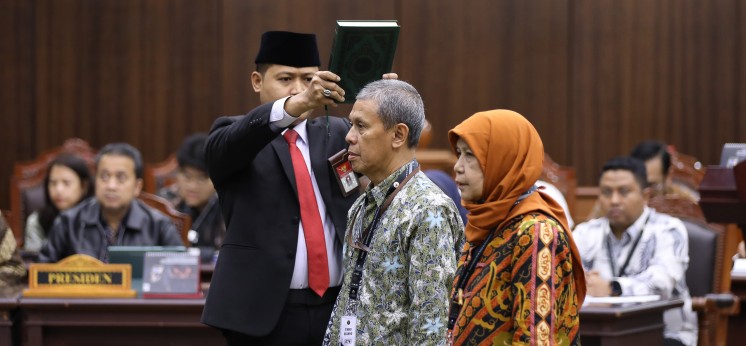
Government’s experts, Muhammad Hanafi and Dede Mia Yusanti having their oaths taken to testify for the resumed hearing on the judicial review of Law No. 65 of 2024 on Patents, Thursday (05/03) at the Courtroom. Photo by MKRI/Ifa.
Jakarta (MKRI) - Patent and intellectual property expert Dede Mia Yusanti argued that the removal of Article 4 letter f of Law No. 65 of 2024 on Patents does not conflict with the Constitution and does not lead to patent evergreening practices, which are often feared to extend the term of protection for drug patents. In her view, regulation of second medical use instead opens opportunities for domestic innovation in the pharmaceutical sector and encourages the development of drug research by universities and the domestic industry. She delivered these remarks while testifying as an expert in the judicial review of Article 4 and the phrase “interested party” in Article 70 paragraph (1) of Law No. 65 of 2024 on Patents (Patent Law) at the Constitutional Court courtroom on Thursday, March 5, 2026.
“The removal of Article 4 letter f is not a constitutional violation and does not cause patent evergreening,” Dede told the Panel of Justices chaired by Chief Justice Suhartoyo.
Dede explained that high drug prices are not solely caused by patents, including second medical use patents. Access to medicines, she said, still benefits from flexibilities that states can use, but these have not been fully optimized in practice.
“Drug prices do not depend solely on the existence of patent protection. Other policy strategies are needed, including accelerating the production of generic drugs and strengthening the national pharmaceutical industry,” she added.
Dede also outlined that Indonesia, as a member of the World Trade Organization (WTO), ratified the TRIPS Agreement through Law No. 7 of 1994, which took effect on January 1, 1995, and as a developing country, Indonesia was obliged to adjust its legislation to TRIPS provisions no later than January 1, 2000.
She noted that several countries, such as India and Brazil, even obtained transition periods for TRIPS implementation until 2005. During that period, India granted patent protection only for processes to manufacture pharmaceutical products, not for the pharmaceutical products themselves, and used this policy window to strengthen its domestic pharmaceutical industry and significantly expand drug production capacity.
Dede went on to discuss the Doha Declaration on the TRIPS Agreement and Public Health, which emphasizes the importance of balancing intellectual property protection with public health interests. She explained that TRIPS gives member states policy space to adopt measures needed to protect public health, as long as they remain consistent with the international agreement. She also stressed that TRIPS does not require member states to adopt patent protection for second medical use, but that such provisions can provide incentives for pharmaceutical innovators to discover new indications for existing drugs.
Meanwhile, Muhammad Hanafi, a researcher at the National Research and Innovation Agency’s Center for Research on Active Pharmaceutical Ingredients and Traditional Medicines (BRIN), explained that modern pharmaceutical science recognizes the concept of second medical use, namely the use of a previously known compound for a medical indication different from its initial use.
“Scientifically, second medical use is not merely an administrative reuse, but must be based on proof of a new pharmacological effect that was previously unknown,” Hanafi said.
He added that the discovery of new indications must be supported by experimental data demonstrating relevant biological activity against a particular disease. In modern pharmaceutical research, approaches such as bioinformatics, computational systems biology, and omics analysis are often used to predict molecular interactions before experimental validation.
According to Hanafi, claims of increased biological activity must also be substantiated through measurable scientific analysis, for example, by comparing 50% inhibitory concentration (IC₅₀) values or other activity parameters, and through combination index (CI) analysis to ensure that any increase in activity is genuinely grounded in testable and reproducible scientific evidence.
Also read:
Coalition for Patient Rights Advocacy for Access to Medicines Challenges Patent Law
Petitioners Revise Petition to Challenge Patent Law Concerning Access to Medicines
Patent Protection Rules Do Not Only Protect Inventors
Govt: Patent Law Framework Ensures Legal Certainty and Drives Drug Innovation
Review of Patent Law Highlights Evergreening and Patients’ Access to Medicines
During the preliminary hearing on Wednesday, December 17, 2025, the Petitioners argued that the removal of Article 4 letter f of Law No. 13 of 2016 on Patents through the Patent Law had eliminated legal protection for the public. The deleted provision previously excluded new uses of existing products and new forms of old compounds that did not provide a meaningful improvement in the properties of patentable objects.
According to the Petitioners, this change contradicts Article 28D paragraph (1) of the 1945 Constitution, which guarantees fair legal certainty, and Article 28H paragraph (1) of the 1945 Constitution, which guarantees the right to health. They further argued that Article 4, letter f, of the Patent Law protects the public and provides legal certainty by preventing low-quality patent applications that are intended solely to secure monopolies for a handful of large corporations. Low-quality patent applications certainly have the potential to violate the constitutional rights of the public, including the Petitioners, to guaranteed protection and legal certainty regarding the requirements for inventions that can be patented, particularly in the field of pharmaceuticals/medicines. (*)
Case tracking: Petition No. 255/PUU-XXIII/2025 (in Indonesian)
Author: Utami Argawati
Editor: Lulu Anjarsari P.
PR: Raisa Ayuditha Marsaulina
Translator: Rizky Kurnia Chaesario
Disclaimer: The original version of the news is in Indonesian. In case of any differences between the English and the Indonesian versions, the Indonesian version will prevail.
Thursday, March 05, 2026 | 14:38 WIB 163