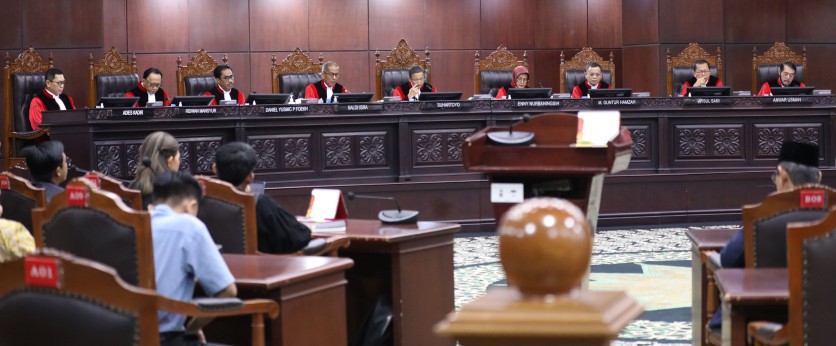
Chief Justice Suhartoyo delivering the verdict in Case No. 20/PUU-XXIV/2026 at the plenary courtroom, Monday (3/2/2026). Photo by MKRI.
JAKARTA (MKRI) — The Constitutional Court (MK) declared the petition for judicial review of Law No. 6 of 2014 on Villages (Village Law) inadmissible. The ruling in Case No. 20/PUU-XXIV/2026 was handed down in a plenary session presided over by Chief Justice Suhartoyo alongside the eight other constitutional justices. The petition was filed by Muamar Ihsan Sjahdjuan (Petitioner I) and Muhammad Rizki (Petitioner II).
“Petition No. 20/PUU-XXIV/2026 is declared inadmissible,” Chief Justice Suhartoyo stated during the ruling hearing on Monday morning, March 2, 2026.
Delivering the Court’s legal considerations, Deputy Chief Justice Saldi Isra explained that the documentary evidence marked as Exhibits P-1 through P-5 submitted in the petition had not been affixed with sufficient stamp duty to qualify as valid evidence under the prevailing statutory laws and regulations. “Consequently, the evidence in each petition cannot be validated in the hearing. In accordance with procedural law, the submission of documentary evidence bearing adequate stamp duty constitutes one of the essential formal requirements in assessing the admissibility of a petition,” Saldi asserted.
Also read:
Ketiadaan Mekanisme Penyelesaian Sengketa Pilkades dalam UU Desa ()
Pemohon Uji Ketiadaan Mekanisme Penyelesaian Sengketa Pilkades Perbaiki Permohonan
Previously, the Petitioners challenged the constitutionality of Article 37 paragraph (6) of the Village Law, which governs the settlement of disputes over the results of village head elections (pilkades). They argued that the provision fails to satisfy the principles of legal certainty and due process of law as guaranteed under Article 28D paragraph (1) of the 1945 Constitution. Article 37 paragraph (6) of the Village Law stipulates, “In the event of a dispute over the results of a Village Head election, the Regent/Mayor shall resolve the dispute within the period referred to in paragraph (5).”
At the preliminary hearing, the Petitioners contended that the enactment of the Village Law was intended to foster democratic, orderly, and equitable village governance. Accordingly, village head elections represent the exercise of citizens’ political rights at the village level. Therefore, the resolution of disputes concerning village head election results should not be treated merely as an administrative matter, but rather as an integral component of safeguarding citizens’ constitutional rights.
The Petitioners further submitted that Article 37 paragraph (6) constitutes the sole explicit norm regulating the settlement of disputes over village head election results. However, they maintained that the provision does not clearly prescribe the mechanism, procedure, standards of assessment, or the legal form and binding force of the decision produced. The article merely designates the regent/mayor as the authority competent to settle such disputes and sets a 30-day time limit, without providing normative parameters governing the adjudicatory process.
Such regulatory lacuna, according to the Petitioners, gives rise to vagueness of norm and opens the door to subjective interpretation and uncontrolled discretion by the competent authority. This condition, they argued, potentially engenders arbitrariness and undermines the protection of citizens’ constitutional rights in disputes over village head election results.
The complete decision: Decision No. 20/PUU-XXIV/2026 (in Bahasa Indonesia)
Author : Utami Argawati
Editor : Lulu Anjarsari P.
PR : Adriana A.Y.
Translator : Yuanna Sisilia
Disclaimer: The original version of the news is in Indonesian. In case of any differences between the English and the Indonesian versions, the Indonesian version will prevail.
Monday, March 02, 2026 | 09:34 WIB 50