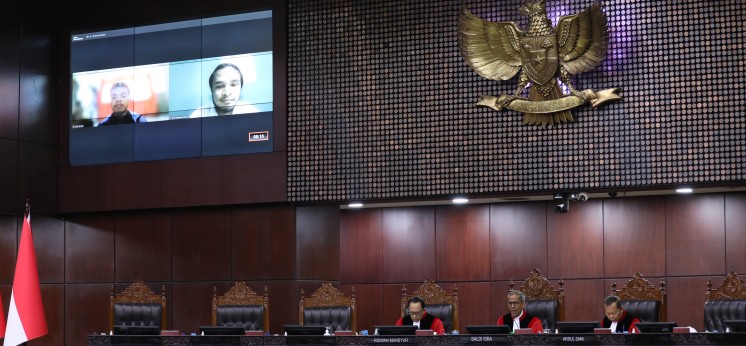
The Petitioners attending the preliminary hearing for the judicial review of Law No. 6 of 2014 on Villages, Friday (1/23/2026). Photo by MKRI/Ifa.
JAKARTA (MKRI) — The Constitutional Court (MK) held a preliminary hearing on the judicial review of Law No. 6 of 2014 on Villages (Village Law) on Friday, January 23, 2026. Petition No. 20/PUU-XXIV/2026 was filed by Muamar Ihsan Sjahdjuan (Petitioner I) and Muhammad Rizki (Petitioner II).
The Petitioners challenge the constitutionality of Article 37 paragraph (6) of the Village Law, which governs the resolution of disputes over village head election (pilkades) results. They argue that the provision falls short of the constitutional guarantees of legal certainty and due process of law as enshrined in Article 28D paragraph (1) of the 1945 Constitution.
Article 37 paragraph (6) of the Village Law stipulates, “In the event of a dispute over the results of the Village Head election, the Regent/Mayor shall resolve the dispute within the time period referred to in paragraph (5).”
The Petitioners assert that the enactment of the Village Law was intended to foster democratic, orderly, and equitable village governance. Village head elections, therefore, constitute a concrete manifestation of citizens’ political rights at the local level. Consequently, disputes over election results cannot be treated merely as administrative matters, but must be viewed as part of the broader protection of citizens’ constitutional rights.
According to the Petitioners, Article 37 paragraph (6) is the sole provision explicitly regulating the resolution of pilkades result disputes. However, the norm does not clearly delineate the mechanism, procedural framework, evidentiary standards, or the legal form and binding force of the resulting decision. It merely designates the regent/mayor as the authority responsible for settlement and prescribes a 30-day time frame, without setting out normative parameters governing the examination process.
“Article 37 paragraph (6) of Law No. 6 of 2014 on Villages constitutes the only norm explicitly regulating the resolution of disputes over Village Head election results. As such, the a quo provision must comply with the constitutional standards of legal certainty and due process of law as guaranteed by Article 28D paragraph (1) of the 1945 Constitution,” Ihsan stated.
The absence of detailed regulation, they contend, gives rise to vagueness of norm, thereby opening the door to subjective interpretation and unchecked administrative discretion. Such a condition, they warn, may engender arbitrariness and undermine the protection of constitutional rights for parties contesting election results.
The Petitioners further presented empirical evidence drawn from state administrative court rulings that illustrate the practical consequences of this regulatory gap. In Decision No. 50/G/2022/PTUN.ABN, the Ambon State Administrative Court declared its authority to examine a dispute over the determination of village head election results due to the absence of specific administrative remedies in the Village Law. A similar pattern emerged in Decision No. 51/G/2019/PTUN.SBY of the Surabaya State Administrative Court concerning a dispute over village head election results in Nganjuk Regency.
Based on these circumstances, the Petitioners maintain that Article 37 paragraph (6) effectively entrusts the resolution of pilkades disputes entirely to regional heads without clear legal safeguards. This, they argue, has triggered layered and protracted dispute processes while eroding legal certainty for citizens.
Accordingly, the Petitioners request the Court to declare Article 37 paragraph (6) of the Village Law unconstitutional and not legally binding insofar as it fails to provide a clear, fair, and legally certain mechanism for resolving disputes over village head election results.
Responding to the petition, Constitutional Justice Ridwan Mansyur advised the Petitioners to further elaborate on their legal standing, particularly whether the enactment of the contested provision has caused constitutional harm, either actual or potential, and how such harm is causally linked to them.
“Refer to Constitutional Court Regulation (PMK) No. 7 of 2025. Examples are provided there. This must be elaborated,” Ridwan said.
The panel granted the Petitioners 14 days to revise their petition. The revised petition must be submitted to the Court no later than Thursday, February 5, 2026, at 12:00 p.m. Western Indonesian Time.
Explore Case No. 20/PUU-XXIV/2026 (in Bahasa Indonesia).
Author : Utami Argawati
Editor : N. Rosi.
Translator : N. Valentino Rahadityo/Yuanna Sisilia
Disclaimer: The original version of the news is in Indonesian. In case of any differences between the English and the Indonesian versions, the Indonesian version will prevail
Friday, January 23, 2026 | 13:28 WIB 52