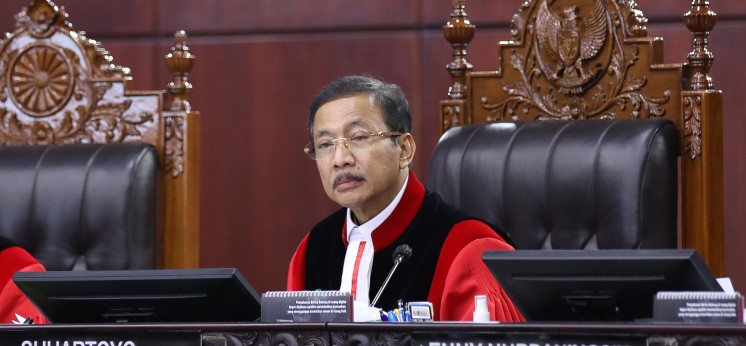
Chief Justice Suhartoyo chairing the ruling hearing for the judicial review of the new Criminal Code, Monday (3/2/2026). Photo by MKRI/Ifa.
JAKARTA (MKRI) — Article 256 of Law No. 1 of 2023 on the Criminal Code (KUHP) does not regulate the right to express opinions in public, nor does it stipulate criminal sanctions for exercising such right. Rather, the provision regulates criminal sanctions for public expressions of opinion—such as parades, rallies, or protests conducted on public roads—that result in disruption of public interests, public disorder, or riots, when carried out without prior notice to the competent authority (Indonesian National Police).
Such was the Court’s legal considerations read out by Constitutional Justice Ridwan Mansyur on the constitutionality of Article 256 of the new Criminal Code. In response to the petition filed by 13 undergraduate (S-1) law students, the Court held that if the public expression of opinion has been duly notified to the competent authority, then—even if the parade, rally, or protest results in disruption of public interests—the participants cannot be charged under Article 256 of the Criminal Code.
Furthermore, he continued, normatively, if the public expression of opinion is not notified to the competent authority but does not cause disruption of public interests, public disorder, or riots, then the participants likewise cannot be subjected to criminal sanctions under Article 256.
Nevertheless, according to the Court, such notice should ideally be made in order to prevent the public expression of opinion from being dispersed by law enforcement officers on the grounds of concerns over potential disruption of public interests, disorder, or riots, as contemplated under Article 15 of the Criminal Code.
Therefore, within the bounds of reasonable reasoning, Article 256 of the Criminal Code must be understood as cumulative in nature. Criminal sanctions may only be imposed where the person in charge, leader, or participants of a parade, rally, or protest both fail to provide prior notice to the competent authority and subsequently cause disruption of public order, public disorder, or riots.
“Accordingly, criminal liability may only be imposed on the exercise of the right to express opinions in public—whether in the form of parades, rallies, or protests—when conducted without prior notice and when such activities result in disruption of public interests, disorder, or riots,” Justice Ridwan explained at the ruling hearing for Decision No. 271/PUU-XXIII/2025, which took place on Monday, March 2, 2026.
Notice Imperative
Substantively, the Court explained that Article 256 of Law No. 1 of 2023 clearly and unequivocally provides that criminal sanctions in relation to rallies or protests, as stipulated therein, cannot be imposed insofar as prior notice has been given to the competent authority. Even where the exercise of the right to express opinions in public—whether in the form of parades, rallies, or protests—results in disruption of public interests, public disorder, or riots, as long as the person in charge, leader, or participants have notified the competent authority, the criminal sanctions under Article 256 of Law No. 1 of 2023 cannot be imposed upon them.
“Based on the entirety of the legal considerations, the criminal sanctions as regulated under Article 256 of Law No. 1 of 2023 do not constitute provisions that hinder citizens from obtaining their rights as guaranteed by the 1945 Constitution. Therefore, the Petitioners’ arguments are unfounded in law,” Justice Ridwan explained.
Accordingly, Article 256 of Law No. 1 of 2023 does not create legal uncertainty, does not violate the right to freedom of expression, does not infringe the right to communicate information, and does not contravene the protection of human rights as guaranteed, inter alia, under Article 28D paragraph (1), Article 28E paragraph (3), Article 28F, and Article 28I paragraph (4) of the 1945 Constitution, contrary to the Petitioners’ assertions. Thus, all of the Petitioners’ arguments are legally unfounded.
“The Court rejects the Petitioners’ petition in its entirety,” declared Chief Justice Suhartoyo while reading out the verdict of the decision.
Also read:
Students Question Guarantees of Freedom of Expression in Public Spaces
Case on Freedom of Expression in Public Spaces Have New Petitioners
At the preliminary hearing on Monday, January 12, 2026, the Petitioners—Tommy Juliandi, lka Aniyati, and others—presented their challenge of the material content of Article 256 of Law No. 1 of 2023 on the Criminal Code (KUHP).
Article 256 of the Criminal Code reads: “Any Person who, without prior notification to the authorities, organize a march, rally, or demonstration on a public road or public place that causes disturbance to the public interests, creates commotion, or riots within the community, shall be sentenced with imprisonment for a maximum of 6 (six) months or a maximum criminal fine of category II.”
The Petitioners argued that expressing opinions does not require prior permission, as it is a guaranteed right directly protected by the 1945 Constitution of the Republic of Indonesia. Peaceful protests are, in essence, a form of non-electoral political participation and a manifestation of citizens’ participation in overseeing government performance or policies through public discussion. However, the challenged article delegitimizes popular political participation by placing such activities in a position where they risk being classified as unlawful acts.
According to the Petitioners, the norm in the challenged provision can be interpreted as providing a legal basis for law enforcement officers to take action against citizens who express opinions without prior administrative notification. In addition, the criminal sanctions contained in the provision concretely create fear and self-censorship among the public in conducting protests or organizing social activities.
The Petitioners further argued that the provision fails to uphold demonstrations as an essential element in nation-building and carries the potential to intimidate. They maintained that the norm is also inconsistent with international legal standards. Indonesia has ratified the International Covenant on Civil and Political Rights (ICCPR) through Law No. 12 of 2005, which provides clear guidance that: the right of peaceful assembly is a fundamental right that must be protected, not merely tolerated; restrictions must be interpreted narrowly; disruption to traffic or daily activities is not a legitimate ground to restrict the right of assembly; and a notification system must be distinguished from an authorization or permit system, with the state prohibited from criminalizing the exercise of the right of assembly solely due to the absence of notification.
Explore case No. 271/PUU-XXIII/2025 (in Indonesian) and access the decision.
Author : Sri Pujianti
Editor : N. Rosi
Translator : Yuniar Widiastuti (NL)
Disclaimer: The original version of the news is in Indonesian. In case of any differences between the English and the Indonesian versions, the Indonesian version will prevail.
Monday, March 02, 2026 | 15:57 WIB 93