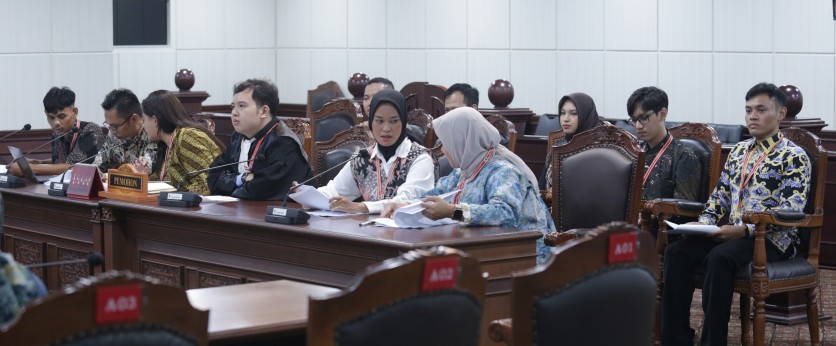
The Petitioners and their counsels at the preliminary hearing for the material judicial review of the Criminal Code for Case No. 271/PUU-XXIII/2025, Monday (1/12/2026). Photo by MKRI/Bayu.
JAKARTA (MKRI) — The Constitutional Court held the preliminary hearing to examine Case No. 271/PUU-XXIII/2025 on Monday, January 12, 2026. It was presided over by Deputy Chief Justice Saldi Isra and Constitutional Justices Ridwan Mansyur and Asrul Sani.
The petition was filed by thirteen undergraduate law students: Tommy Juliandi, lka Aniyati, Siti Fatimah, Ali Fahmi, Narendra A. Reza, Khaerul Imam Azam, Shidqi Ilham Zhafiri, Bagus Adiputro Putra Pratama, Septian Abdiansyah, Sadira Fahrni, Shafira Avriski, Fahri Heriansyah, and Attaubah. They challenge the material content of Article 256 of Law No. 1 of 2023 on the Criminal Code (KUHP) against the 1945 Constitution.
Article 256 of the Criminal Code reads, “Any Person who, without prior notification to the authorities, organize a march, rally, or demonstration on a public road or public place that causes disturbance to the public interests, creates commotion, or riots within the community, shall be sentenced with imprisonment for a maximum of 6 (six) months or a maximum criminal fine of category II.”
The Petitioners argued that expressing opinions does not require prior permission, as it is a guaranteed right directly protected by the 1945 Constitution of the Republic of Indonesia. Peaceful protests are, in essence, a form of non-electoral political participation and a manifestation of citizens’ participation in overseeing government performance or policies through public discussion. However, the challenged article delegitimizes popular political participation by placing such activities in a position where they risk being classified as unlawful acts.
Legal Basis for Law Enforcement Action
According to the Petitioners, the norm in the challenged provision can be interpreted as providing a legal basis for law enforcement officers to take action against citizens who express opinions without prior administrative notification. In addition, the criminal sanctions contained in the provision concretely create fear and self-censorship among the public in conducting protests or organizing social activities. Such constitutional harm is not hypothetical, but real, actual, and potentially occurs at any time and to anyone. Therefore, there is a clear causal link between the application of the provision and the threat to the fulfillment of citizens’ constitutional rights.
The Petitioners further argued that the provision fails to uphold demonstrations as an essential element in nation-building and carries the potential to intimidate. The norm is also inconsistent with international legal standards. Indonesia has ratified the International Covenant on Civil and Political Rights (ICCPR) through Law No. 12 of 2005, which provides clear guidance that: the right of peaceful assembly is a fundamental right that must be protected, not merely tolerated; restrictions must be interpreted narrowly; disruption to traffic or daily activities is not a legitimate ground to restrict the right of assembly; and a notification system must be distinguished from an authorization or permit system, with the state prohibited from criminalizing the exercise of the right of assembly solely due to the absence of notification.
“The Petitioners ask the Court to declare Article 256 of Law No. 1 of 2023 on the Criminal Code contrary to the 1945 Constitution of the Republic of Indonesia and without binding legal force. Alternatively, to declare Article 256 of Law No. 1 of 2023 on the Criminal Code contrary to the 1945 Constitution of the Republic of Indonesia insofar as it is not interpreted that the provision may only be applied to acts carried out intentionally, with clear malicious intent (mens rea), and that pose a real threat to public order,” said counsel for the Petitioners, Ni Kadek Sri Yulianti, while reading out the petitums.
Constitutional Harm
In his advice at the panel hearing, Constitutional Justice Ridwan Mansyur stated that the Petitioners need to further clarify the constitutional rights allegedly violated by the application of this norm and to link them to the relevant provisions of the 1945 Constitution. “In general, this petition is already quite good, but in the legal reasoning there still needs to be more elaboration and a clearer [argument] of the alleged harm—whether it is potential, factual, harming citizens’ rights, and making it more difficult for citizens,” he explained.
Meanwhile, Constitutional Justice Arsul Sani suggested that the Petitioners describe their personal experiences of feeling threatened by the application of the provision. “So that [the justices] are convinced, recount your experience of participating in demonstrations. If it is only based on study and reading, then this is less convincing. This is to show that you, as students, are fighting not only for personal interests but also for public interest, so that state administrators are not authoritarian and law enforcement is not discriminatory. It is not enough to be merely legal observers who then feel [you] have legal standing. Therefore, the petition still needs to be sharpened,” he explained.
Deputy Chief Justice Saldi Isra asked the Petitioners to show the contradiction between the challenged article and the constitutional provisions used as the basis for review. “Lastly, in the petitums, remember to read the norm simply—when does the criminal sanction apply? If notification is given, is the criminal sanction avoided? If notification is not given, what are the consequences? Therefore, is the interpretation requested by the Petitioners truly correct?” he concluded.
At the end of the session, Deputy Chief Justice Saldi announced that the Petitioners would have 14 days to revise the petition. The revised petition must be received by the Court’s Registrar’s Office no later than 12:00 WIB on Monday, January 26, 2026, after which the Court will be in session for the second time to hear the revisions to the petition.
Explore case No. 271/PUU-XXIII/2025 (in Indonesian).
Author : Sri Pujianti
Editor : N. Rosi
Translators : Yuniar Widiastuti (NL)
Disclaimer: The original version of the news is in Indonesian. In case of any differences between the English and the Indonesian versions, the Indonesian version will prevail.
Monday, January 12, 2026 | 18:05 WIB 263