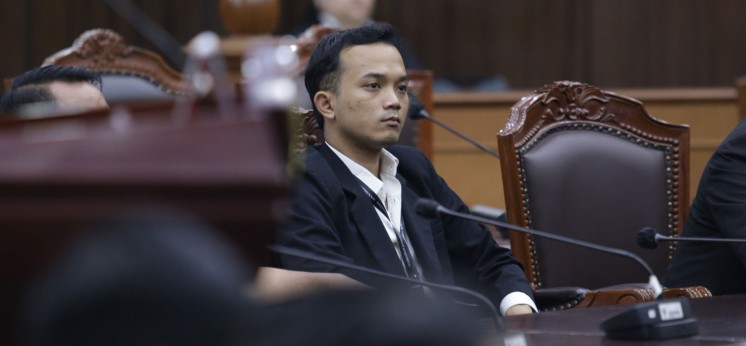
The Petitioner at the ruling hearing for the judicial review of Law No. 1 of 2023 on the Criminal Code for Case No. 22/PUU-XXIV/2026, Monday (3/2/2026). Photo by MKRI/Bayu.
JAKARTA (MKRI) — The Constitutional Court ruled the judicial review petition of Article 232 and Article 233 of Law No. 1 of 2023 on the Criminal Code (KUHP), filed by activist and treasurer of the National Student Executive Board of Nahdlatul Ulama Universities (BEM PTNU) Gangga Listiawan, inadmissible. The Court maintained that the petitums were contradictory.
“Within reasonable reasoning, the Court cannot possibly grant petitums formulated inconsistently or contradictorily,” said Constitutional Justice Ridwan Mansyur while reading out the legal considerations of Decision No. 22/PUU-XXIV/2026 on Monday, March 2, 2026 in the plenary courtroom.
The Court found that the Petitioner’s petitums had been formulated in an unusual manner. In petitum 2, the Petitioner requested the Court to declare several phrases in the two articles under review unconstitutional insofar as they are not interpreted constitutionally.
However, upon examining the wording, the Court observed that the Petitioner had combined several of these phrases by referring to Article 232 and Article 233 of the Criminal Code. In fact, if one refers to Article 233 of the Criminal Code, the phrases “without disturbance” and “obstructs the chairperson or members of a legislative institution and/or a government body” are not found therein.
Conversely, although certain phrases cited by the Petitioner are indeed contained in Article 233 of the Criminal Code, Article 233 does not include the phrase “forces such institution and/or body to take or not to take a decision.” That phrase appears in Article 232 of the Criminal Code. This formulation of the petitum thus creates ambiguity and legal uncertainty as to which substantive content in Article 232 and Article 233 of the Criminal Code is actually being challenged for constitutional review.
In addition, the petitums were framed cumulatively. In petitum 2, the Petitioner requested that Article 232 and Article 233 of Law No. 1 of 2023 be declared unconstitutional insofar as they are not interpreted constitutionally. However, in petitum 3, he requested that Article 232 and Article 233 of the Criminal Code be declared conditionally unconstitutional.
“With regard to such petitums, the Court observed that, on the one hand, the Petitioner requests that the norms of Article 232 and Article 233 of Law No. 1 of 2023 be declared unconstitutional, yet on the other hand, the Petitioner requests that the Court interpret it conditionally unconstitutional,” Justice Ridwan stated.
Also read:
Fearing Criminalization of Protests, BEM PTNU Treasurer Challenges Criminal Code
BEM PTNU Activist Says Criminal Code Law Leads to Legal Uncertainty
Article 232 provides: “Any Person who, by Violence or Threat of Violence, disperses a meeting of a legislative institution and/or a government body, or forces such institution and/or body to take or not take a decision, or expels the chairperson or members of such meeting, shall be punished with imprisonment for a maximum of 6 (six) years.”
Article 233 provides: “Any Person who, by Violence or Threat of Violence, obstructs the chairperson or members of a legislative institution and/or a government body from attending a meeting of such institution and/or body, or from carrying out their duties freely and without disturbance in a meeting of such institution and/or body, shall be punished with imprisonment for a maximum of 3 (three) years or a fine of up to category III.”
According to the Petitioner, Articles 232 and 233 of the Criminal Code potentially and/or in fact conflict with the 1945 Constitution, particularly Article 28D paragraph (1) and Article 28E paragraph (3). This is because, he argued, the norms under review are formulated without clear limits and definite legal standards, thereby opening broad and uncontrolled interpretive space for law enforcement authorities.
He further explained that the vagueness of the phrases in Articles 232 and 233 characterizes them as catch-all norms, namely norms that textually appear to prohibit certain conduct but, in practice, may be stretched and expanded in meaning according to the will of the interpreter without any objective limiting standards. Such a condition directly contradicts the principle of fair legal certainty as guaranteed by Article 28D paragraph (1) of the 1945 Constitution, as it places citizens in a position of legal uncertainty and renders them vulnerable to disproportionate criminalization.
The Petitioner also contended that, in addition to violating the principle of legal certainty, Articles 232 and 233 of the Criminal Code could potentially excessively restrict citizens’ constitutional rights to associate, assemble, and express opinions, as guaranteed by Article 28E paragraph (3) of the 1945 Constitution. In democratic constitutional practice, the expression of opinions in public forums, including during meetings of legislative members and government bodies, constitutes a citizens’ right and serves as an instrument of public oversight over power, and cannot easily be qualified as a criminal act merely because it causes discomfort or disturbance to the activities of state institutions.
In the petitums, the Petitioner requested the Court to declare Articles 232 and 233 of the Criminal Code—in particular the phrases “threat of violence,” “forces such institution and/or body to take or not to take a decision,” “obstructs the chairperson or members of a legislative institution and/or a government body,” and “without disturbance”—contrary to the 1945 Constitution, especially Article 28D paragraph (1) and Article 28E paragraph (3), insofar as they are not interpreted as constitutional.
The Petitioner also requested the Court to declare that the phrases in Articles 232 and 233 of the Criminal Code conditionally not legally binding, insofar as they are not interpreted as follows: the phrase “threat of violence” must be understood as threats accompanied by intent and a real capacity to carry out direct and actual physical violence, which can be proven objectively, and shall not include the expression of opinions, criticism, appeals, or political pressure conveyed peacefully; the phrase “forces such institution and/or body to take or not to take a decision” must be understood as acts carried out through physical violence or real and direct threats of physical violence that eliminate freedom of will, and shall not encompass the conveyance of aspirations, demonstrations, criticism, or other forms of public participation guaranteed by the Constitution; the phrase “obstructs the chairperson or members of a legislative institution and/or a government body” must be understood as concrete physical actions that directly impede the performance of official duties, and shall not include activities of expressing opinions in public or protest actions; and the phrase “without disturbance” must be interpreted strictly and narrowly as disturbances in the form of physical violence, and may not be construed as a restriction on criticism, protest, or citizens’ political expression guaranteed by the Constitution.
Explore case No. 22/PUU-XXIV/2026 (in Indonesian) and access the decision here.
Author : Mimi Kartika
Editor : N. Rosi
Translator : Yuniar Widiastuti (NL)
Disclaimer: The original version of the news is in Indonesian. In case of any differences between the English and the Indonesian versions, the Indonesian version will prevail.
Monday, March 02, 2026 | 13:15 WIB 84