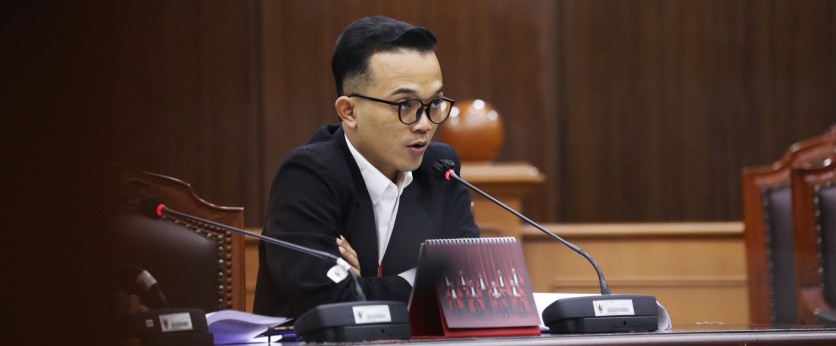
The Petitioner of the judicial review of Law No. 1 of 2023 on the Criminal Code for Case No. 22/PUU-XXIV/2026 presenting the case merits, Friday (1/23/2026). Photo by MKRI/Panji.
JAKARTA (MKRI) — Treasurer of the National Student Executive Board of Nahdlatul Ulama Universities (BEM PTNU) Gangga Listiawan has filed a petition for the judicial review of Article 232 and Article 233 of Law No. 1 of 2023 on the Criminal Code (KUHP). In Petition No. 22/PUU-XXIV/2026, the Petitioner challenges the provisions regulating criminal offenses against the conduct of meetings of legislative institutions and government bodies, which he alleges to be contrary to Article 1 paragraph (3), Article 28D paragraph (1), Article 28E paragraph (3), and Article 28F of the 1945 Constitution.
Gangga stated that, as the treasurer of nationwide BEM PTNU—an organization that coordinates student executive boards of Nahdlatul Ulama universities throughout Indonesia—he has a direct interest in activities involving public policy advocacy, the expression of students’ aspirations, and the organization of peaceful and constitutional protests. However, as a result of the enactment of Articles 232 and 233 of the Criminal Code, he has become concerned and hesitant to engage in protests, because such actions could be construed as acts of “coercion” or “obstruction.”
“These two norms a quo threaten legal certainty and the protection of the constitutional rights of students as a critical group,” he said at the preliminary hearing on Friday, January 23, 2026 in the courtroom.
Article 232 provides: “Any Person who, by Violence or Threat of Violence, disperses a meeting of a legislative institution and/or a government body, or forces such institution and/or body to take or not take a decision, or expels the chairperson or members of such meeting, shall be punished with imprisonment for a maximum of 6 (six) years.”
Article 233 provides: “Any Person who, by Violence or Threat of Violence, obstructs the chairperson or members of a legislative institution and/or a government body from attending a meeting of such institution and/or body, or from carrying out their duties freely and without disturbance in a meeting of such institution and/or body, shall be punished with imprisonment for a maximum of 3 (three) years or a fine of up to category III.”
According to the Petitioner, the formulation of these provisions is open to multiple interpretations and places students as the group most vulnerable to criminalization in advocacy activities, protests, and criticism against policies. As such, the provisions threaten the protection of students’ constitutional rights and violate the principle of a state governed by the rule of law that guarantees the protection of human rights. Although the challenged norms mention the element of violence, they do not provide clear and objective boundaries between actual physical violence and political expression in a democratic state, thereby creating opportunities for the criminalization of citizens’ constitutional activities guaranteed by the 1945 Constitution.
Accordingly, in his petitums, the Petitioner requests the Court to declare Article 232 and Article 233 of the Criminal Code unconstitutional and not legally binding.
The petition was examined by a panel consisting of Chief Justice Suhartoyo (chair) and Constitutional Justices Daniel Yusmic P. Foekh and M. Guntur Hamzah. During the advisory session, Justice Foekh stated that the Petitioner needs to clarify whether he is acting in a representative capacity on behalf of an organization or as an individual, and to add an explanation of his status as an active student at a particular university or higher education institution.
“Evidence of active participation related to the expression of aspirations in public spaces should be narrated in this petition. In addition, in my view, it is also necessary to elaborate on the fulfillment of the five requirements of constitutional rights impairment; if you are acting as an activist, please describe this,” he said.
Before adjourning the session, Chief Justice Suhartoyo announced that the Petitioners would have 14 days to revise the petition. The revised petition, either softcopy or hardcopy, must be submitted to the Court no later than 12:00 WIB on Thursday, February 5, 2026.
Explore case No. 22/PUU-XXIV/2026 (in Indonesian).
Author : Mimi Kartika
Editor : N. Rosi
Translator : Yuniar Widiastuti (NL)
Disclaimer: The original version of the news is in Indonesian. In case of any differences between the English and the Indonesian versions, the Indonesian version will prevail.
Friday, January 23, 2026 | 14:43 WIB 104