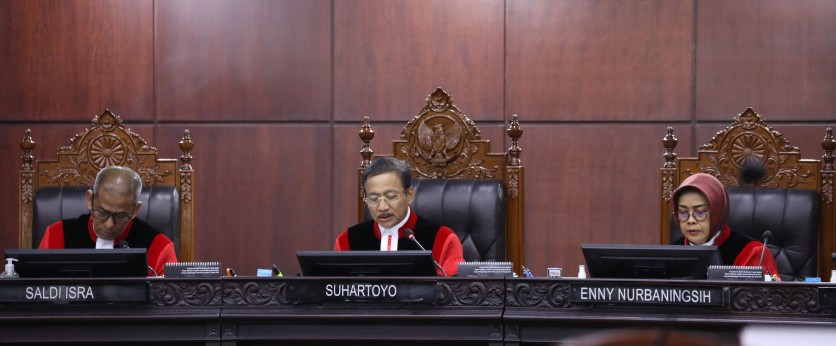
The Constitutional Court held a pronouncement hearing for a determination in a judicial review case of Law Number 19 of 2000 on Tax Collection with Distress Warrants, on Monday (03/02/2026) in the Court’s plenary courtroom. Photo by MKRI/Panji.
JAKARTA, (MKRI) – The Constitutional Court read out its determination on the petition filed by PT Simac Indonesia, represented by Domastor Ginting (the Petitioner), concerning the judicial review of Law Number 19 of 2000 concerning Amendments to Law Number 19 of 1997 on Tax Collection with Distress Warrants, on Monday (03/02/2026). The determination in Case Number 19/PUU-XXIV/2026 was delivered directly by Chief Justice Suhartoyo from the Plenary Courtroom of Building 1 of the Court.
The Court stated that it had received the petition submitted by PT Simac Indonesia and had also received a letter regarding the withdrawal of the petition. The Court further confirmed during the hearing that the Petitioner acknowledged the withdrawal of the petition.
Based on the Judges’ Deliberation Meeting (RPH) held on February 6 and 9, 2026, the Court determined that the withdrawal of the petition was legally justified. Consequently, the Petitioner may not refile the a quo petition. The RPH also instructed the Registrar to record the withdrawal in the e-BRPK system and to return a copy of the petition file to the Petitioner.
“Granting the withdrawal of the Petitioner’s petition,” stated Chief Justice Suhartoyo when reading out the determination.
Read also:
PT Simac Indonesia Questions Tax Liability for Dissolved Company
PT Simac Indonesia Withdraws Petition on Tax Liability Rules for Dissolved Companies
Previously, the Petitioner argued that Article 10 paragraph (5), Article 10A, Article 29, and Article 33 paragraph (1) of Law Number 19 of 1997 were contrary to the 1945 Constitution of the Republic of Indonesia (UUD 1945). According to the Petitioner, these provisions create legal uncertainty regarding the responsible taxpayer for companies that have been dissolved.
The provisions raise questions, among others, in cases involving changes or substitutions of the responsible taxpayer: why is the distress warrant served on the liquidator and not on the responsible taxpayer prior to the appointment of the liquidator (the former responsible taxpayer)? Does the former responsible taxpayer remain liable for the collection of tax debts when the distress warrant is only served on the liquidator (the new responsible taxpayer)? In the Petitioner’s concrete case, the application of Article 10 paragraph (5) of the law resulted in uncertainty regarding who bears responsibility for tax obligations when a company has been dissolved. (*)
Author : Sri Pujianti
Editor : Lulu Anjarsari P.
PR : Raisa Ayuditha M.
Translator : Agusweka PS.
Disclaimer: The original version of the news is in Indonesian. In case of any differences between the English and the Indonesian versions, the Indonesian version prevails.
The full decision is available at the following link: Decision Number 19/PUU-XXIV/2026.
Monday, March 02, 2026 | 09:53 WIB 51