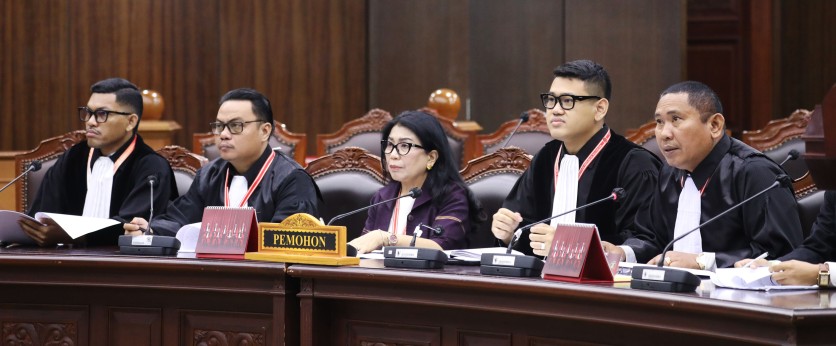
The Petitioners’ legal counsel in the judicial review of Law No. 19 of 1997 on Tax Collection by Distress Warrant delivering the main points of their petition directly in a panel courtroom on Friday (23/1/2026). Photo by MKRI/Panji.
Jakarta (MKRI) - PT Simac Indonesia (In Liquidation), represented by Domastor Ginting, has filed a petition for a material judicial review of Law No. 19 of 2000 on the amendment to Law No. 19 of 1997 on Tax Collection by Distress Warrant (PPSP Law) with the Constitutional Court (MK). The preliminary hearing in Case No. 19/PUU-XXIV/2026 was heard by a Panel of Justices chaired by Chief Justice Suhartoyo in the Plenary Courtroom on Friday, January 23, 2026.
In this petition, the Petitioner argues that Article 10 paragraph (5), Article 10A, Article 29, and Article 33 paragraph (1) of the PPSP Law are contrary to the 1945 Constitution.
Article 10 paragraph (5) of the PPSP Law reads, “In the case where a taxpayer is declared bankrupt, the distress warrant is served on the curator, supervising judge, or the Office of the Custodian of Abandoned Property, and in the event where a taxpayer is declared dissolved or in liquidation, the distress warrant shall be served on the person or entity charged with carrying out the winding-up or on the liquidator.”
Article 10A of the PPSP Law reads, “the procedures for the execution of immediate and simultaneous collection, as well as the execution of a distress warrant, shall be stipulated by a Ministerial Decree or a Regional Head Decree.”
Article 29 of the PPSP Law reads, “Prevention measures may only be imposed on a tax liable who has tax arrears of at least Rp100,000,000.00 (one hundred million rupiah) and whose good faith in settling such tax debt is in doubt.”
Article 33 of the PPSP Law reads, “Detention may only be imposed on a tax liable who has tax arrears of at least Rp100,000,000 (one hundred million rupiah) and whose good faith in settling such tax debt is in doubt.”
The Petitioner claims that these provisions create legal uncertainty as to who bears tax liability when a company has been dissolved. Among other issues, they question why, when there is a change of tax liable person, the distress warrant must be addressed to the liquidator, and why it cannot also be served on the former tax liable person before the liquidator is appointed. They ask whether the former tax liable person remains responsible for tax collection if the distress warrant is served only on the liquidator, who is the new tax liable person.
In the concrete case, the application of Article 10 paragraph (5) has allegedly created uncertainty over who is liable for the company’s tax debts post-dissolution. Under Article 1 point 3 of the PPSP Law, “tax liable” refers to an individual or entity responsible for paying tax, including representatives who exercise the rights and fulfill the obligations of the taxpayer under tax laws and regulations.
“The legal entity is in dissolution, yet the tax liable is being detained while at the same time the Petitioner is pursuing legal remedies to challenge the tax liability. Since the Petitioner has personally experienced legal uncertainty in tax regulation, its legal standing has been fulfilled,” said Cuaca, the Petitioner’s legal counsel.
The Petitioner also challenges Article 10A as implemented through Minister of Finance Regulation Number 61 of 2023 on Procedures for Tax Collection on Outstanding Tax (PMK 61/2023). They argue that this regulation goes beyond the delegated authority of Article 10A by including coercive measures, restrictions, and detailed rules on taxpayers’ rights and obligations, whereas it should only contain technical provisions on collection procedures. They further contend that, although the PPSP Law targets collection at taxpayers and not their spouses, PMK 61/2023 extends liability beyond what the statute allows and, in practice, enforcement is directed at former management through prevention and detention, while no collection action is taken against new management. This, they say, creates legal uncertainty contrary to Article 1 paragraph (3) and Article 28D paragraph (1) of the 1945 Constitution.
On these grounds, the Petitioner asks the Court to declare that the phrase “in the event where a taxpayer is declared dissolved or in liquidation, the distress warrant shall be served on the person or entity charged with carrying out the winding-up or on the liquidator” in Article 10 paragraph (5) is unconstitutional and non-binding unless interpreted to mean that “the last liquidator is the tax liable who is personally and/or jointly liable for payment of the tax owed where the taxpayer is declared dissolved.” They also request that Article 36 paragraph (2) of the PPSP Law be declared unconstitutional and without binding legal force.
Constitutional Loss
During the panel’s advice, Justice Daniel Yusmic P. Foekh raised the issue of legal standing for a private legal entity, stressing the need to clarify who is authorized to represent the company.
“In the petition, on the one hand, it refers to ‘the Petitioner’, while in the petitum it refers to ‘the Petitioners’. Is this meant to indicate tax liable 1 and 2, then who are they? This must be clear, otherwise it will appear fictitious, so there must be someone duly authorized to represent them so that the constitutional loss can also be explained,” Justice Daniel explained.
Constitutional Justice M. Guntur Hamzah further stated that the Petitioners need to pay attention to their legal standing and the posita, which are still mixed together. “In the posita, you must persuade the Court that there is a conflict between the norm being reviewed and the constitutional benchmark in the 1945 Constitution. Legal standing should only set out the concrete case the principal has experienced. That is important, including how to present the comparison and its underlying philosophy,” Justice Guntur said.
Chief Justice Suhartoyo then offered advice regarding the Petitioner’s legal standing. “The detention concerns the tax liable or the former directors, while the Petitioner is the takeover entity. The tax liable consists of the husband and wife as directors/commissioners, if you are challenging this norm but doing so in the name of the Petitioner, is this relevant? If you persist in this, the Court has already cautioned you about this issue of legal standing,” Chief Justice Suhartoyo explained.
Before adjourning the session, Chief Justice Suhartoyo granted the Petitioner 14 days to revise the petition. The revised petition must be submitted to the Court by Thursday, February 5, 2026, at 12.00 Western Indonesian Time, after which the Court will schedule a further hearing to examine the main points of the revised petition.
Case tracking: Petition No. 19/PUU-XXIV/2026
Author: Sri Pujianti.
Editor: N. Rosi.
Translator: Rizky Kurnia Chaesario
Disclaimer: The original version of the news is in Indonesian. In case of any differences between the English and the Indonesian versions, the Indonesian version prevails.
Friday, January 23, 2026 | 14:30 WIB 143