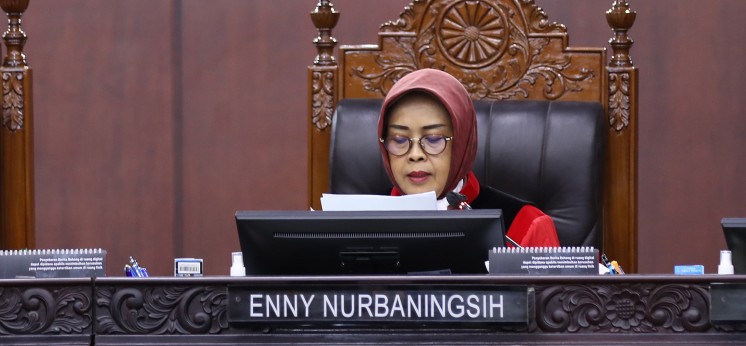
The Constitutional Justice reads out the Court’s legal considerations during the Decision Hearing on the judicial review of Law Number 1 of 2023 on the Criminal Code, Monday (02/03/2026) at the Constitutional Court’s courtroom. Photo by MKRI/Ifa.
JAKARTA, (MKRI) – The existence of Article 434 paragraph (2) letter a of Law Number 1 of 2023 on the Criminal Code (New Criminal Code) constitutes a norm that grants judges the discretion to assess evidence in criminal defamation cases. Moreover, the provision does not automatically compel judges to impose defamation sanctions as regulated under Article 433 of Law 1/2023 if the evidence presented is deemed insufficient in the judge’s assessment.
This formed part of the Court’s legal considerations, as read by Constitutional Justice Enny Nurbaningsih in the judicial review of the Criminal Code on Monday (03/02/2026). The Pronouncement of Decision in Case Number 12/PUU-XXIV/2026 was presided over by Chief Justice Suhartoyo from the Plenary Courtroom of the Constitutional Court Building I, Jakarta. The petition was filed by Ariyanto Zalukhu (Petitioner I), Dewi Hajar Rahmawati Ali (Petitioner II), Widia Putri Andini (Petitioner III), Isya Nurul Awaliah Fazrin (Petitioner IV), Assagaf Reyvan Afandi (Petitioner V), Alexandra Asheilla Taufik (Petitioner VI), and Rizki Kurniawan (Petitioner VII), upon which the Court delivered several considerations.
In criminal evidentiary practice, there are two cumulative prerequisites: the fulfillment of the minimum requirement of valid evidence and the formation of the judge’s conviction regarding the defendant’s guilt based on such evidence. This evidentiary construction is oriented toward the pursuit of material truth rather than merely formal truth. Such orientation necessitates careful, rational, and accountable examination and assessment of evidence, supported by clear reasoning in judicial decisions. Therefore, the application of this principle ensures that judges are not merely “mouthpieces” of the law but independent interpreters of the law in pursuit of justice.
For the Purpose of Evidence
Furthermore, Article 235 paragraph (1) letter h of the New Criminal Code essentially provides that anything may be used for evidentiary purposes in court proceedings as long as it is obtained lawfully. Thus, in line with Article 235 paragraph (1) letter h of the a quo law, the existence of Article 434 paragraph (2) letter a of Law 1/2023 constitutes a norm that grants judges discretion in assessing evidence in defamation cases.
The verification of the truth of an allegation is permissible when the accused is a public official and the allegation relates to the performance of their duties. The Court considered that such a provision cannot be separated from the judge’s conviction. Regarding such judicial conviction, the Court has previously provided clarification in Decision Number 244/PUU-XXIII/2025.
“If the Court were to follow the petitum of the Petitioners a quo, it would potentially narrow the scope of judicial discretion in assessing evidence in criminal cases. With regard to the Petitioners’ concern that the application of the a quo norm would hinder the right to freedom as stipulated under Article 28E paragraphs (2) and (3) of the 1945 Constitution of the Republic of Indonesia (UUD 1945), the Court considers such concern to be unfounded. Therefore, according to the Court, the Petitioners’ argument concerning the phrase ‘the judge deems it necessary’ in Article 434 paragraph (2) letter a of Law 1/2023 being contrary to the 1945 Constitution of the Republic of Indonesia (UUD 1945) unless interpreted as requested in the petitum is legally unfounded,” Enny explained.
Accordingly, the Court held that the norms of Article 433 paragraphs (1) and (3), as well as the phrase “the judge deems it necessary” in Article 434 paragraph (2) letter a of Law 1/2023, are not contrary to the principle of fair legal certainty and the freedom of thought and expression as guaranteed under Article 28D paragraph (1) and Article 28E paragraphs (2) and (3) of the 1945 Constitution of the Republic of Indonesia (UUD 1945). Therefore, all of the Petitioners’ arguments are legally unfounded.
“To reject the Petitioners’ petition in its entirety,” stated Chief Justice Suhartoyo in reading out the ruling.
Read also:
Court Asked to Clarify Victims of Defamation Offense in Criminal Code
During the Preliminary Hearing held on Thursday (01/22/2026), the Petitioners argued that Article 433 paragraph (1), Article 433 paragraph (3), and Article 434 paragraph (2) of the Criminal Code are contrary to the 1945 Constitution of the Republic of Indonesia (UUD 1945). They asserted that the phrase “another person” in Article 433 paragraph (1) creates inconsistency and legal uncertainty in defining the subject of victims in defamation offenses, as it refers to the party whose honor or reputation is attacked through defamatory acts.
However, the a quo norm does not provide clarity regarding who is constitutionally intended as “another person” within the context of protecting honor and reputation through criminal law. This question becomes crucial because defamation offenses as regulated under the a quo provision are complaint-based offenses. Consequently, the scope of the victim directly determines who is entitled to file a criminal complaint and, at the same time, who may potentially be subject to criminalization. Thus, the broader and more undefined the meaning of the phrase “another person,” the greater the potential for criminalizing citizens’ expressions, criticisms, and opinions.
Furthermore, the Petitioners argued that the phrase “for the public interest or in necessary self-defense” in Article 433 paragraph (3) of the Criminal Code also creates legal uncertainty. The provision is considered to lack a clear definition and parameters regarding what constitutes “public interest” and “necessary self-defense.” As students, the Petitioners have academic obligations to critique public policies and exercise social control; however, due to the existence of such provisions, they fear that such actions may be criminalized as defamation.
Therefore, in their petitum, the Petitioners requested the Court to declare Article 433 paragraph (1) of the Criminal Code contrary to the 1945 Constitution of the Republic of Indonesia (UUD 1945) and conditionally unconstitutional insofar as it is not interpreted to mean:
“Any person who orally attacks the honor or reputation of another person, except against corporations, government institutions, groups of individuals, public officials, and/or public figures, by alleging the commission of an act with the intention that it be known publicly, shall be punished for defamation with a maximum imprisonment of 9 (nine) months or a fine up to Category II.”
Explore the Case: Number 12/PUU-XXIV/2026
Author : Sri Pujianti
Editor : N. Rosi
Translator : Agusweka PS.
Disclaimer: The original version of the news is in Indonesian. In case of any differences between the English and the Indonesian versions, the Indonesian version prevails.
Read the full decision at the following link: Decision Number 12/PUU-XXIV/2026
Monday, March 02, 2026 | 16:09 WIB 91