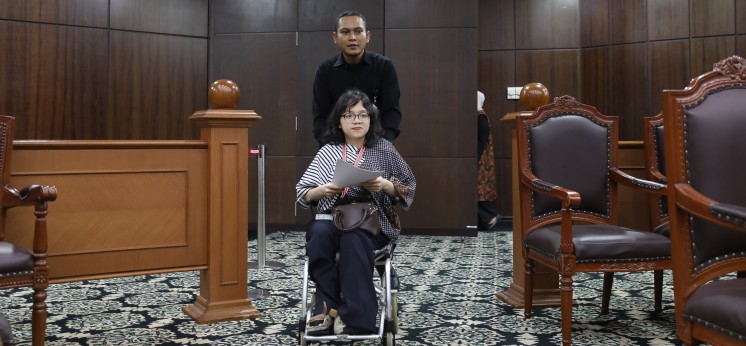
The Petitioner entering the courtroom for the judicial review hearing of Law No. 1 of 2023 on the Criminal Procedure Code, Thursday (1/22/2026). Photo by MKRI/Ifa.
JAKARTA (MKRI) — Several university students have filed a material judicial review of Law No. 1 of 2023 on the Criminal Code (KUHP) to the Constitutional Court. The preliminary hearing for Case No. 12/PUU-XXIV/2026 was presided over by a panel chaired by Constitutional Justice Enny Nurbaningsih in the plenary courtroom on Thursday, January 22, 2026.
These students are Ariyanto Zalukhu, Dewi Hajar Rahmawati Ali, Widia Putri Andini, Isya Nurul Awaliah Fazrin, Assagaf Reyvan Afandi, Alexandra Asheilla Taufik, and Rizki Kurniawan (Petitioners I-VII). In the petition, they argue that Article 433 paragraphs (1) and (3) and Article 434 paragraph (2) of the Criminal Code (KUHP) are unconstitutional.
Article 433 paragraph (1) reads: “Any Person who verbally assault the honor or reputation of another person by accusing something, with the intention that it is known to the public, shall be sentenced due to slander, with imprisonment for a maximum of 9 (nine) months or a maximum criminal fine of category II.”
Article 433 paragraph (3) reads: “The acts as referred to in paragraph (1) and paragraph (2) shall not be sentenced if it is conducted in the public interest or out of necessity of self-defense.”
Article 434 paragraph (2) reads: “Proving the validity of allegations as referred to in paragraph (1) may only be conducted in the event that: a. the judge deems it necessary to examine the validity of the allegation to consider the defendant's statement that the defendant committed said action in the public interest or out of necessity of self-defense; or b. Officials are accused of doing something in carrying out their official duties.”
Ariyanto stated that the phrase “another person” in Article 433 paragraph (1) gives rise to inconsistency and legal uncertainty in defining the subject of the victim of the offense of defamation. The provision refers to a subject whose honor or reputation is attacked through defamatory acts. However, the norm in question does not provide clarity as to who is constitutionally meant by “another person” in the context of protecting honor and reputation under criminal law. The question of who qualifies as “another person” is crucial, because defamation as regulated in the provision constitutes a complaint-based offense. Consequently, the scope of the victim subject directly determines who is entitled to file a criminal complaint and, at the same time, who may potentially be criminalized. Thus, the broader and more undefined the meaning of the phrase “another person,” the greater the space for the criminalization of citizens’ expression, criticism, and opinions.
Requirement to Prove One’s Own Justification
The Petitioners further argue that the phrase “in the public interest or out of necessity of self-defense” in Article 433 paragraph (3) of the KUHP also creates legal uncertainty. The provision is considered to lack clear definitions and parameters regarding what constitutes “public interest” and “out of necessity of self-defense.” As students, the Petitioners have academic obligations to critique public policies and exercise social control; however, due to the existence of such provisions, they fear that these activities could be criminalized as defamation.
Accordingly, in their petitums, the Petitioners request the Court to declare Article 433 paragraph (1) of the Criminal Code conditionally unconstitutional and not legally binding insofar as it is not interpreted as: “Any person who verbally assault the honor or reputation of another person, except corporations, government institutions, groups of individuals, public officials, and/or public figures, by accusing something, with the intention that it is known to the public, shall be sentenced due to slander, with imprisonment for a maximum of 9 (nine) months or a maximum criminal fine of category II.”
They also request the Court to declare Article 433 paragraph (3) of Law No. 1 of 2023 on the Criminal Code conditionally unconstitutional and not legally binding insofar as it is not interpreted as: “The acts as referred to in paragraph (1) and paragraph (2) shall not be sentenced if it is conducted in the public interest or out of necessity of self-defense, or if they constitute an assessment, opinion, evaluation, or a factual statement,” as read out by Priskila Octaviani on behalf of the Petitioners.
Legal Arguments
In his advice, Constitutional Justice Daniel Yusmic P. Foekh stated that the Petitioners merely quoted the provisions without elaborating on the constitutional harm suffered as a result of the application of those norms. “Therefore, it is necessary to add relevant legal arguments demonstrating how the Petitioners’ constitutional rights are harmed,” he emphasized.
Subsequently, Constitutional Justice Anwar Usman noted that the Petitioners needed to adjust the format of their petitums. He argued that the petitums did not yet comply with the applicable procedural requirements, including Article 10 of Constitutional Court Regulation No. 7 of 2025 on Procedure for Judicial Review of Laws.
Meanwhile, Constitutional Justice Enny provided substantive guidance, advising the Petitioners to pay close attention to the explanatory provisions of the articles under review. “In the petitums, it must be consistent whether the challenge is directed at all provisions or only at specific phrases, as this is directly related to the alleged constitutional harm. In Constitutional Court Decision No. 105/PUU-XXII/2024, the victim was directly identified; therefore, in this petition, the legal standing of the Petitioners needs to be strengthened—whether it is sufficient merely to state that they are university students,” she explained.
Before adjourning the session, Justice Enny announced that the Petitioners would have 14 days to revise the petition. The revised petition must be submitted to the Court no later than 12:00 WIB on Wednesday, February 4, 2026. The Court will then schedule a second hearing to examine the revised petition.
Explore case No. 12/PUU-XXIV/2026 (in Indonesian).
Author : Sri Pujianti
Editor : N. Rosi
Translator : Yuniar Widiastuti (NL)
Disclaimer: The original version of the news is in Indonesian. In case of any differences between the English and the Indonesian versions, the Indonesian version will prevail.
Thursday, January 22, 2026 | 20:06 WIB 936