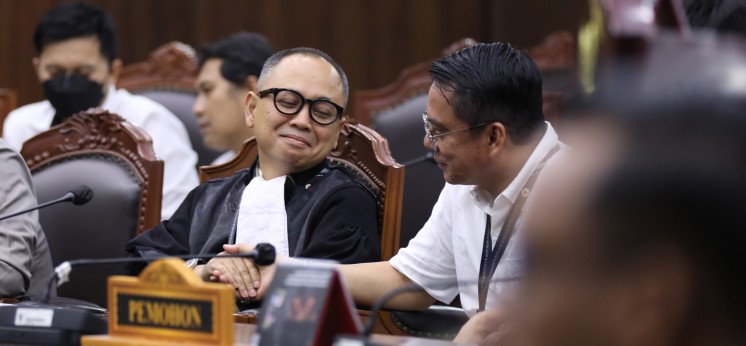
Petitioners’ legal counsel after attending the Decision Pronouncement Hearing on the material judicial review of Law No. 31 of 1999 on the Eradication of Corruption, Monday (02/03). Photo by MKRI/Ifa.
Jakarta (MKRI) - The Constitutional Court has partially granted Case No. 71/PUU-XXIII/2025, a material judicial review of Article 21 of Law No. 31 of 1999 on the Eradication of Corruption, as amended by Law No. 20 of 2001. In its ruling, the Court declared the phrase “directly or indirectly” in Article 21 unconstitutional and without binding legal force.
“This shift in the Court’s position on the phrase is based on the consideration that ‘directly or indirectly’ is potentially used as a ‘rubber’ term (flexible or elastic) to ensnare anyone whom law‑enforcement officers regard as obstructing legal proceedings,” Justice Arsul Sani said as he read out the Court’s legal reasoning in Decision No. 71/PUU-XXIII/2025 on Monday, March 2, 2026, in the plenary courtroom.
Arsul explained that the words “or indirectly” in Article 21 constitute the offence of obstruction of justice, often described in Indonesian criminal law doctrine as the crime of obstructing legal proceedings. The provision is designed to protect law-enforcement processes, from investigation and prosecution to trial, from any acts that hinder, impede, or disrupt ongoing proceedings.
He noted that obstruction of justice is codified in Article 25 of the United Nations Convention against Corruption (UNCAC), which Indonesia ratified through Law No. 7 of 2006, and in Articles 281 and 282 of the new Criminal Code.
The elements of the obstruction of justice offence in Article 21 of the Anti‑Corruption Law comprise: (i) subjective elements, namely (a) “any person” and (b) “intentionally”; and (ii) objective elements, namely (c) preventing, obstructing, or thwarting, directly or indirectly, an investigation, prosecution, or court hearing, and (d) doing so in relation to a suspect, defendant, or witnesses in a corruption case. As to the prohibited conduct (actus reus), the provision uses the terms “prevent, obstruct, or thwart” without giving a detailed or exhaustive definition of what acts fall into those categories.
The Court noted that lawmakers deliberately chose this open formulation so the provision can remain adaptable and anticipatory in the face of evolving corruption methods, with both positive law and court jurisprudence supplying concrete examples of prohibited conduct under the article. Were the legislature to draft a closed list of acts, the norm could quickly become ineffective, as new forms of obstruction not explicitly mentioned in the text could be exploited by offenders to evade liability.
Article 21 of the Anti‑Corruption Law also specifies how the prohibited conduct—preventing, obstructing, or thwarting legal proceedings in corruption cases—may be carried out, namely “directly or indirectly.” In general criminal‑law doctrine, this phrase corresponds to direct acts (onmiddellijk) and indirect acts (middellijk): a direct act is conduct performed personally by the perpetrator that causes the offence, while an indirect act is conduct that does not itself constitute the crime but facilitates or enables another person to commit it.
Placed in the context of Article 21, the phrase “directly or indirectly” means the punishable conduct is not limited to particular “ways” of committing the crime, but extends to any act that in fact results in ongoing proceedings being delayed, disrupted, or brought to a halt.
Some acts that fall within “preventing, obstructing, or thwarting” are already clearly set out in Articles 281 and 282 of the 2023 Criminal Code, Article 25 of UNCAC, and Indonesian case law on obstruction of justice—typically unlawful conduct carried out directly by the perpetrator that directly triggers the offence. However, by adding the phrase “or indirectly,” the provision also sweeps in other, less explicit forms of conduct that, in substance, hinder proceedings—such as spreading disinformation, exerting social pressure, or using intermediaries—whose assessment depends heavily on law‑enforcement officials’ subjective judgment.
This risk is heightened for the Petitioner’s profession as a lawyer, who must advocate for clients and frequently confront law‑enforcement agencies. Non‑litigation advocacy—publishing in print or online media, organizing public discussions or seminars—and even investigative journalism on ongoing cases or academically grounded opinion pieces could all be treated as “indirect” obstruction, despite being carried out within legal boundaries.
In effect, the phrase “or indirectly” blurs the line between lawful, protected activity—including freedom of expression—and unlawful conduct, creating a risk of over‑criminalization. Although indirect acts should still be subject to the principles of fault and intent—requiring proof of mens rea, awareness of ongoing proceedings, and a concrete contribution to hindering them—such safeguards do not fully dispel the uncertainty for people who cannot predict whether lawful actions might be loosely treated as offences.
The Court noted that, so long as a person intentionally prevents, obstructs, or thwarts legal proceedings at the investigation, prosecution, or trial stage in a corruption case, they can be prosecuted under Article 21 without the “directly or indirectly” language. To ensure fair legal certainty and to avoid that phrase being used as a rubber clause against lawyers, journalists, and anti-corruption activists, the Court concluded that Article 21 need not be aligned verbatim with UNCAC Article 25, especially since recent national criminal‑law reforms on obstruction of justice no longer include the “directly or indirectly” wording.
Also read:
Lawyer Challenges Anti-Corruption Law for Potentially Restricting Public Participation
Lawyer Challenges Anti-Corruption Law over Clause on Obstruction of Investigation
House: Arbitrary Prosecution Under Article 21 of Anti-Corruption Law Unjustifiable
Government: Obstructive Acts Must Be Proven to Involve Criminal Intent
Police Refute Allegation of Authority Abuse in Anti-Corruption Law
Article 21 of the Anti-Corruption Law reads: “Anyone who intentionally prevents, hinders, or frustrates, directly or indirectly, the investigation, prosecution, and examination in court of suspects or defendants or witnesses in corruption cases shall be sentenced to imprisonment of at least three (3) years and up to twelve (12) years and/or fined at least Rp150,000,000 (one hundred and fifty million rupiahs) and at most Rp600,000,000 (six hundred million rupiahs).” The article’s elucidation simply states: “Article 21 is sufficiently clear.”
Petitioner Hermawanto, an advocate, argued that the phrase “or indirectly” in Article 21 and its explanation could be used to prosecute any citizen who voices public opinion or exercises social control through the mass media, seminars, campus discussions, demonstrations, press conferences, and similar forums. If such public expressions were, in a police investigator’s subjective view, deemed to “obstruct investigation, prosecution, or trial” merely because they indirectly influence law‑enforcement processes, he warned, this would create a serious threat to freedom of expression and to people’s sense of security when speaking out. Yet the Constitution affirms that freedom to convey opinions and to feel secure in expressing them are essential elements of a democratic state. (*)
Decision No. 71/PUU-XXIII/2025 (in Indonesian)
Author: Mimi Kartika
Editor: Lulu Anjarsari P.
PR: Andhini S.F.
Translator: Rizky Kurnia Chaesario/Yuanna Sisilia
Disclaimer: The original version of the news is in Indonesian. In case of any differences between the English and the Indonesian versions, the Indonesian version will prevail.
Monday, March 02, 2026 | 14:25 WIB 229