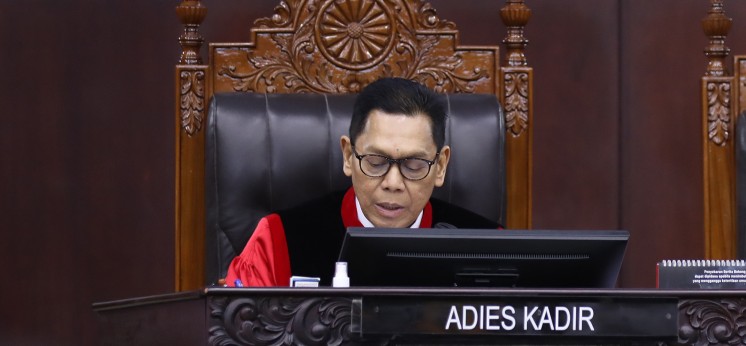
Justice Adies Kadir reading out the Court’s legal consideration during the Decision Pronouncement Hearing on the judicial review of Law No. 17 of 2014 of the MD3 Law on Monday (02/03). Photo by MKRI/Ifa.
Jakarta (MKRI) - The Constitutional Court (MK) rejected the petition for material judicial review of Article 239 paragraph (2) letter d of Law No. 17 of 2014 on the People’s Consultative Assembly, the House of Representatives, the Regional Representative Council, and the Regional House of Representatives (MD3 Law) filed by five university students. The Court reaffirmed its stance that the mechanism of midterm replacement (PAW) of DPR members by political parties is constitutional.
“Because the PAW mechanism is part of efforts to maintain a balance in the relationship between political parties, legislative candidates, and the constituents who vote for them in general elections,” said Justice Adies Kadir when reading the legal considerations of Decision No. 44/PUU-XXIV/2026 on Monday, March 2, 2026, at the Plenary Courtroom in Jakarta.
Justice Adies explained that the Court had also considered the involvement of the people in the PAW mechanism for DPR members, as requested by the Petitioners in the a quo case. In the excerpt of the Court’s legal considerations in Decision No. 22/PUU-XXIII/2025, the Court essentially held that the request to require people’s approval is inconsistent with representative democracy, tantamount to holding a repeat election in the electoral district concerned, and contradicts the principle of one man one vote.
Apart from being inconsistent with the concept of representative democracy, the Petitioners’ request to hold a poll involving all voters in the relevant electoral district could give rise to other problems, such as polarization sharpening pro and contra views, which could potentially trigger conflict in society and hamper development processes that should proceed swiftly.
The Court’s position as set out in the quoted legal considerations of Decision No. 22/PUU-XXIII/2025 was then reaffirmed in Decisions No. 41/PUU-XXIII/2025 and No. 199/PUU-XXIII/2025, and as of the pronouncement of this decision, the Court had no strong and fundamental reasons to depart from its stance in those legal considerations. Based on the above legal considerations, because the substance of the a quo petition is the same as the substance of Petition No. 22/PUU-XXIII/2025 and the Court remains with its position, the legal considerations in Decision No. 22/PUU-XXIII/2025 apply mutatis mutandis in examining the arguments of the Petitioners.
“Since there are no strong and fundamental reasons to depart from the position in the legal considerations of the aforementioned decisions, the arguments of the Petitioners must be declared unfounded in law,” Justice Adies said.
Thus, the Court held that the norm of Article 239 paragraph (2) letter d of Law 17/2014 does not conflict with the principle of popular sovereignty and does not violate the constitutional right of the people to collectively pursue their common interests as guaranteed by Article 1 paragraph (2) and Article 28C paragraph (2) of the 1945 Constitution of the Republic of Indonesia, contrary to what the Petitioners alleged, and therefore the Petitioners’ arguments are entirely unfounded in law.
Article 239 paragraph (2) letter d of the MD3 Law stipulates: “DPR members are dismissed between terms as referred to in paragraph (1) letter c if: d. proposed by their political party in accordance with the laws and regulations.” This provision underscores that DPR membership is highly dependent on the political party that nominates the member, not on the subsequent approval of the people, the holders of sovereignty, and those who elected the legislator concerned.
Also read:
Recall Rule for DPR Members by Parties Challenged at the Constitutional Court
Clarifying Constitutional Harm from Party Recall of DPR Members
The Petitioners comprise I Kadek Agus Yudi Luliana, Martha Tri Lestari, Kadek Bayu Sukrisnawan, Komang Ayu Trisna Dewi, and Tono Wilson Tamba. They contend that Article 239 paragraph (2) letter d of the MD3 Law grants political parties the authority to remove their cadres who are serving in representative institutions.
In fact, they argue, party cadres who become DPR members are elected by the people in general elections, so without the people’s choice, those party-nominated cadres would not be able to win seats in parliament. The Petitioners believe that DPR members are entirely under party control through the party’s recall power and the dismissal of cadres who serve in the DPR between terms.
In the interest of the people and to reduce the powerful control of parties over their members in parliament, which may degrade legislators’ capacity to fight for the people’s aspirations, the Petitioners argue that the right of recall must be conditioned on the approval of the constituents. They consider the provision a risk of creating a situation in which DPR members side more with party leaders, fearing they may be dismissed at any time, rather than siding with the people. As a result, policies adopted by the legislative body may harm the public instead. (*)
Decision No. 44/PUU-XXIV/2026 (in Indonesian)
Author: Mimi Kartika
Editor: Lulu Anjarsari P.
PR: Adriana A.Y.
Translator: Rizky Kurnia Chaesario
Disclaimer: The original version of the news is in Indonesian. In case of any differences between the English and the Indonesian versions, the Indonesian version will prevail.
Monday, March 02, 2026 | 19:49 WIB 140