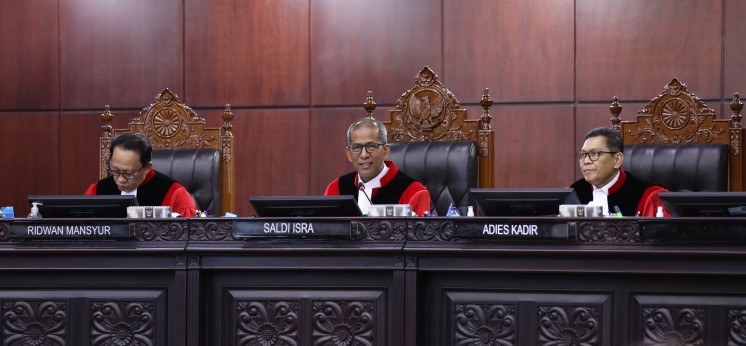
Deputy Chief Justice Saldi Isra, along with Justices Ridwan Mansyur and Adies Kadir, presiding over the panel hearing to examine the revised petition on the MD3 Law on Wednesday (18/02). Photo by MKRI/Ifa.
Jakarta (MKRI) - The Petitioners in Case No. 44/PUU-XXIV/2026 have strengthened their qualifications and clarified the constitutional rights violations they allege in their material judicial review of Article 239 paragraph (2) letter d of Law No. 17 of 2014 on the People’s Consultative Assembly, the People’s Representative Council, the Regional People’s Representative Council, and Regional Representative Council (MD3 Law). They presented their revisions at a hearing on Wednesday, February 18, 2026.
“We have reinforced and clarified the constitutional harm suffered by each Petitioner, and we emphasize that this harm is specific and actual,” said I Kadek Agus Yudi Luliana, one of the Petitioners, who joined the hearing online.
The Petitioners also elaborated on the mechanism by which political parties can recall DPR members in connection with their petition. They added arguments asserting that the current scheme for mid-term replacement (PAW) of DPR members by parties conflicts with the 1945 Constitution.
The petitum has also been revised. The Petitioners now ask the Court to declare Article 239 paragraph (2) letter d of the MD3 Law unconstitutional and conditionally non‑binding unless interpreted to read: “DPR members shall be dismissed between terms as referred to in paragraph (1) letter c if: … d. they are proposed for dismissal by their political party in accordance with laws and regulations, with the approval of voters who held the right to vote in the previous General Election in their electoral district.”
Also read:
Recall Rule for DPR Members by Parties Challenged at the Constitutional Court
During the preliminary hearing on Thursday, February 5, 2026, the Petitioners argue that this article makes the People’s Representative Council (DPR) heavily dependent on the sponsoring political party rather than on the approval of the people, who hold sovereignty and elect legislators. Article 239 paragraph (2) letter d of the MD3 Law stipulates: “DPR members are dismissed between terms as referred to in paragraph (1) letter c if: d. proposed by their political party in accordance with the laws and regulations.”
The Petitioners comprise I Kadek Agus Yudi Luliana, Martha Tri Lestari, Kadek Bayu Sukrisnawan, Komang Ayu Trisna Dewi, and Tono Wilson Tamba. They contend that Article 239 paragraph (2) letter d of the MD3 Law grants political parties the authority to remove their cadres who are serving in representative institutions.
In fact, they argue, party cadres who become DPR members are elected by the people in general elections, so without the people’s choice, those party-nominated cadres would not be able to win seats in parliament. The Petitioners believe that DPR members are entirely under party control through the party’s recall power and the dismissal of cadres who serve in the DPR between terms.
In the interest of the people and to reduce the powerful control of parties over their members in parliament, which may degrade legislators’ capacity to fight for the people’s aspirations, the Petitioners argue that the right of recall must be conditioned on the approval of the constituents. They consider the provision a risk of creating a situation in which DPR members side more with party leaders, fearing they may be dismissed at any time, rather than siding with the people. As a result, policies adopted by the legislative body may instead harm the public.
Case tracking: Petition No. 44/PUU-XXIV/2026 (in Indonesian)
Author: Mimi Kartika
Editor: Lulu Anjarsari P.
PR: Adriana A.Y.
Translator: Rizky Kurnia Chaesario
Disclaimer: The original version of the news is in Indonesian. In case of any differences between the English and the Indonesian versions, the Indonesian version will prevail.
Wednesday, February 18, 2026 | 19:46 WIB 144