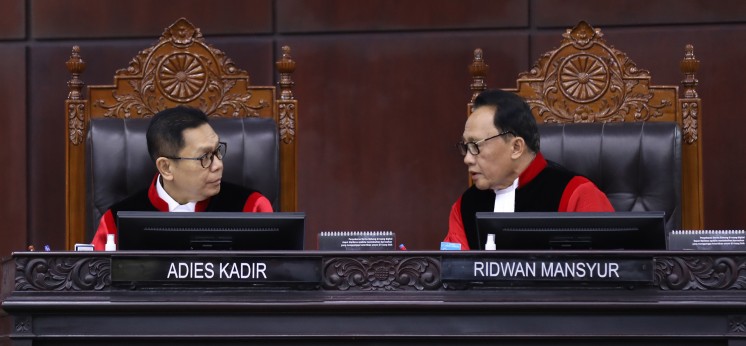
Justices Ridwan Mansyur and Adies Kadir during the Decision Pronouncement Hearing of the material judicial review of Law No. 7 of 2017 on General Elections on Monday (02/03). Photo by MKRI/Ifa.
Jakarta (MKRI) - The Constitutional Court has declared inadmissible a material judicial review of Article 240 paragraph (1) letter n of Law No. 7 of 2017 on General Elections. Chief Justice Suhartoyo announced the ruling in Decision No. 43/PUU-XXIV/2026 at a plenary hearing on Monday, March 2, 2026.
“The petition is inadmissible,” Chief Justice Suhartoyo said as he read out the decision.
In the Court’s legal considerations, Justice Ridwan Mansyur explained that petitum points 2 and 3 were ambiguously drafted. Both asked the Court to interpret Article 240 paragraph (1) letter n of the General Election Law, but point 2 began with the standard formula that the provision “is contrary to the 1945 Constitution and has no binding legal force insofar as it is interpreted to mean…,” while point 3 opened with the phrase “remains valid and binding insofar as it is interpreted to mean…,” and was not phrased in the usual format required under Constitutional Court Regulation No. 7 of 2025.
The wording of petitum points 2 and 3 is therefore unclear as to whether they are meant to operate cumulatively or as alternative requests. If points 2 and 3 are intended as alternative petitums, an alternative structure must be made by inserting the word “or” between petitum point 2 and petitum point 3.
“By inserting the word ‘or’, the Court can then choose one of the two petitums, in casu petitum points 2 and 3, that it considers relevant in light of the constitutionality of the norm being reviewed,” Justice Ridwan said.
Within reasonable limits of legal reasoning, given how petitum points 2 and 3 are drafted, the Court cannot grant a petition whose petitum is formulated cumulatively but is internally contradictory.
Also read:
Questioning Party Membership Requirement to Run as Legislative Candidate
Petitioners Revise Petition on Candidacy Requirements for DPR and Regional Council Members
Yudi Syamhudi Suyuti, as Petitioner I, and Adrianne Thaliandra, as Petitioner II, have filed a petition for material judicial review of Article 240 paragraph (1) letter n of Law No. 7 of 2017 on General Elections (General Election Law).
They argued that the party membership requirement set out in Article 240 paragraph (1) letter n of the General Election Law exceeds constitutional limits because it violates morality and rationality and creates intolerable injustice.
They added that with the inclusion of letter n, the Petitioners believe it has become an obstacle to improving the DPR and DPRD as representative bodies for segments of the people or community groups who are not members of political parties, as detailed in this petition. Therefore, the Petitioners ask the Court to review the norm so that the Court may establish a new law.
In their petition, the Petitioners argue that this provision conflicts with Article 1 paragraph (2) of the 1945 Constitution, which affirms that sovereignty is in the hands of the people. They contend that the requirement to be a party member in order to stand as a candidate for the DPR or DPRD restricts citizens’ right to directly represent the people’s interests.(*)
Case tracking: Petition No. 43/PUU-XXIV/2026 (in Indonesian)
Decision No. 43/PUU-XXIV/2026 (in Indonesian)
Author: Utami Argawati
Editor: Lulu Anjarsari P.
PR: Andhini S.F.
Translator: Rizky Kurnia Chaesario
Disclaimer: The original version of the news is in Indonesian. In case of any differences between the English and the Indonesian versions, the Indonesian version will prevail.
Monday, March 02, 2026 | 13:10 WIB 75