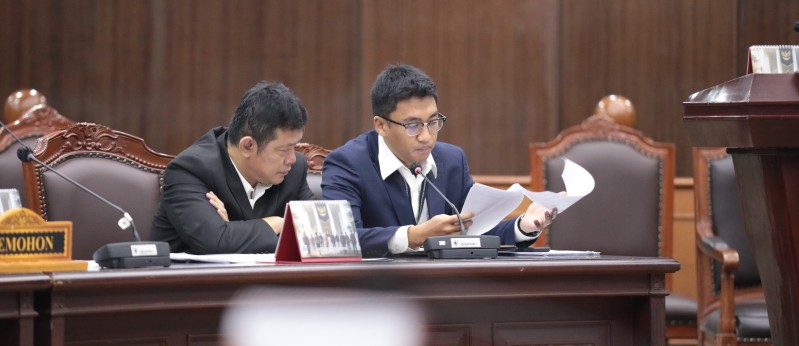
Petitioners of the General Election Law review delivering the main points of the petition during the preliminary hearing on Thursday (05/02). Photo by MKRI/IlhamWM.
Jakarta (MKRI) - Yudi Syamhudi Suyuti, as Petitioner I, and Adrianne Thaliandra, as Petitioner II, have filed a petition for judicial review of Article 240 paragraph (1) letter n of Law No. 7 of 2017 on General Elections (General Election Law). At the hearing chaired by Chief Justice Suhartoyo and accompanied by Justices Daniel Yusmic P. Foekh and M. Guntur Hamzah, the Petitioners appeared without legal counsel.
Yudi Syamhudi Suyuti stated that the filing of this case is permitted under Article 60 of the Constitutional Court Law in conjunction with Article 78 paragraph (2) of Constitutional Court Regulation No. 2 of 2021, which allows a renewed review of statutory norms previously examined by the Court, provided there are new grounds or arguments.
“Article 60 of the Constitutional Court Law, in conjunction with Article 78 paragraph (2) of Constitutional Court Regulation No. 2 of 2021, allows the Petitioners to refile a material review of provisions, articles, and/or parts of a law that have been reviewed by the Court. Paragraph (2) reads: the provisions as referred to in paragraph (1) may be exempted if the constitutional provisions invoked as the basis of review differ or if there are different grounds for the petition,” Yudi said, reading out Petition No. 43/PUU-XXIV/2026.
Russell Victory Satria, another Petitioner, argued that the party membership requirement set out in Article 240 paragraph (1) letter n of the General Election Law exceeds constitutional limits because it violates morality and rationality and creates intolerable injustice.
“With the inclusion of letter n, the Petitioners believe it has become an obstacle to improving the DPR and DPRD as representative bodies for segments of the people or community groups who are not members of political parties, as detailed in this petition. Therefore, the Petitioners ask the Court to review the norm so the Court may establish new law,” Yudi said in the preliminary hearing held on Thursday, February 5, 2026, afternoon.
In their petition, the Petitioners argue that this provision conflicts with Article 1 paragraph (2) of the 1945 Constitution, which affirms that sovereignty is in the hands of the people. They contend that the requirement to be a party member in order to stand as a candidate for the DPR or DPRD restricts citizens’ right to directly represent the people’s interests.
The Petitioners also present sociological and political arguments, drawing on the historical development of representative institutions, the evolution of democracy, and current socio-political conditions. They believe the formation of a “People’s Fraction” (Fraksi Rakyat) could strengthen public participation in state decision-making and balance the power of party factions with that of community representatives.
In addition, the Petitioners argue that the party membership requirement is inconsistent with human rights principles under Article 21 paragraph (1) of the Universal Declaration of Human Rights, which guarantees everyone the right to take part in government, either directly or through freely chosen representatives.
The Petitioners also highlight Indonesia’s independence struggle, which involved numerous non-party groups. They argue that a purely party-based representation system risks diminishing comprehensive public representation. On this basis, they request the Court to declare Article 240 paragraph (1) letter n of the General Election Law unconstitutional and without binding legal force.
Justice M. Guntur Hamzah offered guidance on revising the petition. He advised the Petitioners to review Petition No. 40/PUU-XXIV/2026, which was heard concurrently.
“Petition 40/PUU-XXIV/2026 already complies with the standard of Constitutional Court Regulation No. 7 of 2025. Petition 43 is still not quite right. To draft it, you can take Petition 40 as a close example, or look for another. Then, for Petition 43, if the subject is strictly letter n, then limit it to that. Otherwise, it will not match the petitum, so keep it specific,” Justice Guntur stressed.
At the close of the hearing, the Panel of Justices gave the Petitioners 14 days to revise their petition. The revised petition must be submitted by Wednesday, February 18, 2026, at 12.00 Western Indonesia Time.
Author: Utami Argawati
Editor: Lulu Anjarsari P.
PR: Andhini S.F.
Translator: Rizky Kurnia Chaesario
Disclaimer: The original version of the news is in Indonesian. In case of any differences between the English and the Indonesian versions, the Indonesian version will prevail.
Thursday, February 05, 2026 | 16:24 WIB 109