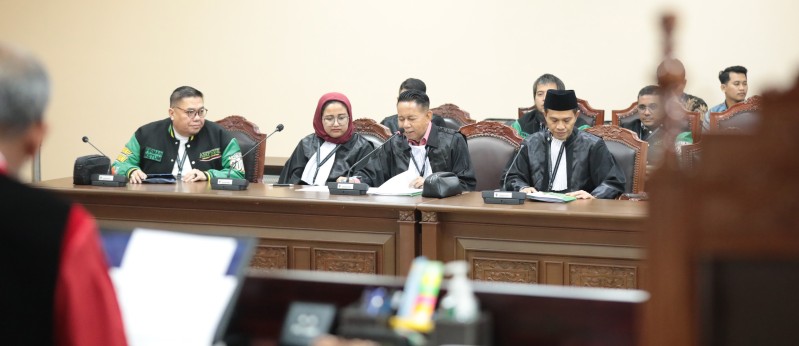
The Petitioner’s legal team presenting the revisions to the petition against Law No. 14 of 2025 on Hajj and Umrah, Monday (2/23/2026). Photo by MKRI/Ilham W. M.
JAKARTA (MKRI) — The Coalition for the Protection of Umrah-Hajj Pilgrimage and Ecosystem has presented the revisions to petition No. 47/PUU-XXIV/2026 for the judicial review of Law No. 14 of 2025 on the Third Amendment to Law No. 8 of 2019 on the Administration of Hajj and Umrah. They have removed and added several provisions under review from their previous petition. The challenged provisions now consist of Article 86 paragraph (1) letter b, Article 87A, Article 88A, Article 96 paragraph (5) letters d and e, Article 97 paragraph (1) and paragraph (2) letters b and d, as well as Article 110 paragraph (1) and paragraph (2) letters b and d.
“The constitutional grounds for review remain the same, Your Honors—namely Article 27 paragraph (1), Article 28D paragraph (1), Article 28G paragraph (1), Article 28I paragraph (4), and Article 29 paragraph (2) of the 1945 Constitution,” stated the Petitioners’ counsel, Firman Adi Candra
The arguments of the petition have likewise been adjusted in accordance with the amended object of review and the constitutional provisions invoked as the basis for judicial review under the 1945 Constitution. Corresponding revisions have also been made to the petitums of the petition.
The coalition consists of the Association of Muslim Hajj-Umrah Organizers of the Republic of Indonesia (Amphuri), represented by chairman Firman M. Nur; PT Nasuha Yassinta Jaya Abadi, represented by director M. Firmansyah; and Ustadz Akhmad Barakwan as an individual petitioner. They contend that the provisions under review give rise to a lack of legal certainty regarding the implementation of independent umrah.
Furthermore, the Petitioners contended that Article 86 paragraph (1) letter b of the Hajj and Umrah Law opens space for the implementation of independent umrah without placing it within a licensing and supervisory regime equivalent to that applicable to umrah travel organizers. This norm creates a dualism of legal regimes that results in unequal legal treatment between legal subjects in similar situations.
Also read: Coalition Seeks Equal Protection for Independent Umrah
The Petitioners also view Articles 87A and 88A of the Hajj and Umrah Law as failing to adequately regulate service standards, supervisory mechanisms, and sanctions in the administration of independent umrah. This lack of regulation gives rise to a legal vacuum and is contrary to the principle of a state governed by law, which requires the State to be present through regulation, supervision, and protection of citizens.
In addition, according to the Petitioners, independent umrah does not receive protection equivalent to that afforded to PPIU pilgrims as regulated in Article 96 paragraph (5) letters d and e and paragraph (6) of the Hajj and Umrah Law, and there are normative contradictions in the regulation of independent umrah. This is considered a form of denial of the State’s constitutional obligation to provide legal protection and a sense of security to citizens.
The Petitioners also challenge Article 97 of the Hajj and Umrah Law, which does not regulate a transitional period or a deadline for the issuance of implementing regulations concerning independent umrah. The absence of such transitional arrangements creates serious legal uncertainty and poses a high risk to the implementation of the norm.
In their petitums, the Petitioners request the Court to declare the articles being petitioned unconstitutional and not legally binding insofar as they are not interpreted as they proposed.
Explore case No. 47/PUU-XXIV/2026 (in Indonesian).
Author : Mimi Kartika
Editor : Lulu Anjarsari P.
PR : Fauzan Febriyan
Translator : Yuniar Widiastuti (NL)
Disclaimer: The original version of the news is in Indonesian. In case of any differences between the English and the Indonesian versions, the Indonesian version will prevail.
Monday, February 23, 2026 | 14:21 WIB 212