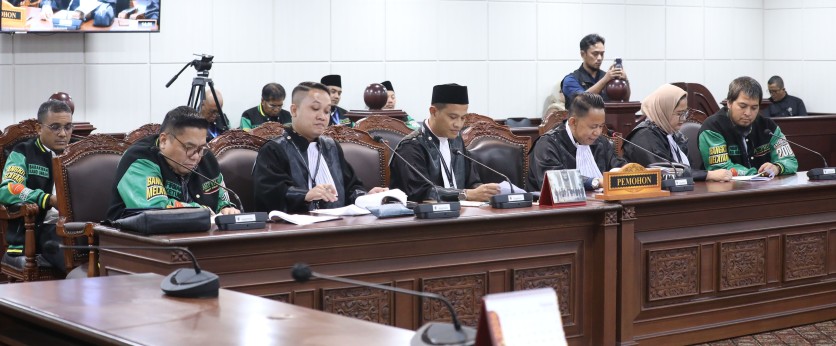
Association of Muslim Hajj-Umrah Organizers and their counsels presenting their petition against Law No. 14 of 2025 on Hajj and Umrah, Monday (2/9/2026). Photo by MKRI/Panji.
JAKARTA (MKRI) — The Coalition for the Protection of Umrah-Hajj Pilgrimage and Ecosystem has filed a petition for the judicial review of Article 1, Article 86 paragraph (1) letter b, Article 87A, Article 88A, Article 96 paragraph (5) letters d and e, and Article 97 of Law No. 14 of 2025 on the Third Amendment to Law No. 8 of 2019 on the Administration of Hajj and Umrah to the Constitutional Court. They contend that the provisions under review give rise to a lack of legal certainty regarding the implementation of independent umrah.
“Article 1 of the Law a quo does not contain a definition or explanation of independent umrah, even though the term is used repeatedly, systematically, and determinatively in various subsequent provisions, thereby creating a normative vacuum at the level of general provisions,” said the Petitioners’ counsel Firman Adi Candra at the preliminary hearing of Case No. 47/PUU-XXIV/2026 on Monday, February 9, 2026 in the Court’s plenary courtroom.
The coalition consists of the Association of Muslim Hajj-Umrah Organizers of the Republic of Indonesia (Amphuri), represented by chairman Firman M. Nur; PT Nasuha Yassinta Jaya Abadi, represented by director M. Firmansyah; and Ustadz Akhmad Barakwan as an individual petitioner.
They argued that the absence of a definition of independent umrah in Article 1 of the Hajj and Umrah Law has direct implications for the pattern of umrah worship, the legal relationship between pilgrims and umrah travel organizers (PPIU), as well as the State’s responsibility to protect umrah pilgrims. This absence of a normative definition creates legal uncertainty, opens room for diverse interpretations, and contradicts the principle of lex certa and the principle of clarity of formulation of legal norms, as consistently emphasized in the Court’s practice and decisions.
Furthermore, the Petitioners contended that Article 86 paragraph (1) letter b of the Hajj and Umrah Law opens space for the implementation of independent umrah without placing it within a licensing and supervisory regime equivalent to that applicable to umrah travel organizers. This norm creates a dualism of legal regimes that results in unequal legal treatment between legal subjects in similar situations.
The Petitioners also view Articles 87A and 88A of the Hajj and Umrah Law as failing to adequately regulate service standards, supervisory mechanisms, and sanctions in the administration of independent umrah. This lack of regulation gives rise to a legal vacuum and is contrary to the principle of a state governed by law, which requires the State to be present through regulation, supervision, and protection of citizens.
In addition, according to the Petitioners, independent umrah does not receive protection equivalent to that afforded to PPIU pilgrims as regulated in Article 96 paragraph (5) letters d and e and paragraph (6) of the Hajj and Umrah Law, and there are normative contradictions in the regulation of independent umrah. This is considered a form of denial of the State’s constitutional obligation to provide legal protection and a sense of security to citizens.
The Petitioners also challenge Article 97 of the Hajj and Umrah Law, which does not regulate a transitional period or a deadline for the issuance of implementing regulations concerning independent umrah. The absence of such transitional arrangements creates serious legal uncertainty and poses a high risk to the implementation of the norm.
In their petitums, the Petitioners requested the Court to declare Article 1, Article 86 paragraph (1) letter b, Article 87A, Article 88A, Article 96 paragraph (5) letters d and e, and Article 97 of the Hajj and Umrah Law unconstitutional and not legally binding insofar as they are not interpreted as proposed by the Petitioners. Among other things, the Petitioners sought for Article 1 of the Hajj and Umrah Law to contain a clear, firm, and specific definition of independent umrah, and for the administration of umrah worship to be carried out within a governance framework that guarantees the safety, security, and legal certainty of pilgrims through Article 97 of the Hajj and Umrah Law.
The petition was heard by a panel comprising by Deputy Chief Justice Saldi Isra (chair) and Constitutional Justices Ridwan Mansyur and Adies Kadir. During the advisory session, Justice Ridwan stated that the Petitioners had not sufficiently elaborated the impairment of their constitutional rights and the causal relationship between the contested norms and the provisions of the 1945 Constitution used as the benchmark for review.
“This also concerns the inequality mentioned earlier, creating an imbalanced and discriminatory legal regime, thereby causing harm to Petitioner I, Petitioner II, and Petitioner III—but it is not yet clear where that causal link lies; the causa verband is not apparent, as far as I can see,” he said.
Before adjourning the hearing, Deputy Chief Justice Saldi announced that the Petitioners would have 14 days to revise the petition, whose softcopy and hardcopy must be resubmitted no later than 12:00 WIB on Monday, February 23, 2026.
Explore case No. 47/PUU-XXIV/2026 (in Indonesian).
Author : Mimi Kartika
Editor : Lulu Anjarsari P.
PR : Fauzan Febriyan
Translator : Yuniar Widiastuti (NL)
Disclaimer: The original version of the news is in Indonesian. In case of any differences between the English and the Indonesian versions, the Indonesian version will prevail.
Monday, February 09, 2026 | 16:25 WIB 98