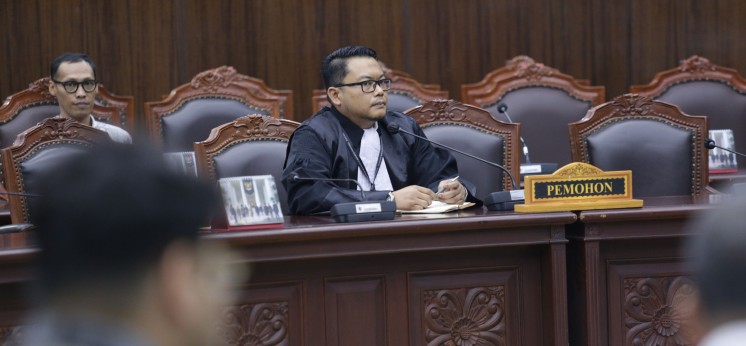
Case No. 210/PUU-XXIII/2025 on the judicial review of Law No. 7 of 2020 of the Constitutional Court being postponed, Wednesday (2/11/2026). Photo by MKRI/Bayu.
JAKARTA (MKRI) — The Constitutional Court held another hearing for the material judicial review of Law No. 7 of 2020 on the Third Amendment to Law No. 24 of 2003 on the Constitutional Court on Wednesday, February 11, 2026. This sixth hearing for Case No. 210/PUU-XXIII/2025 had been scheduled to hear statements from the expert and witness presented by Marzuki Darusman, Fatia Nadia, Muhammad Busyro Muqoddas, and Trisno Raharjo (Petitioners I-IV).
“In fact, today’s hearing was scheduled to hear testimonies of expert and witness presented by the Petitioner. However, based on the letter submitted, they requested a postponement as they were not yet prepared. Therefore, the panel has granted the request and rescheduled the hearing for Wednesday, February 25, 2026, at 10:00 WIB,” explained Chief Justice Suhartoyo, who presided over the hearing in the plenary courtroom.
Right of Recusal
At the hearing, counsel Dudy Agung Trisna stated that he had submitted a letter requesting Constitutional Justice Adies Kadir to exercise the right of recusal. “We have also submitted a letter requesting [the exercise of] the right of recusal for Mr. Adies Kadir, Your Honors,” Dudy said before the Chief Justice Suhartoyo and members of the panel.
In response, Chief Justice Suhartoyo stated that the request would be taken into consideration, while also explaining the application of the request for recusal. “The right of recusal is exercised at the time of deliberation and decision-making. During the ongoing trial process, we cannot prohibit one or more justices from participating in or being involved in the proceedings. If, at the conclusion of the proceedings when the Court is to render its decision, the recusal request is found to be without merit, or the justice concerned chooses not to exercise the right of recusal, it could give rise to a presumption of guilt, effectively placing blame on someone prematurely. Therefore, the judicial process will continue with full participation. This applies equally to all justices,” he elaborated.
Also read:
Citizens Ask to Be Able to File Petitions on Institutional Authority Dispute
Petitioners Seeking to File Petition on Institutional Authority Dispute Affirm Legal Standing
Hearing on Standing to File Institutional Authority Dispute Petition Postponed
Govt: Allowing Citizens to File SKLN Petitions Could Politicize Constitutional Jurisdiction
House: Expanding SKLN Subject Could Alter Indonesian Constitutional System
The Petitioners challenge Article 61 paragraph (1) of the Constitutional Court Law. They believe it is inconsistent with Article 24C paragraph (1), Article 28D paragraph (1), and Article 281 paragraph (4) of the 1945 Constitution. Article 61 paragraph (1) provides that “A petitioner shall be a state institution whose authority is granted by the 1945 Constitution of the Republic of Indonesia and which has a direct interest in the disputed authority.”
The Petitioners contend that in exercising its authority to resolve disputes over the powers of state institutions, the Court has demonstrated its ability to concretely decide issues of authority arising between two state institutions. Therefore, to enhance the significance of this authority, the Court should also allow citizens to submit petitions regarding disputes over the powers of state institutions—particularly where such powers have factually and specifically resulted in constitutional harm to citizens.
Based on these arguments, the Petitioners assert that citizens should also have the right to submit petitions disputing the authority of state institutions (vide Article 10 paragraph (1) letter b), which limits who may act as petitioners, and Article 61 paragraph (1) further specifies that only state institutions may do so. In short, such provisions restrict citizens’ right to defend their constitutional rights.
Therefore, the Petitioners request that the Court provide an interpretation and clarification as to who may file a constitutional complaint. Accordingly, any citizen whose constitutional rights have been violated by a state institution in the exercise of its authority should be able to file a constitutional complaint regarding disputes over the powers of state institutions.
Explore case No. 210/PUU-XXIII/2025 (in Indonesian).
Author : Sri Pujianti
Editor : Lulu Anjarsari P.
PR : Fauzan Febriyan
Translator : Yuniar Widiastuti (NL)
Disclaimer: The original version of the news is in Indonesian. In case of any differences between the English and the Indonesian versions, the Indonesian version will prevail.
Wednesday, February 11, 2026 | 12:05 WIB 84