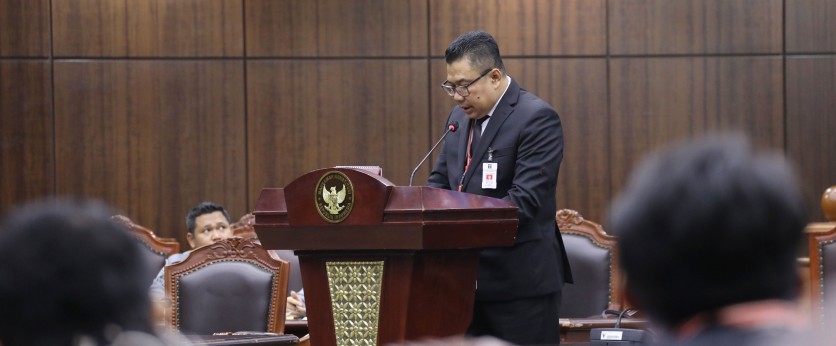
Law Ministry advisor for inter-institutional affairs and bureaucratic reform Sucipto testifying on behalf of the Government at a judicial review hearing of the Constitutional Court Law, Tuesday (1/20/2026). Photo by MKRI/Panji.
JAKARTA (MKRI) — Granting legal standing to citizens as petitioners in disputes over the authority of state institutions (SKLN) could potentially trigger an exponential increase in cases, which would be disproportionate to the institutional capacity of the Constitutional Court, said the Law Ministry advisor for inter-institutional affairs and bureaucratic reform Sucipto representing the Government at a hearing for the judicial review of Law No. 7 of 2020 on the Third Amendment to Law No. 24 of 2003 on the Constitutional Court on Tuesday January 20, 2026. This fourth hearing for Case No. 210/PUU-XXIII/2025 was to hear statements from the House of Representatives (DPR) and representatives of the Government/President; however, the House was unable to attend.
With respect to the petition, the Government is of the view that the resulting increase in the Constitutional Court’s caseload would risk diverting it from its role as the guardian of the Constitution, particularly in the context of constitutional review of statutes, thereby diminishing the quality of its decisions and the effectiveness of constitutional adjudication. Referring to data available on the official website mkri.id, Sucipto noted that in 2025 the total number of constitutional review cases reached 284, the majority of which are still under examination in 2026.
“Accordingly, opening access to SKLN petitions for citizens would also allow for the politicization of constitutional adjudication and potentially deviate from its original function as a forum for resolving disputes over constitutional authority,” Sucipto stated from the Court’s plenary courtroom.
Furthermore, he explained that, from the perspective of proportionate governance under the rule of law, strengthening the administrative courts and optimizing existing legal protection mechanisms constitute more effective and constitutional solutions than fundamentally expanding the scope of SKLN. Therefore, maintaining Article 61 paragraph (1) of the Constitutional Court Law as a constitutional norm is a choice that aligns with legal certainty, institutional efficiency, and the balanced protection of citizens’ constitutional rights.
Consequences of Constitutional Court’s Authority
With regard to the authority to adjudicate constitutional complaints, the Government stated that such authority is not regulated under the 1945 Constitution of the Republic of Indonesia, nor does the Constitution contain any norm granting the Constitutional Court the power to examine individual complaints against state actions. The authority of the Constitutional Court is attributive and limitative, confined to what is regulated and conferred by the 1945 Constitution. Accordingly, the Petitioners’ effort to transform SKLN into a constitutional complaint mechanism essentially constitutes an expansion of the Court’s authority beyond the constitutional and statutory design. Moreover, the 1945 Constitution does not provide for a constitutional complaint mechanism. The absence of such authority is a consequence of the limitative nature of the Constitutional Court’s powers as stipulated in Article 24C paragraph (1) of the 1945 Constitution.
“In the minutes of the special committee meeting on the Constitutional Court Bill dated July 5, 2003, it is stated that the subjects entitled to act as petitioners in SKLN cases are only state institutions whose authorities are conferred by the Constitution,” Sucipto explained.
Also read:
Citizens Ask to Be Able to File Petitions on Institutional Authority Dispute
Petitioners Seeking to File Petition on Institutional Authority Dispute Affirm Legal Standing
Hearing on Standing to File Institutional Authority Dispute Petition Postponed
Marzuki Darusman, Fatia Nadia, Muhammad Busyro Muqoddas, and Trisno Raharjo (Petitioners I-IV) challenge Article 61 paragraph (1) of the Constitutional Court Law. They believe it is inconsistent with Article 24C paragraph (1), Article 28D paragraph (1), and Article 281 paragraph (4) of the 1945 Constitution. Article 61 paragraph (1) provides that “A petitioner shall be a state institution whose authority is granted by the 1945 Constitution of the Republic of Indonesia and which has a direct interest in the disputed authority.”
The Petitioners contend that in exercising its authority to resolve disputes over the powers of state institutions, the Court has demonstrated its ability to concretely decide issues of authority arising between two state institutions. Therefore, to enhance the significance of this authority, the Court should also allow citizens to submit petitions regarding disputes over the powers of state institutions—particularly where such powers have factually and specifically resulted in constitutional harm to citizens.
Based on these arguments, the Petitioners assert that citizens should also have the right to submit petitions disputing the authority of state institutions (vide Article 10 paragraph (1) letter b), which limits who may act as petitioners, and Article 61 paragraph (1) further specifies that only state institutions may do so. In short, such provisions restrict citizens’ right to defend their constitutional rights.
Therefore, the Petitioners request that the Court provide an interpretation and clarification as to who may file a constitutional complaint. Accordingly, any citizen whose constitutional rights have been violated by a state institution in the exercise of its authority should be able to file a constitutional complaint regarding disputes over the powers of state institutions.
Explore case No. 210/PUU-XXIII/2025 (in Indonesian).
Author : Sri Pujianti
Editor : Lulu Anjarsari P.
PR : Fauzan Febriyan
Translator : Yuniar Widiastuti (NL)
Disclaimer: The original version of the news is in Indonesian. In case of any differences between the English and the Indonesian versions, the Indonesian version will prevail.
Tuesday, January 20, 2026 | 15:00 WIB 105