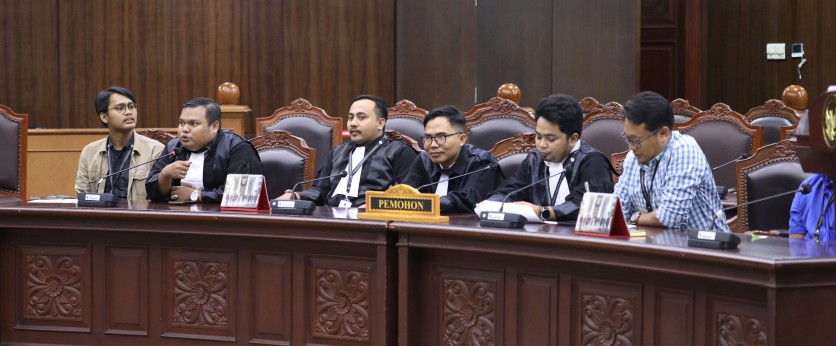
The Petitioner and their counsels at the second hearing for the judicial review of the Election Law for Case No. 37/PUU-XXIV/2026, Wednesday (2/11/2026). Photo by MKRI/Panji.
JAKARTA (MKRI) — The organization Kawal Pemilu dan Demokrasi Indonesia (lit. Safeguarding Elections and Indonesian Democracy) presented the revisions to their judicial review petition of Article 414 paragraph (1) of Law No. 7 of 2017 on General Elections, as reinterpreted through Constitutional Court Decision No. 116/PUU-XXI/2023. The Petitioner, represented by chairman Miftahol Arifin and secretary-general Abd. Adim, emphasized that the legal uncertainty, which underlies their key argument for Case No. 37/PUU-XXIV/2026, came about since the pronouncement of Decision No. 116/PUU-XXI/2023 on February 29, 2024.
“This legal uncertainty relates to the absence of an upper limit of threshold as determined by the legislatures,” said the Petitioner’s counsel Sipghotulloh Mujaddidi at the petition revision hearing on Wednesday, February 11, 2026.
Also read: Election Activists Call for Maximum Parliamentary Threshold of 2.5 Percent
Article 414 paragraph (1) of the Election Law stipulates: “A political party contesting in a legislative election must reach the electoral threshold, which is 4% (four percent) of the national number of valid votes, in order to be included in the seat allocation for DPR members.”
However, Constitutional Court Decision No. 116/PUU-XXI/2023 declared Article 414 paragraph (1) of the Election Law constitutional insofar as it continues to apply to the 2024 DPR election, and conditionally constitutional for application to the 2029 DPR election and subsequent elections, provided that amendments are made to the parliamentary threshold norm and to the amount or percentage of the parliamentary threshold in accordance with the prescribed requirements.
The Petitioner argued that the said decision does not establish a constitutionally permissible maximum parliamentary threshold. The absence of such a constitutional ceiling gives rise to tangible legal uncertainty, as the lawmakers have very broad discretion to increase the threshold without clear constitutional guardrails.
Meanwhile, the majority of political parties in discussions on amending the Election Law do not wish to lower the parliamentary threshold. Some parties have even proposed increasing the threshold to 5 percent, 7 percent, or as high as 8 percent.
The Petitioner admitted to have submitted the Constitutional Court’s legal considerations relating to this issue to the House of Representatives (DPR). However, the discourse on not reducing the threshold came to the surface, thus compelling them to file this petition to the Court.
According to the Petitioner, the parliamentary threshold should not exceed 2.5 percent. Therefore, in the petitums, the Petitioner requests that the Court declare Article 414 paragraph (1) of the Election Law, as reinterpreted through Constitutional Court Decision No. 116/PUU-XXI/2023, conditionally constitutional to apply in the 2029 DPR election and subsequent elections insofar as an amendment has been made to the parliamentary threshold, with it not exceeding 2.5 percent, and with reference to the prescribed requirements.
Explore case No. 37/PUU-XXIV/2026 (in Indonesian).
Author : Mimi Kartika
Editor : N. Rosi
Translator : Yuniar Widiastuti (NL)
Disclaimer: The original version of the news is in Indonesian. In case of any differences between the English and the Indonesian versions, the Indonesian version will prevail.
Wednesday, February 11, 2026 | 17:48 WIB 170