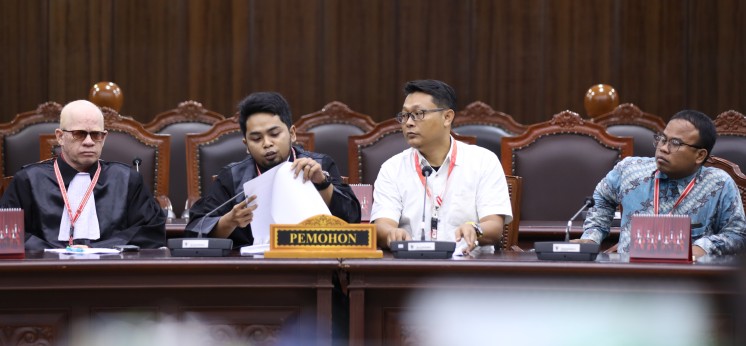
Kawal Pemilu dan Demokrasi Indonesia (Petitioner) at the preliminary hearing for the judicial review of the Election Law for Case No. 37/PUU-XXIV/2026, Thursday (1/29/2026). Photo by MKRI.
JAKARTA (MKRI) — An organization called Kawal Pemilu dan Demokrasi Indonesia (lit. Safeguarding Elections and Indonesian Democracy), represented by chairman Miftahol Arifin and secretary-general Abd. Adim, has challenged the constitutionality of Article 414 paragraph (1) of Law No. 7 of 2017 on General Elections to the Constitutional Court. In Case No. 37/PUU-XXIV/2026, they assert that the article has not regulated the upper limit of the parliamentary threshold, thus allowing for fluctuations of the threshold in the discussion of the amendment to the Election Law.
Article 414 paragraph (1) of the Election Law stipulates: “A political party contesting in a legislative election must reach the electoral threshold, which is 4% (four percent) of the national number of valid votes, in order to be included in the seat allocation for DPR members.” However, Constitutional Court Decision No. 116/PUU-XXI/2023 declared Article 414 paragraph (1) of the Election Law constitutional insofar as it continues to apply to the 2024 DPR election, and conditionally constitutional for application to the 2029 DPR election and subsequent elections, provided that amendments are made to the parliamentary threshold norm and to the amount or percentage of the parliamentary threshold in accordance with the prescribed requirements.
“Nevertheless, Decision 116 does not establish a constitutionally permissible maximum parliamentary threshold. The absence of such a constitutional ceiling gives rise to tangible legal uncertainty, as the lawmakers have very broad discretion to increase the threshold without clear constitutional guardrails,” stated the Petitioner’s counsel Sipghotulloh Mujaddidi at the preliminary hearing in the courtroom on Thursday, January 29, 2026.
According to the Petitioner, the parliamentary threshold should not exceed 2.5 percent. By contrast, the existing 4 percent parliamentary threshold has created disproportionality within the electoral system, as millions of votes have been rendered ineffective and cannot be converted into seats due to the 4 percent threshold requirement.
Meanwhile, the majority of political parties in discussions on amending the Election Law do not wish to lower the parliamentary threshold. Some parties have even proposed increasing the threshold to 5 percent, 7 percent, or as high as 8 percent.
Yet, the Petitioner continued, the Constitutional Court’s decision was grounded in the consideration that setting the amount or percentage of the parliamentary threshold without a clear method, calculation, or rational justification—together with the empirical reality of the 4 percent threshold—has resulted in disproportionality within the electoral system, because voters’ ballots cannot be converted into seats due to the threshold in question. The fluctuation of proposed threshold levels in the discourse on revising the Election Law serves as evidence that the constitutional parameters articulated in the Constitutional Court’s decision continue to leave room for legal uncertainty and multiple interpretations, as they do not address fundamental issues such as the constitutionally justifiable level of the threshold or the degree of vote disproportionality that can be tolerated in pursuit of political party simplification.
According to the Petitioner, in the absence of constitutional answers to these issues, lawmakers may continue to maintain or even raise the parliamentary threshold to extreme levels “in the name of simplification,” “in the name of sustainability,” or “in the name of public participation,” even though doing so would cause millions more votes to be wasted because they cannot be converted into seats in the House. Ultimately, this would undermine democratic principles that place sovereignty in the hands of the people, as stipulated in Article 1 paragraph (2) of the 1945 Constitution.
In the petitums, the Petitioner requests that the Court declare Article 414 paragraph (1) of the Election Law unconstitutional and not legally binding insofar as it is not interpreted to mean that “amendments must be made to the parliamentary threshold norm, with the parliamentary threshold not exceeding 2.5 percent, and with reference to the prescribed requirements.”
The petition was heard by a panel of justices chaired by Chief Justice Suhartoyo, with Constitutional Justices Daniel Yusmic P. Foekh and M. Guntur Hamzah sitting as members. During the advisory session, Justice Guntur stated that the Petitioner could submit an academic study of the arguments contained in the petition to the House (DPR), in light of the planned revision of the Election Law and following Constitutional Court Decision No. 116/PUU-XXI/2023, which has reinterpreted Article 414 paragraph (1) of the Election Law.
“But if you wish to proceed with this petition, then present the arguments as to why the Court need not wait for what it itself required in Decision 116, and why you seek the Court to decide this case now—what grounds lead you to believe that the Court should rule on this matter,” Justice Guntur stated.
At the end of the session, Chief Justice Suhartoyo announced that the Petitioner would have 14 days to revise the petition. The revised softcopy or hardcopy of the petition must have been received by the Court no later than 12:00 WIB on Wednesday, February 11, 2026.
Explore case No. 37/PUU-XXIV/2026 (in Indonesian).
Author : Mimi Kartika
Editor : N. Rosi
Translator : Yuniar Widiastuti (NL)
Disclaimer: The original version of the news is in Indonesian. In case of any differences between the English and the Indonesian versions, the Indonesian version will prevail.
Thursday, January 29, 2026 | 16:24 WIB 263