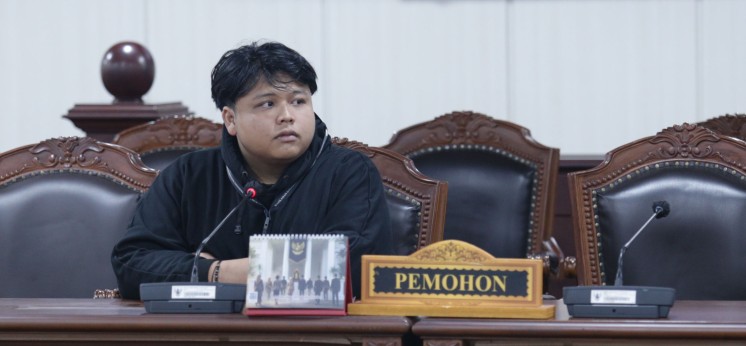
The Petitioners confirming the withdrawal of petition No. 15/PUU-XXIV/2026 on Law No. 1 of 2015 on Regional Elections, Friday (2/6/2026). Photo by MKRI/Bayu.
JAKARTA (MKRI) — The Petitioners of Case No. 15/PUU-XXIV/2026 have decided to withdraw their petition on the constitutionality of Article 143 paragraph (3) letter b of Law No. 1 of 2015 on the Election of Governors, Regents, and Mayors (Regional Head Election/Pilkada Law. They made the confirmation at the hearing initially scheduled to examine the revisions to the petition on Friday, February 6, 2026.
Chair of the panel, Constitutional Justice Enny Nurbaningsih, asked for confirmation of the withdrawal request. “Is it true? Do all three (petitioners) wish to withdraw? Have you signed [the request]?” she asked.
Only one of the Petitioners—Alexander Muhammad Naabil (Petitioners III)—attended the hearing to make confirmation of the withdrawal request. Meanwhile, Azriel Rafi Raditya and Naufal Naziih (Petitioners I-II), were absent.
“Yes, all three, Your Honor,” said Alexander.
Also read: Four Law Students Challenge Pilkada Law on Dispute Resolution by Deliberation
The Petitioners challenged the provision on the resolution of election disputes by the provincial Elections Supervisory Body (Bawaslu) and regency/city Elections Supervisory Committee (Panwaslu) through deliberation and consensus. They asserted that the regulation on resolving regional head election disputes through deliberation, as stipulated in Article 143 paragraph (3) letter b of the law a quo, gives rise to a number of systemic juridical and theoretical implications. The implications at issue are not limited to the technical aspects of dispute resolution, but also affect the overall legal construction of regional elections, including the fundamental principles of elections, the enforcement of electoral administrative norms, and the relations among actors in the administration of regional elections, they stressed.
According to the Petitioners, the implementation of Article 143 paragraph (3) letter b of the Regional Election Law allegedly results in a reduction of the principles of direct, general, free, confidential, honest, and fair elections (luberjurdil); a shift in determining the eligibility of prospective candidates from an imperative to a compromise-based approach; imbalances of power relations within deliberative forums; and the absence of guarantees of transparency and accountability in the conduct of deliberations. They argued that the challenged provision is contrary to Article 18 paragraph (4), Article 22E paragraph (1), and Article 28D paragraph (1) of the 1945 Constitution.
Article 143 paragraph (3) letter b of the Pilkada Law provides: “The Provincial Bawaslu and Regency/City Supervisory Committee shall resolve disputes through the following stages: … (b) bringing together the disputing parties to reach an agreement through deliberation and consensus.” In their petitums, the Petitioners request the Court to declare Article 143 paragraph (3) letter b of the Regional Election Law unconstitutional and without binding legal force insofar as it is not interpreted as “resolving disputes through adjudicatory proceedings.”
Explore case No. 15/PUU-XXIV/2026 (in Indonesian).
Author : Mimi Kartika
Editor : Lulu Anjarsari P.
PR : Fauzan Febriyan
Translator : Yuniar Widiastuti (NL)
Disclaimer: The original version of the news is in Indonesian. In case of any differences between the English and the Indonesian versions, the Indonesian version will prevail.
Friday, February 06, 2026 | 13:53 WIB 77