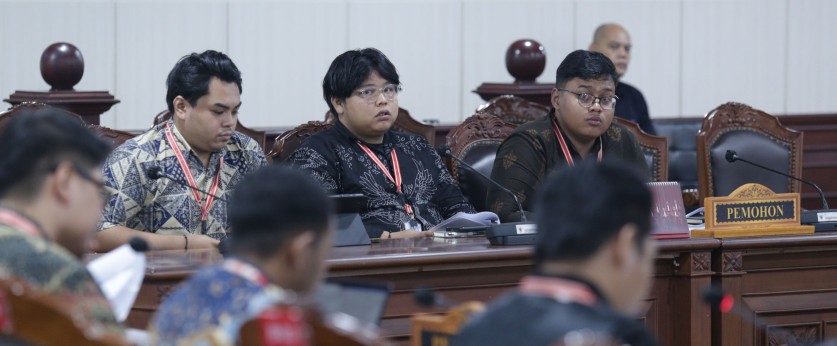
The Petitioners at the preliminary hearing for the judicial review of Law No. 1 of 2015 on Regional Elections for Case No. 15/PUU-XXIV/2026, Friday (1/23/2026). Photo by MKRI/Bayu.
JAKARTA (MKRI) — Four students of the Faculty of Law of Universitas Indonesia (FH UI) have filed a petition for the judicial review of Article 143 paragraph (3) letter b of Law No. 1 of 2015 on the Election of Governors, Regents, and Mayors (Regional Head Election/Pilkada Law) before the Constitutional Court. In Petition No. 15/PUU-XXIV/2026, the Petitioners challenge the provision on the resolution of election disputes by the provincial Elections Supervisory Body (Bawaslu) and regency/city Elections Supervisory Committee (Panwaslu) through deliberation and consensus.
“The regulation on resolving regional head election disputes through deliberation, as stipulated in Article 143 paragraph (3) letter b of the law a quo, gives rise to a number of systemic juridical and theoretical implications,” said Petitioner Azriel Rafi Raditya, alongside Naufal Naziih and Alexander Muhammad Naabil, at the preliminary hearing on Friday, January 23, 2026 in the courtroom. Another Petitioner, Bandaro Bani Adlan, was absent until the hearing concluded.
According to the Petitioners, the implications at issue are not limited to the technical aspects of dispute resolution, but also affect the overall legal construction of regional elections, including the fundamental principles of elections, the enforcement of electoral administrative norms, and the relations among actors in the administration of regional elections. The implementation of Article 143 paragraph (3) letter b of the Regional Election Law allegedly results in a reduction of the principles of direct, general, free, confidential, honest, and fair elections (luberjurdil); a shift in determining the eligibility of prospective candidates from an imperative to a compromise-based approach; imbalances of power relations within deliberative forums; and the absence of guarantees of transparency and accountability in the conduct of deliberations.
Article 143 paragraph (3) letter b of the Pilkada Law provides: “The Provincial Bawaslu and Regency/City Supervisory Committee shall resolve disputes through the following stages: … (b) bringing together the disputing parties to reach an agreement through deliberation and consensus.” The Petitioners argue that the challenged provision is contrary to Article 18 paragraph (4), Article 22E paragraph (1), and Article 28D paragraph (1) of the 1945 Constitution.
In practice, the resolution of election disputes by Bawaslu through deliberation is conducted behind closed doors and does not provide public access to the proceedings, considerations, or the bases of the parties’ agreement. This condition prevents open public oversight of the dispute resolution process and raises doubts as to the independence and impartiality of the outcomes achieved. In the context of elections as an expression of popular sovereignty, such closed proceedings are inconsistent with the principles of openness and accountability.
The closed nature of deliberation, as regulated by Article 30 paragraph (1) of Regulation of Bawaslu of the Republic of Indonesia No. 2 of 2020 on Procedures for Resolving Disputes in the Election of Governors and Vice Governors, Regents and Vice Regents, and Mayors and Vice Mayors, also creates broad opportunities for the intrusion of political interests, power relations, and administrative pressure that cannot be publicly controlled. In the absence of strict evidentiary mechanisms and of decisions containing explicit legal reasoning, the outcomes of mediation become difficult to scrutinize, both juridically and ethically. This situation is considered to have the potential to produce procedural unfairness for disadvantaged parties.
These concerns are further exacerbated in disputes over candidacy and administrative verification of regional election participants. In many cases, deliberations facilitated by Bawaslu have resulted in corrections, adjustments, or annulments of administrative decisions previously issued by election organizers, without prior substantive examination of alleged violations. In other words, the substance of objections or alleged violations underlying the dispute is not always thoroughly tested, but instead resolved through administrative compromise.
By contrast, adjudicatory or trial-based mechanisms ensure compliance with due process of law, including open hearings, equal opportunities for the parties to be heard, examination of evidence, and legal reasoning clearly articulated in decisions. Judicial proceedings also enable public oversight, thereby conferring stronger legal and democratic legitimacy on their outcomes.
The clarity of decisions produced through adjudication is a crucial aspect of resolving election disputes, as such decisions not only determine the legal fate of the parties, but also directly affect citizens’ political rights and the legitimacy of election results. Decisions accompanied by open and rational legal reasoning allow the public to understand the basis of decision-making and provide avenues for correction through further legal remedies.
Because disputes over the electoral process form part of public law and concern the exercise of popular sovereignty, their resolution cannot be entrusted solely to closed, agreement-based mechanisms. A state governed by the rule of law requires that such disputes be resolved through open, objective, and evidence-based adjudicatory mechanisms in order to guarantee procedural justice and legal certainty.
Accordingly, the Petitioners contend that the use of deliberation as the primary mechanism for resolving electoral process disputes, particularly as practiced by Bawaslu, is inconsistent with the principles of due process of law and openness. Therefore, electoral process disputes should be resolved through judicial or adjudicatory mechanisms that ensure transparency, fairness, and clarity of decisions, in line with the principles of a democratic rule-of-law state as guaranteed by the 1945 Constitution.
In their petitums, the Petitioners request the Court to declare Article 143 paragraph (3) letter b of the Regional Election Law unconstitutional and without binding legal force insofar as it is not interpreted as “resolving disputes through adjudicatory proceedings.”
The petition was examined by a panel consisting of Constitutional Justices Enny Nurbaningsih (chair), Anwar Usman, and M. Guntur Hamzah. During the advisory session, Justice Guntur stated that the Petitioners must elaborate their arguments regarding the inconsistency between the challenged provision and the articles of the 1945 Constitution invoked as the basis for review.
In addition, he emphasized that the Petitioners must clearly explain the intent of their request, given that the fourth precept of Pancasila reads: “Democracy lead by wisdom in Deliberation/Representation.” “Are we saying that deliberation and consensus are unconstitutional? You must challenge that notion by clarifying that the deliberation and consensus referred to here are not those contemplated by the fourth precept of Pancasila, but rather deliberation in the specific context of dispute resolution that promotes compromise,” Justice Guntur remarked.
Before adjourning the session, Justice Enny announced that the Petitioners would have 14 days to revise the petition. The revised petition, either softcopy or hardcopy, must be submitted to the Court no later than 12:00 WIB on Thursday, February 5, 2026.
Explore case No. 15/PUU-XXIV/2026 (in Indonesian).
Author : Mimi Kartika
Editor : N. Rosi
Translator : Yuniar Widiastuti (NL)
Disclaimer: The original version of the news is in Indonesian. In case of any differences between the English and the Indonesian versions, the Indonesian version will prevail.
Friday, January 23, 2026 | 13:01 WIB 92