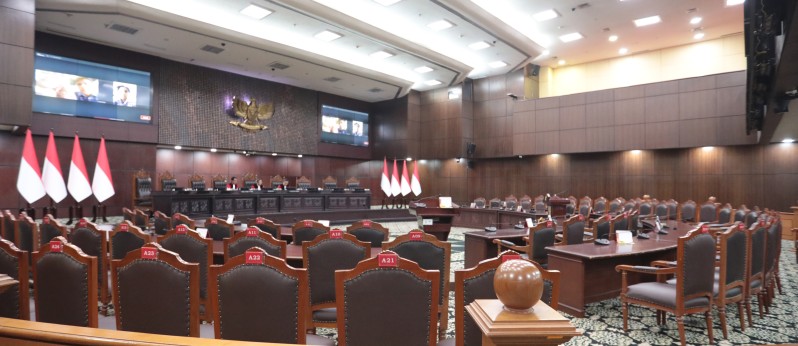
Petitioners in the judicial review of the Law on Financial Sector Development and Strengthening absent without valid reason at the preliminary hearing scheduled to examine revisions to their petition, Friday (2/6/2026). Photo by MKRI/IlhamWM.
JAKARTA (MKRI) — Chief Justice Suhartoyo once again chaired a follow-up hearing for the judicial review of Law No. 4 of 2023 on Financial Sector Development and Strengthening (P2SK Law) against the 1945 Constitution on Friday, February 6, 2026. Zahra Angelina Ismaryanti (Petitioner I), Gregorius David Susanto (Petitioner II), and Muhammad Khoirudin Umar Fahri (Petitioner III) were absent when the plenary hearing for Case No. 7/PUU-XXIV/2026 commenced in the Plenary Courtroom of the Constitutional Court.
The agenda of the hearing was to hear the principal revisions to the petition. However, none of the Petitioners appeared before the Court.
“The absence has been confirmed by the Registrar’s Office. We will report this matter in the justices’ deliberation meeting,” Chief Justice Suhartoyo stated during the hearing, accompanied by Constitutional Justices Daniel Yusmic P. Foekh and M. Guntur Hamzah.
Also read: Concerns over Personal Data Leaks, Digital Rupiah Issuance Provision Challenged
At the preliminary hearing on Wednesday, January 21, 2026, the Petitioners challenged the constitutionality of Article 14A paragraph (5) of the P2SK Law. They asserted that they have a direct interest in the regulation of the payment system and currency in Indonesia, particularly concerning the planned issuance of a digital rupiah by Bank Indonesia as stipulated under the a quo law.
According to the Petitioners, they will likely conduct transactions using the digital rupiah in the future, whether voluntarily or by necessity should physical currency be reduced or even phased out. They contended that, unlike physical rupiah, banknotes and coins, which are inherently anonymous and leave no personal data trail, the digital rupiah possesses fundamentally different characteristics.
Every transaction conducted using the digital rupiah, they argued, would be digitally recorded and stored in the database of Bank Indonesia, complete with users’ personal data. Such data may include names, national identity numbers (NIK), account numbers, transaction histories, and potentially even geolocation data indicating where transactions take place.
The Petitioners further maintained that the existence and enforceability of the a quo provision fail to provide explicit and adequate guarantees for personal data protection. The regulatory framework concerning the digital rupiah, they argued, is entirely delegated to Bank Indonesia Regulations, without clear statutory limitations, standards, or governing principles enshrined in the law itself.
They claimed to have no certainty regarding what categories of personal data will be collected by the central bank; how such data will be stored and safeguarded against breaches or misuse; who may access the data; how long the data will be retained; whether it may be disclosed to third parties; and what sanctions would apply in the event of data leakage or abuse.
In their view, this regulatory ambiguity poses a tangible threat to their right to privacy. Absent explicit statutory boundaries, Bank Indonesia could, in theory, collect excessive personal data, retain it indefinitely, and share it with other institutions without user consent. The Petitioners warned of the potential for mass surveillance over their entire financial activities, enabling the creation of detailed profiles concerning their habits, preferences, locations, and even political inclinations.
Such a scenario, they argued, would constitute a grave infringement of the right to personal data protection and the right to security as guaranteed under Article 28G paragraph (1) of the 1945 Constitution.
Moreover, the Petitioners contended that Article 14A paragraph (5) of the P2SK Law effectively delegates the comprehensive regulation of the digital rupiah to Bank Indonesia Regulations without establishing clear parameters, criteria, or guiding principles within the statute itself.
Explore the Case: Case No. 7/PUU-XXIV/2026
Author : Sri Pujianti
Editor : Lulu Anjarsari P.
PR : Andhini S.F.
Translator : Yuanna Sisilia
Disclaimer: The original version of the news is in Indonesian. In case of any differences between the English and the Indonesian versions, the Indonesian version will prevail.
Friday, February 06, 2026 | 11:59 WIB 46