JAKARTA (MKRI) — Three students have filed a petition for judicial review, questioning the constitutionality of a provision on the issuance of the Digital Rupiah under Law No. 4 of 2023 on the Development and Strengthening of the Financial Sector (P2SK Law). They argue that the norm does not provide adequate safeguards for personal data protection.
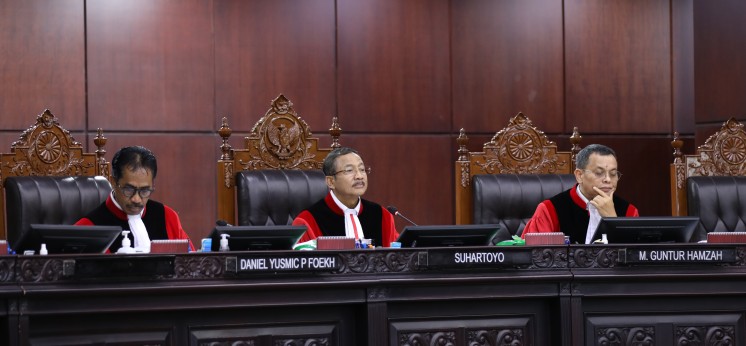
As students and Indonesian citizens engaged in economic activities, Zahra Angelina Ismaryanti (Petitioner I), Gregorius David Susanto (Petitioner II), and Muhammad Khoirudin Umar Fahri (Petitioner III) challenged Article 14A paragraph (5) of the P2SK Law against the 1945 Constitution at the Constitutional Court. The preliminary hearing for Case No. 7/PUU-XXIV/2026 was presided over by Chief Justice Suhartoyo on Wednesday, January 21, 2026.
Article 14A paragraph (5) of the a quo law stipulates, “Further provisions regarding the issuance of the Digital Rupiah as referred to in paragraph (1) shall be regulated in Bank Indonesia Regulations.” Zahra explained that the Petitioners have a direct and specific interest in the regulation of the national payment system and currency, including Bank Indonesia’s plan to issue a Digital Rupiah as mandated by the P2SK Law. In the future, they may frequently conduct transactions using the Digital Rupiah, either voluntarily or due to policy shifts that reduce or eliminate physical currency.
Unlike physical rupiah, banknotes and coins, which are anonymous and leave no digital trace, the Digital Rupiah possesses fundamentally distinct characteristics. Each transaction would be electronically recorded and stored in Bank Indonesia’s database, potentially including users’ personal data, such as name, National Identification Number (NIK), bank account details, transaction history, and geolocation data.
According to the Petitioners, the contested provision fails to provide clear and comprehensive guarantees for personal data protection because it delegates the entire regulatory framework of the Digital Rupiah to Bank Indonesia Regulations. They contend that there is no statutory clarity as to what categories of personal data will be collected, how such data will be secured against breaches or misuse, who may access the data, how long it will be retained, whether it may be shared with third parties, and what sanctions would apply in the event of data leakage.
This regulatory ambiguity, they argue, poses a tangible threat to their right to privacy. Absent explicit statutory limitations, Bank Indonesia could potentially collect excessive personal data, retain it indefinitely, or disseminate it to other institutions without users’ consent. The Petitioners further asserted that such a framework may give rise to mass surveillance of financial activities, enabling the construction of detailed profiles concerning individuals’ habits, preferences, locations, and even political leanings. In their view, this constitutes a serious infringement of the right to personal security and data protection as guaranteed under Article 28G paragraph (1) of the 1945 Constitution.
They also maintained that Article 14A paragraph (5) effectively delegates full regulatory authority over the Digital Rupiah to subordinate legislation without prescribing clear statutory parameters, criteria, or guiding principles.
In their petitum, the Petitioners requested the Court to declare Article 14A paragraph (5) of Law No. 4 of 2023 on the Development and Strengthening of the Financial Sector, which reads, “Further provisions regarding the issuance of the Digital Rupiah as referred to in paragraph (1) shall be regulated in Bank Indonesia Regulations,” contrary to Article 23 paragraph (3), Article 23D, Article 28D paragraph (1), and Article 28G paragraph (1) of the 1945 Constitution. They further asked the Court to declare the provision unconstitutional and not legally binding, along with all its legal consequences.
Legal Standing
In his advice to the Petitioners, Constitutional Justice Daniel Yusmic P. Foekh emphasized the need to elaborate on their legal standing as students and to clearly describe the actual or potential constitutional impairment they may suffer, for example in relation to tuition payments or other financial transactions.
“Explain how this norm contradicts the 1945 Constitution. The more constitutional touchstones you invoke, the more comprehensive your constitutional argument must be. Also elaborate on the position of Bank Indonesia within the constitutional structure. Break it down using relevant principles and doctrines to convince the justices of the merits of this petition,” Justice Foekh advised.
Constitutional Justice M. Guntur Hamzah, for his part, reminded the Petitioners to clarify their position as prospective users who have not yet used the Digital Rupiah. He suggested that they draw parallels with existing electronic money instruments to substantiate the immediacy of their constitutional loss. “You need to present supporting evidence to strengthen your legal standing,” he said.
Meanwhile, Chief Justice Suhartoyo urged the Petitioners to study previous petitions available on the Court’s official website to better understand the systematic structure of a constitutional petition. He noted that their explanation of legal standing had yet to clearly correlate the challenged provision with the alleged constitutional impairment. “Please elaborate on how the enactment of the challenged norm directly affects your constitutional rights,” he stated.
Before adjourning the hearing, Chief Justice Suhartoyo granted the Petitioners 14 days to revise and refine their petition. The amended petition must be submitted to the Registrar’s Office of the Court no later than Tuesday, February 3, 2026, at 12:00 PM WIB. The Court will subsequently schedule the next hearing to examine the revisions.
Explore The Case: Case No. 7/PUU-XXIV/2026 (in Bahasa Indonesia).
Author : Sri Pujianti
Editor : Lulu Anjarsari P.
PR : Andhini S.F.
Translator : N. Valentino Rahadityo/Yuanna Sisilia
Disclaimer: The original version of the news is in Indonesian. In case of any differences between the English and the Indonesian versions, the Indonesian version will prevail.
Wednesday, January 21, 2026 | 16:10 WIB 93