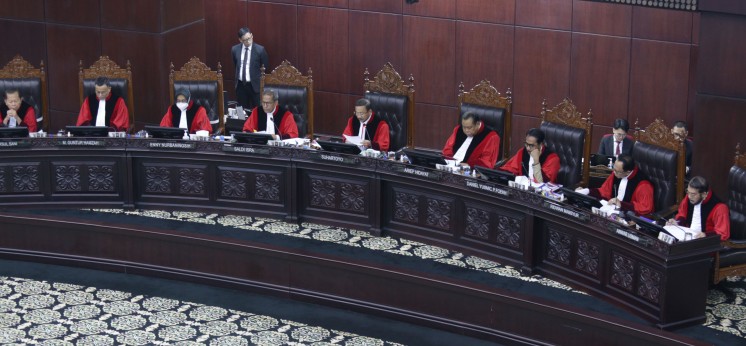
The ruling hearing for Decision No. 243/PUU-XXIII/2025 on the Marriage Law, Monday (2/2/2026). Photo by MKRI/Bayu.
JAKARTA (MKRI) — The Constitutional Court ruled to declare the material judicial review petition of Article 2 paragraph (1) of Law No. 1974 on Marriages, as last amended by Law No. 16 of 2019, and Article 35 letters a and b of Law No. 23 of 2006 on Population Administration inadmissible. The petition was filed by public policy observer Henoch Thomas and advocates Uswatun Hasanah, Syamsul Jahidin, and Marina Ria Aritonang—Petitioners I-IV, respectively.
“Verdict: [The Court] adjudicated, declares Petition No. 265/PUU-XXIII/2025 inadmissible,” stated Chief Justice Suhartoyo at the ruling hearing for Decision No. 265/PUU-XXIII/2025 on Monday, February 2, 2026 in the plenary courtroom.
The Court was of the view that the Petitioners’ posita predominantly elaborated on legal uncertainty of the registration of interfaith marriages as a consequence of the application of Article 2 paragraph (1) of Law No. 1 of 1974 on Marriages. Meanwhile, the said provision regulates the requirements for the validity of marriage, not the registration of marriage.
Furthermore, the Court encountered difficulty in understanding the true intent behind the two alternative formulations of the petitums 3 and 4—whether the Petitioners sought Article 2 paragraph (1) of Law No. 1 of 1974 to be interpreted as set out in point 3 or in point 4. This difficulty was compounded by the fact that, in the posita, they did not clearly set forth the reasons for requesting that Article 2 paragraph (1) of Law No. 1 of 1974 be interpreted in the manner sought.
According to the Court, the formulation of the petitums gives rise to ambiguity, even though the Petitioners requested that the norm under review be declared unconstitutional. However, in formulating the petitums, the Petitioners did not at all request that the norm under review be declared not legally binding, nor did they request that the norm be declare conditionally unconstitutional.
“The formulation of the Petitioners’ petitums is incomplete and atypical for a judicial review of legislation,” Chief Justice Suhartoyo concluded.
Also read:
Ban on Interfaith Marriage Challenged Again
Petitioners of Marriage Law Also Challenge Population Administration Law
The Petitioners asserted that their constitutional rights have been impaired by the application of Article 35 letters a and b of the Population Administration Law, which reads: “The Registration of Marriages referred to in Article 34 applies also to: a. marriages determined by a Court; and b. marriages of Foreigners which were performed in Indonesia, on the request of the Foreigner in question.”
They also challenged Article 2 paragraph (1) of the Marriage Law, which stipulates that: “A marriage shall be legitimate if it is performed according to the laws of the respective religions and beliefs of the parties concerned.” According to them, the provision does not clearly and expressly regulate marriage in the context of the registration of marriages between couples of different religions, thus creating normative ambiguity and multiple interpretations that lead to legal uncertainty.
They asserted that such normative ambiguity has been construed as if only marriages between couples of the same religion may be registered. This interpretation directly results in the restriction of access to the registration of interfaith marriages, they claimed.
The Petitioners further argued that the Constitutional Court has an important role in providing a constitutional interpretation of Article 2 paragraph (1) of the Marriage Law, so that the norm a quo is no longer construed as a basis for prohibiting or rejecting applications for the registration of interfaith marriages. The core constitutional issue concerning Article 2 paragraph (1) of the Marriage Law does not lie in determining the validity or invalidity of a marriage according to religious law—which falls within the domain of religious institutions and organizations—but rather in the legal uncertainty surrounding the role of the State in the registration of interfaith marriages.
In their petitums, the Petitioners request the Court to declare Article 2 paragraph (1) of the Marriage Law and Article 35 letters a and b of the Population Administration Law unconstitutional and not legally binding. They also submitted alternative petitums, requesting the Court to declare Article 2 paragraph (1) of the Marriage Law conditionally unconstitutional and not legally binding insofar as it is not interpreted as: “A marriage shall be legitimate if it is performed according to the laws of the respective religions and beliefs of the parties concerned, and every marriage between adherents of different religions and beliefs is valid insofar as it has been declared valid according to the laws of the respective religions and beliefs of the parties concerned.”
They further request the Court to declare Article 35 letter a of the Population Administration Law conditionally unconstitutional and not legally binding, insofar as it is not interpreted as “Marriages between Indonesian citizens of different religions and/or adherents of beliefs” and “The registration of marriages between Indonesian citizens of different religions and/or adherents of beliefs does not constitute state recognition of interfaith marriages and/or marriages of adherents of beliefs, but rather constitutes an administrative act; therefore, the state is obliged to register such marriages without the need for a court decision.”
Explore case No. 265/PUU-XXIII/2025 (in Indonesian).
Author : Mimi Kartika
Editor : Nur R.
Translator : Yuniar Widiastuti (NL)
Disclaimer: The original version of the news is in Indonesian. In case of any differences between the English and the Indonesian versions, the Indonesian version will prevail.
Monday, February 02, 2026 | 16:05 WIB 196