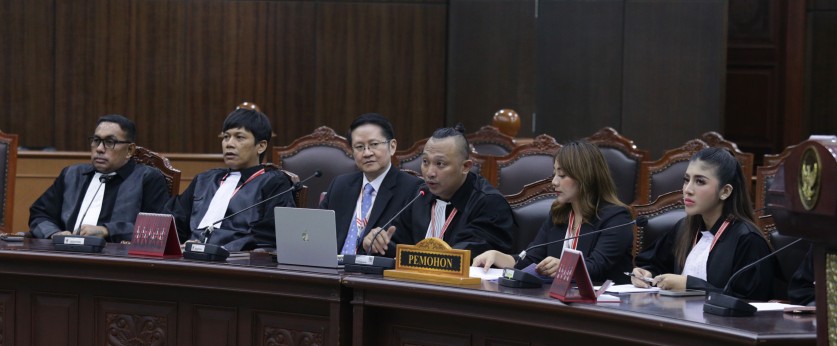
The Petitioners of Case No. 243/PUU-XXIII/2025 and their counsels at the preliminary hearing for the material judicial review of the Marriage Law, Friday (1/9/2026). Photo by MKRI/Bayu.
JAKARTA (MKRI) — Public policy observer Henoch Thomas and advocates Uswatun Hasanah and Syamsul Jahidin—Petitioners I-III, respectively—have filed a material judicial review petition of Article 2 paragraph (1) of Law No. 1974 on Marriage, as last amended by Law No. 16 of 2019, to the Constitutional Court. Petitioner III believes that the challenged provision restricts the constitutional rights of Petitioners I and II to marry their respective partners who adhere to different religions.
“The term ‘according to’ in the provision a quo does not clearly and expressly explain marriage in the context of marriage registration between couples of different religions, thereby giving rise to normative ambiguity and multiple interpretations that result in legal uncertainty,” said Syamsul at the preliminary hearing for case No. 265/PUU-XXIII/2025 on Friday, January 9, 2026.
Article 2 paragraph (1) of the Marriage Law stipulates that “A marriage shall be legitimate if it is performed according to the laws of the respective religions and beliefs of the parties concerned.” According to the Petitioners, the provision does not clearly and expressly regulate marriage in the context of the registration of marriages between couples of different religions, thus creating normative ambiguity and multiple interpretations that lead to legal uncertainty.
Such normative ambiguity has been construed as if only marriages between couples of the same religion may be registered. According to the Petitioners, this interpretation directly results in the restriction of access to the registration of interfaith marriages.
The constitutional harm suffered by the Petitioners is specific and actual, because the ambiguity of Article 2 paragraph (1) of the Marriage Law has caused them to be unable to enter into marriage with partners of different religions. This harm has become concrete and potential following the issuance of the Supreme Court Circular Letter No. 2 of 2023 on Guidelines for Judges in Adjudicating Applications for the Registration of Marriages Between Persons of Different Religions and Beliefs, which explicitly prohibits courts from granting confirmation for the registration of interfaith marriages.
In addition to the absence of legal certainty in the registration of marriages, there are also further potential harms in the form of the lack of certainty regarding the rights and obligations of husband and wife, the rights of children, family rights, inheritance rights, and other rights which, by rational reasoning, can be expected to arise. The Petitioners contend that Article 2 paragraph (1) of the Marriage Law is contrary to Article 1 paragraph (3), Article 28D paragraph (1), Article 28B paragraph (1), and Article 28I paragraph (4) of the 1945 Constitution of the Republic of Indonesia.
In their petitums, the Petitioners request the Court to declare Article 2 paragraph (1) of the Marriage Law unconstitutional and not legally binding, or to declare it conditionally unconstitutional and not legally binding insofar as it is not interpreted as follows: “Every marriage shall be registered in accordance with the applicable laws and regulations;” or “A marriage shall be legitimate if it is performed according to the laws of the respective religions and beliefs of the parties concerned, and every marriage between adherents of different religions and beliefs is valid insofar as it has been declared valid according to the laws of the respective religions and beliefs of the parties concerned.”
This petition was examined by a panel chaired by Deputy Chief Justice Saldi Isra, with Constitutional Justices Ridwan Mansyur and Arsul Sani as members. During the advisory session, Justice Ridwan stated that the Petitioners must elaborate and prove the constitutional harm they have suffered and strengthen their legal standing in this petition.
“That harm must also be explained as being contrary to the provisions contained in the 1945 Constitution of the Republic of Indonesia. This is what you have not yet elaborated sufficiently in the discussion of legal standing,” he said.
Before adjourning the session, Deputy Chief Justice Saldi Isra stated that the Petitioners would have 14 days to revise the petition. The softcopy or hardcopy of the petition must be received by the Court no later than 12:00 WIB on Thursday, January 22, 2026.
Explore case No. 265/PUU-XXIII/2025 (in Indonesian).
Author : Mimi Kartika
Editor : Nur R.
Translators : Yuniar Widiastuti (NL)
Disclaimer: The original version of the news is in Indonesian. In case of any differences between the English and the Indonesian versions, the Indonesian version will prevail.
Friday, January 09, 2026 | 11:40 WIB 2060