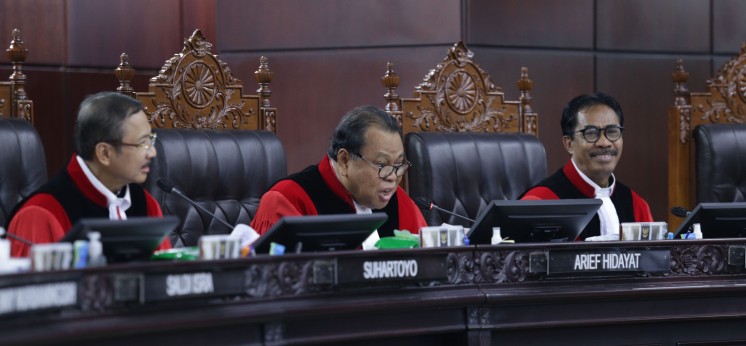
Ruling hearing for Case No. 276/PUU-XXIII/2025 on the material judicial review of Law No. 28 of 2014 on Copyright, Monday (2/2/2026). Photo by MKRI/Bay.
JAKARTA (MKRI) — The Constitutional Court (MK) declared the petition for a material judicial review of Law No. 28 of 2014 on Copyright Law inadmissible. Decision No. 276/PUU-XXIII/2025 was pronounced on Monday, February 2, 2026, in a plenary ruling hearing chaired by Chief Justice Suhartoyo alongside the other constitutional justices.
In its legal considerations delivered by Deputy Chief Justice Saldi Isra, the Court explained that although the Petitioner was able to demonstrate that he had produced a number of works in various activities, he failed to prove that such works constituted original ideas or concepts. Consequently, the works in question could not be regarded as objects protected by copyright because they fall within the exclusions set out in Article 41(b) of Law No. 28 of 2014.
Saldi further stated that the Petitioner’s inability to establish the originality of the alleged ideas or concepts also prevented him from substantiating a specific constitutional loss. According to the Court, the Petitioner was unable to clearly describe any constitutional impairment that had a direct causal relationship with the enactment and enforcement of the statutory norm under review.
The Court did not find any convincing explanation that the alleged constitutional loss suffered by the Petitioner was directly caused by the validity of the challenged provision of the Copyright Law, including in relation to all works he claimed to have produced.
“Although the Court has the authority to adjudicate the petition, because the Petitioner does not have legal standing to file the a quo petition, the Court does not consider the subject matter of the petition any further,” Saldi asserted.
Also read:
Petitioner Revises Copyright Law Petition, Strengthens Legal Standing
Idea–Expression Dichotomy in Copyright Law Questioned for Its Impact on Creativity
Petitioner’s Arguments
Previously, Rega Felix (the Petitioner) filed a judicial review of Article 41(b) of Law No. 28 of 2014 on Copyright. He described the constitutional losses he claimed to have suffered as an academic.
He argued that various ideas and concepts he had conveyed through different media, including statements delivered declaratively in public hearings before the Court, were subsequently used by other parties without authorization.
Among the ideas he alleged to have been appropriated were the concept of benefit rights in Islamic banking transactions in Indonesia (January 18, 2022), the concept of resolving halal fatwa disputes through the religious courts (June 26, 2023), the concept of four principles of personal data transfer formulated through eight atomic definitions and three semantic valuation parameters (August 21, 2025), as well as a graph model concept concerning the prioritization of mining permits (December 4, 2025).
The Petitioner explained that the Copyright Law regime distinguishes between moral rights and economic rights. Moral rights are regulated under Article 5, while economic rights are governed by Article 8 of the Copyright Law. According to him, this distinction has significant implications because criminal sanctions generally attach only to violations of economic rights involving commercialization.
As a result, violations of moral rights do not automatically give rise to criminal liability. In his view, this weakens legal protection for creators, particularly lecturers and academics.
He also questioned the application of the idea–expression dichotomy under Article 41(b) of the Copyright Law, which separates ideas from their expression in a copyrighted work. The Petitioner argued that this provision complicates the determination of the boundary between moral rights and economic rights, especially in relation to works such as lectures, academic talks, or speeches that are inherently rich in ideas, methods, and concepts.
In practice, he contended, legal protection tends to focus on the tangible form of expression, whether visual or auditory, rather than on the substance of ideas generated through lengthy academic processes involving research, development, time, cost, and intellectual effort.
In his petitum, the Petitioner requested that the Court declare the phrase “any idea, procedure, system, method, concept, principle, finding or data, even if it has been disclosed, expressed, illustrated, explained, or incorporated in a Work” in Article 41(b) of the Copyright Law contrary to the 1945 Constitution and conditionally unconstitutional, insofar as it is not interpreted as excluding protection of moral rights over inseparable parts of the work.
Explore the case: Case No. 276/PUU-XXIII/2025
Author: Utami Argawati
Editor: N. Rosi
Translator: Yuanna Sisilia
The complete decision: Decision No. No. 276/PUU-XXIII/2025
Disclaimer: The original version of the news is in Indonesian. In case of any differences between the English and the Indonesian versions, the Indonesian version will prevail.
Monday, February 02, 2026 | 17:08 WIB 76