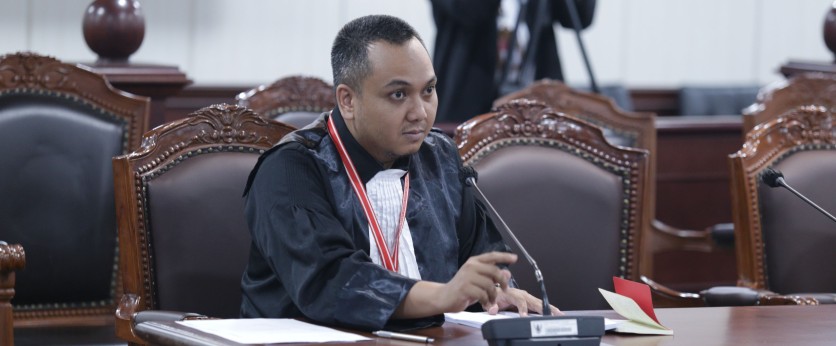
The Petitioner’s legal counsel attending the petition revision hearing for Case No. 276/PUU-XXIII/2025 on the material judicial review of Law No. 28 of 2014 on Copyright, Monday (1/26/2026). Photo by MKRI/Bay.
JAKARTA (MKRI) — On Monday, January 26, 2026, the Constitutional Court of the Republic of Indonesia (MKRI) held a petition revision hearing for the material judicial review of Law No. 28 of 2014 on Copyright. The hearing for Case No. 276/PUU-XXIII/2025 was presided over by Constitutional Justice Arief Hidayat, with Constitutional Justices Enny Nurbaningsih and Arsul Sani as panel members.
During the hearing, the Petitioner, Rega Felix, conveyed several revisions to his petition. He explained that the personal narrative contained in the petition had been significantly reduced, while the theoretical substance had been further elaborated. In addition, the section on legal standing was revised and strengthened by clarifying the Petitioner’s original ideas and supporting them with relevant evidence.
“Overall, the personal narrative has indeed been drastically reduced. However, the theoretical substance has been deepened, and the legal standing section has been revised and reinforced by clarifying which aspects constitute original ideas and by providing supporting evidence,” Rega Felix stated.
To further bolster his arguments, the Petitioner also added references to jurisprudence, particularly Whelan v. Jaslow Dental Laboratory in the United States, which he considered relevant to the issue of idea protection within the copyright regime.
Also read:
Idea–Expression Dichotomy in Copyright Law Questioned for Its Impact on Creativity
Previously, the Petitioner had outlined the constitutional harm he claimed to have suffered as an academic. According to him, the harm stemmed from various ideas and concepts he had conveyed through different media and declaratively in public hearings before the Court, which were subsequently used by other parties without authorization.
Among the ideas allegedly appropriated were the concept of benefit rights in sharia banking transactions in Indonesia (January 18, 2022), the concept of resolving halal fatwa conflicts through religious courts (June 26, 2023), the concept of four principles of personal data transfer through eight atomic definitions and three semantic valuation parameters (August 21, 2025), and the concept of a graph model for prioritizing mining permits (December 4, 2025).
The Petitioner further explained that the Copyright Law distinguishes between moral rights and economic rights. Moral rights are regulated under Article 5, while economic rights are governed by Article 8 of the Copyright Law. This distinction, he argued, has significant implications, as criminal sanctions generally apply only to violations of economic rights related to commercialization. As a result, violations of moral rights do not automatically entail criminal consequences, thereby weakening legal protection for creators, particularly lecturers.
Moreover, the Petitioner highlighted the application of the idea–expression dichotomy concept under Article 41 letter b of the Copyright Law, which separates ideas from protected works. He argued that this provision complicates the determination of boundaries between moral rights and economic rights, especially for works in the form of lectures, courses, or speeches that are rich in ideas, methods, and concepts. In practice, legal protection tends to focus on visual or audio expressions rather than on the substantive ideas produced through lengthy academic processes.
The Petitioner emphasized that such ideas are generated through research and development that require considerable time, effort, cost, and intellectual labor. He stressed that he was not seeking royalties or economic rights, but viewed the appropriation of ideas without proper acknowledgment as detrimental to the dignity and honor of the academic profession. The Petitioner also noted that the relatively low welfare of lecturers exacerbates the situation, as the state has yet to optimally fulfill its constitutional responsibility to guarantee the right to education and the welfare of educators.
In his petitum, the Petitioner requested the Court to declare the phrase “any idea, procedure, system, method, concept, principle, discovery, or data, even if it has been disclosed, stated, described, explained, or combined in a Work” in Article 41 letter b of the Copyright Law as contrary to the 1945 Constitution of the Republic of Indonesia and conditionally unconstitutional and not legally binding, insofar as it is not interpreted as an exception to the protection of moral rights over inseparable parts of a work.
Explore the Case: Petition No. 276/PUU-XXIII/2025
Author : Utami Argawati
Editor : N. Rosi
Translator : Yuanna Sisilia
Disclaimer: The original version of the news is in Indonesian. In case of any differences between the English and the Indonesian versions, the Indonesian version will prevail.
Monday, January 26, 2026 | 19:30 WIB 63