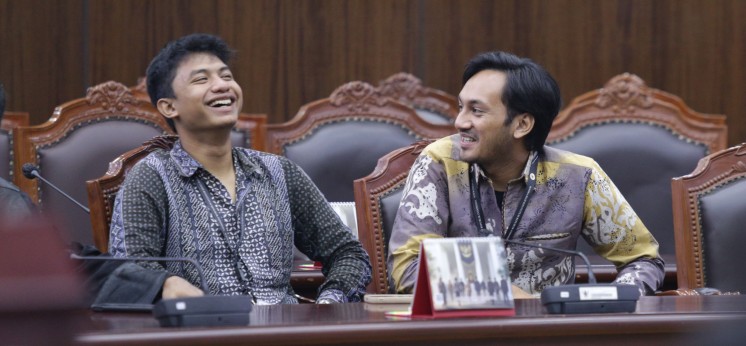
Petitioners attending the Decision Pronouncement Hearing of Case No. 256/PUU-XXIII/2025 on the material judicial review of Law No. 17 of 2014 on the People’s Consultative Assembly, the House of Representatives, the Regional Representative Council, and the Regional Legislative Council, Monday (2/2). Photo by MKRI/Bay.
Jakarta (MKRI) - The Constitutional Court (MK) found that the alleged constitutional losses of Muhammad Farhan Firdaus (Petitioner I), Roby Purnama Sidiq (Petitioner II), Muhammad Alaudin Fathan Ghazy (Petitioner III), Muhafiddin Nezar Yusufi (Petitioner IV), and Amanda Tiara Karim (Petitioner V) were unclear, whether in specific and actual terms or at least as potential losses that, under reasonable assessment, could be expected to occur.
These were the legal considerations read out by Chief Justice Suhartoyo in connection with the petition challenging the term of office of members of the House of Representatives (DPR), filed by five students of the Faculty of Sharia and Law at Universitas Islam Negeri Syarief Hidayatullah (UIN) Jakarta. They sought a judicial review of Article 76 paragraph (4) of Law No. 17 of 2014 on the People’s Consultative Assembly, the House of Representatives, the Regional Representative Council, and the Regional House of Representatives (MD3 Law). The pronouncement of Decision No. 256/PUU-XXIII/2025 took place in the Plenary Courtroom on Monday, February 2, 2026.
The Court explained that, in substance, the Petitioners had, in outlining their alleged constitutional losses and their legal standing requirements in the review of Article 76 paragraph (4) of the MD3 Law, met the formal qualifications to act as petitioners in a constitutional review case. However, the Court found no causal link between the arguments and evidence they submitted regarding the alleged violation of their constitutional rights and the implementation of the challenged provision.
The Court further noted that, in describing their legal standing, the Petitioners largely elaborated on their constitutional rights as students to develop themselves and to participate in democracy, including the right to oversee the exercise of power by DPR members whose terms of office are not subject to term limits.
In this regard, Chief Justice Suhartoyo continued, the Petitioners merely juxtaposed legal theories on the limitation of power that they studied as law students with the absence of term limits for DPR members, but did not explain how the lack of term limits specifically, actually, or even potentially impaired their constitutional rights.
“Thus, irrespective of whether the alleged unconstitutionality of Article 76 paragraph (4) of Law 17/2014 can be proven, the Court has no doubt in concluding that the Petitioners lack legal standing to file the petition a quo,” Chief Justice Suhartoyo stated. Although the Court has jurisdiction to adjudicate the petition, it declined to consider the merits any further because the Petitioners failed to establish legal standing.
“Thus, irrespective of whether the alleged unconstitutionality of Article 76 paragraph (4) of Law 17/2014 can be proven, the Court has no doubt in concluding that the Petitioners lack legal standing to file the petition a quo. Although the Court has jurisdiction to adjudicate the petition, because the Petitioners failed to establish legal standing, the Court declined to consider the merits of the petition any further ,” Chief Justice Suhartoyo stated.
Also read:
Five Students Request Restrictions on the Term of Office for Members of the House
Petitioners Clarify Petitum on the House of Representatives Tenure Period Limit
During the preliminary hearing on Thursday, January 8, 2026, the Petitioners stated that Article 76 paragraph (4) of the MD3 Law is contrary to Article 1 paragraph (3), Article 20 paragraph (1), and Article 28C paragraph (2) of the 1945 Constitution of the Republic of Indonesia. Article 76 paragraph (4) of the MD3 Law enables members of the House to hold office without any time limit.
On the one hand, executive and judicial powers are limited. However, members of the House may hold office without time limits.
Currently, many members of the House hold office for four to eight consecutive terms. This phenomenon resulted in political stagnation, discouraging the circulation of new ideas and representation, and increasing the dominance of party elites in the legislative process.
Case tracking: Petition No. 256/PUU-XXIII/2025 (in Indonesian)
Decision No. 256/PUU-XXIII/2025 (in Indonesian)
Author: Sri Pujianti.
Editor: N. Rosi.
PR: Raisa Ayuditha Marsaulina.
Translator: Rizky Kurnia Chaesario
Disclaimer: The original version of the news is in Indonesian. In case of any differences between the English and the Indonesian versions, the Indonesian version prevails.
Monday, February 02, 2026 | 18:35 WIB 128