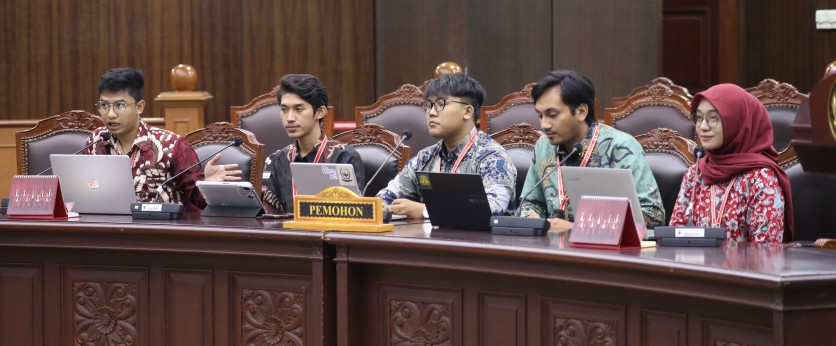
Petitioners of MD3 Law review delivering revised petition on Wednesday (21/1/2026). Photo by MKRI/Panji.
Jakarta (MKRI) - The Constitutional Court (MK) resumed the hearing on a petition filed by five students from the Faculty of Sharia and Law at Universitas Islam Negeri Syarif Hidayatullah University (UIN) Jakarta, challenging the term of office of members of the House of Representatives (DPR). The second hearing in Case No. 256/PUU-XXIII/2025, which focused on the main points of the revised petition, was chaired by Deputy Chief Justice Saldi Isra on Wednesday, January 21, 2026, in the Plenary Courtroom. The Petitioners are Muhammad Farhan Firdaus (Petitioner I), Roby Purnama Sidiq (Petitioner II), Muhammad Alaudin Fathan Ghazy (Petitioner III), Muhafiddin Nezar Yusufi (Petitioner IV), and Amanda Tiara Karim (Petitioner V).
During the hearing, Farhan detailed several improvements made to the petition, including the attachment of Constitutional Court Regulation (PMK) 7/2025, arguments to ensure that the a quo petition is not nebis in idem with earlier cases heard by the Court, references to academic works previously written by the Petitioners on law and democracy, and refinements to the petitum.
“Declare that the provision in Article 76 paragraph (4) of Law No. 17 of 2014 on the People’s Consultative Assembly, the House of Representatives, the Regional Representative Council, and Regional Legislative Councils, containing the phrase ‘The term of office of DPR members is 5 (five) years and ends when the new DPR members take their oath/pledge’ is contrary to the 1945 Constitution of the Republic of Indonesia and has no binding legal force insofar as it is not interpreted to mean ‘The term of office of DPR members is 5 (five) years and ends when the new DPR members take their oath/pledge and they may be re-elected to the same office only for one additional term’,” Farhan read as he presented the revised petitum.
Also read:
Five Students Request Restrictions on the Term of Office for Members of the House
During the preliminary hearing on Thursday, January 8, 2026, these undergraduate students explained that Article 76 paragraph (4) of Law No. 17 of 2014 on the People’s Consultative Assembly, the House of Representatives, the Regional Representative Council, and Regional Legislative Councilsis contrary to Article 1 paragraph (3), Article 20 paragraph (1), and Article 28C paragraph (2) of the 1945 Constitution of the Republic of Indonesia.
According to the Petitioner, Article 76 paragraph (4) of the MD3 Law enables members of the House to hold office without any time limit. In principle, this is contrary to constitutionalism that serves as the foundation of the state of law. Moreover, restrictions on the term of office are a fundamental instrument for maintaining the balance of power.
On the one hand, executive and judicial powers are limited. However, members of the House may hold office without time limits. Accordingly, this leads to systemic inconsistencies within the Indonesian state design. This discrepancy violates the symmetry principle in the system of checks and balances by allowing one branch of government to exercise lifelong authority without time limits, which conceptually contradicts the constitutional spirit of a power-limiting system.
Currently, many members of the House hold office for four to eight consecutive terms. This phenomenon resulted in political stagnation, discouraging the circulation of new ideas and representation, and increasing the dominance of party elites in the national legislative process.
Case tracking: Petition No. 256/PUU-XXIII/2025
Author: Sri Pujianti.
Editor: N. Rosi.
PR: Raisa Ayuditha Marsaulina.
Translator: Rizky Kurnia Chaesario
Disclaimer: The original version of the news is in Indonesian. In case of any differences between the English and the Indonesian versions, the Indonesian version prevails.
Wednesday, January 21, 2026 | 19:37 WIB 89