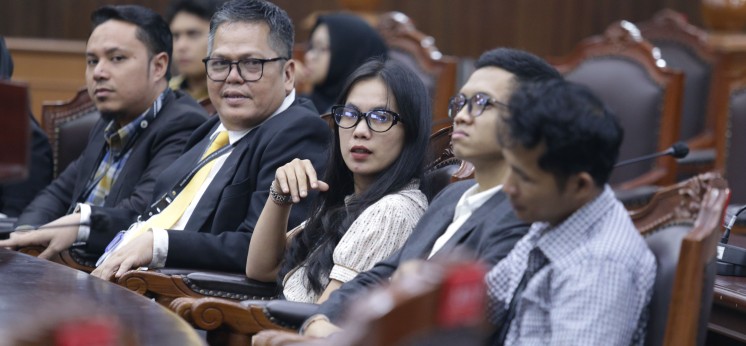
The Petitioners at the ruling hearing for the judicial review of Law No. 13 of 2022 on Lawmaking for Case No. 257/PUU-XXIII/2025, Monday (2/2/2026). Photo by MKRI/Bayu.
JAKARTA (MKRI) — The Constitutional Court rejected the entire petition for judicial review of Law No. 13 of 2022 on Lawmaking. They contended that Article 96 paragraph (8) of the Law unconstitutional. The Petitioners were Bernita Matondang, Muhammad Amyusril Baramirdin, Aisyah Nurul Fajri, Mohammad Farid, Rosalina, Riski Wibowo, Hamid, Sardi, Junanda Arpianto, Parini Meika Sari, and Peberius Gea.
The Decision No. 257/PUU-XXIII/2025 was delivered at the ruling hearing in the plenary courtroom on Monday, February 2, 2026. Chief Justice Suhartoyo handed down the verdict alongside the other eight constitutional justices.
The Petitioners challenged the phrase “may explain” in Article 96 paragraph (8) of the Law on the Lawmaking Law, arguing that it is facultative and fails to provide certainty regarding the obligation of lawmakers to follow up on public input. As a result, members of the public who have formally participated receive no clarity as to whether their views are accepted, considered, or discussed in the legislative process.
In its legal considerations, the Constitutional Court referred to Decision No. 82/PUU-XXI/2023, in which it had reviewed the same norm. The Court emphasized that the word “may” in the provision must not be construed as eliminating the public’s right to participate in the formation of laws and regulations. The interpretation of the provision must be aligned with the principle of meaningful participation as affirmed in Constitutional Court Decision No. 91/PUU-XVII/2020, which encompasses the right to be heard, the right to have opinions considered, and the right to receive explanations.
Deputy Chief Justice Saldi Isra explained that the core of the Petitioners’ request essentially was for the Court to change the phrase “may provide an explanation” to “ought to provide an explanation to the public.” However, according to the Court, the use of the word “ought” lacks clear parameters and has the potential to create legal uncertainty.
“According to the Court, by using the word ‘ought,’ the phrase ‘ought to provide an explanation to the public’ would in fact weaken the norm of Article 96 paragraph (8) of Law No. 13 of 2022. Therefore, the Petitioners’ request to use the phrase ‘ought to provide an explanation to the public’ in the norm of Article 96 paragraph (8) of Law No. 13 of 2022 would instead give rise to legal uncertainty due to the absence of clear parameters, and would not strengthen the guarantee of the right to obtain information as alleged by the Petitioners. Appendix II Point 242 of Law No. 12 of 2011 on Lawmaking has set out linguistic drafting guidelines for legislative products, including that they must be clear, certain, objective, and avoid ambiguity. Accordingly, the choice of diction ‘ought,’ in the Court’s view, does not provide clarity of meaning within the norm and even weakens the norm of Article 96 paragraph (8) of Law No. 13 of 2022,” he explained.
Meanwhile, with respect to the other interpretation sought by the Petitioners in their petitums—i.e. the request to add phrases within the framework of respect for the principle of legal certainty and the phrase “submitted through official mechanisms”—the Court held that such phrases were not necessary to be added to the body of the Law a quo, as doing so would render the norm of Article 96 paragraph (8) of Law No. 13 of 2022 inefficient. Moreover, such regulation is technical in nature because it concerns what types of public input require explanations, which falls within the scope of further regulation as stipulated in Article 96 paragraph (9) of Law No. 13 of 2022. Accordingly, the Court held that the Petitioners’ arguments were legally unfounded.
“Based on all of these considerations, the Court is of the opinion that the norm of Article 96 paragraph (8) of Law No. 13 of 2022 does not give rise to legal uncertainty and does not violate the right to legal certainty or the right to obtain information as guaranteed under Article 28D paragraph (1) and Article 28F of the 1945 Constitution. Therefore, all of the Petitioners’ arguments are declared to be without legal merit,” Justice Saldi concluded.
Also read:
Lawmaking Law Tested for Eliminating Feedback Mechanism on Public Input
Petitioners Revise Petition of Phrase ‘May Explain’ in Lawmaking Law
At the preliminary hearing, the Petitioners previously argued that the norm a quo was in violation of the principle of fair legal certainty protected under Article 28F of the 1945 Constitution. They argued that legal certainty is not limited to the formal validity of norms, but also clarity, comprehensibility, and predictability of legal procedures, particularly in the implementation of public participation. They claimed that public participation must be meaningful, encompassing the right to be heard, to be considered, and to obtain an explanation regarding the opinions submitted. Without certainty of follow-up, public participation risks becoming merely symbolic.
Explore Case No. 257/PUU-XXIII/2025 (in Indonesian).
Author : Utami Argawati
Editor : Lulu Anjarsari P.
PR : Adriana A. Y.
Translator : Yuniar Widiastuti (NL)
Disclaimer: The original version of the news is in Indonesian. In case of any differences between the English and the Indonesian versions, the Indonesian version will prevail.
Monday, February 02, 2026 | 15:59 WIB 201