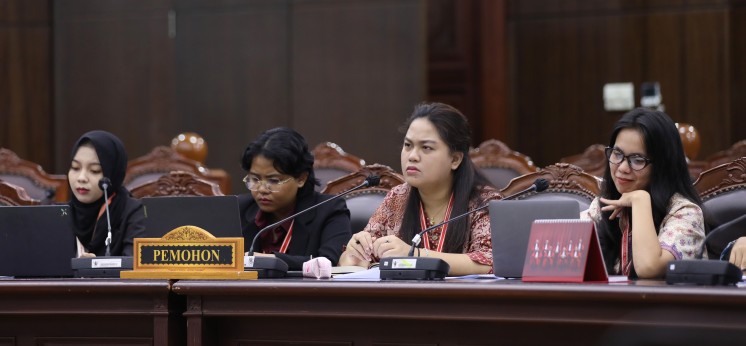
The Petitioners’ counsels at the preliminary hearing for the judicial review of Law No. 13 of 2022 on Lawmaking, Thursday (1/8/2025). Photo by MKRI/Ifa.
JAKARTA (MKRI) — Bernita Matondang, Muhammad Amyusril Baramirdin, Aisyah Nurul Fajri and eight other petitioners challenge the constitutionality of Law No. 13 of 2022 on Lawmaking. They believe Article 96 paragraph (8) of the Lawmaking Law has created procedural uncertainty, which could potentially violate citizens’ constitutional rights guarantee. The Petitioners of Case No. 257/PUU-XXIII/2025 conveyed this at the preliminary hearing on Thursday, January 8, 2026.
In their petition, the Petitioners challenge the phrase “may explain” in Article 96 paragraph (8) of the Law on the Lawmaking Law, arguing that it is facultative in nature and fails to provide certainty regarding the obligation of lawmakers to follow up on public input. As a result, members of the public who have formally participated receive no clarity as to whether their views are accepted, considered, or discussed in the legislative process.
The hearing was presided over by Constitutional Justices Arief Hidayat (chair), Enny Nurbaningsih, and Daniel Yusmic P. Foekh. The Petitioners argue that this condition is contrary to the principle of fair legal certainty guaranteed by Article 28D paragraph (1) of the 1945 Constitution of the Republic of Indonesia.
They argued that legal certainty is not limited to the formal validity of norms, but also clarity, comprehensibility, and predictability of legal procedures, particularly in the implementation of public participation.
“Public participation must be meaningful, encompassing the right to be heard, to be considered, and to obtain an explanation regarding the opinions submitted. Without certainty of follow-up, public participation risks becoming merely symbolic,” said Aisyah Nurul Fajri, who attended the hearing.
Furthermore, the Petitioners emphasized that public participation constitutes part of procedural due process in a democratic state governed by the rule of law. In their view, the public’s rights do not end with the submission of opinions, but also include the right for those opinions to be considered and to receive explanations thereof. This standard, they added, has been affirmed by the Constitutional Court in Decision No. 91/PUU-XVIII/2020 concerning meaningful participation.
In their petition, the Petitioners stated that they had exercised their right to public participation by submitting academic studies and policy briefs through official mechanisms to lawmakers. However, the absence of an obligation to respond under Article 96 paragraph (8) of the Lawmaking Law has resulted in a lack of certainty regarding the status and follow-up of those submissions.
In addition to its implications for legal certainty, the Petitioners contend that the norm a quo also weakens the right to collectively advance oneself as guaranteed by Article 28C paragraph (2) of the 1945 Constitution. They believe collective public participation, particularly that based on academic studies, loses its substantive meaning when it is not accompanied by clear and documented feedbacks.
The Petitioners also highlighted the potential for procedural inequality in public participation. Without a uniform standard imposing an obligation to respond, there is a risk of disparate treatment of members of the public who provide input, which would be contrary to the principles of popular sovereignty and equality before the law as stipulated in Article 1 paragraph (2) and Article 27 paragraph (1) of the 1945 Constitution.
The phrase “may explain,” the Petitioners argued, creates informational uncertainty in terms of the right to information. The public is not guaranteed access to official, written, and accountable information regarding the processing of public input, even though such rights are protected under Article 28F of the 1945 Constitution.
For comparison, the Petitioners cited public participation practices in Finland, which require parliament to provide follow-up and official discussion of citizens’ initiatives. The Petitioners believe this practice demonstrates that modern representative democracy can operate in tandem with procedural obligations to respond to public aspirations.
On that basis, in their petitums, the Petitioners request that the Court declare Article 96 paragraph (8) of the Lawmaking conditionally constitutional insofar as the phrase “may explain” is not interpreted as excluding a procedural obligation to provide an explanation regarding the follow-up of public input in the process of forming laws and regulations.
Legal Standing
In response to the petition, Constitutional Justice Enny Nurbaningsih advised the Petitioners to clearly elaborate the legal standing of each petitioner. She emphasized that arguments concerning allegedly impaired constitutional rights must be accompanied by comprehensive explanations and strong reasoning.
She stated that the more rights, constitutional benchmarks, and constitutional provisions are cited, the greater the Petitioners’ responsibility to systematically develop and explain their arguments. Therefore, all arguments presented need to be revised and clarified.
“Why then are those rights claimed as legal standing, as if there was an assumption of impairment related to those rights? The more rights and constitutional benchmarks you cite, the greater the responsibility to elaborate and construct the arguments, and the more there is that you need to improve later,” she stated.
She also stressed that the Petitioners must elaborate the requirements for constitutional impairment, including whether the alleged harm is specific, actual, or potential, as well as the causal relationship between the challenged norm and the harm suffered. She noted that these aspects had not been adequately explained and must be further elaborated in the discussion of legal standing, given that the provision being challenged directly concerns public participation.
The panel of justices gave the Petitioners 14 days to revise the petition, which must be submitted to the Court’s Registrar’s Office by Wednesday, January 21, 2026.
Explore Case No. 257/PUU-XXIII/2025 (in Indonesian).
Author : Utami Argawati
Editor : Lulu Anjarsari P.
PR : Adriana Airlia Yusrin
Translator : Yuniar Widiastuti (NL)
Disclaimer: The original version of the news is in Indonesian. In case of any differences between the English and the Indonesian versions, the Indonesian version will prevail.
Thursday, January 08, 2026 | 10:21 WIB 242