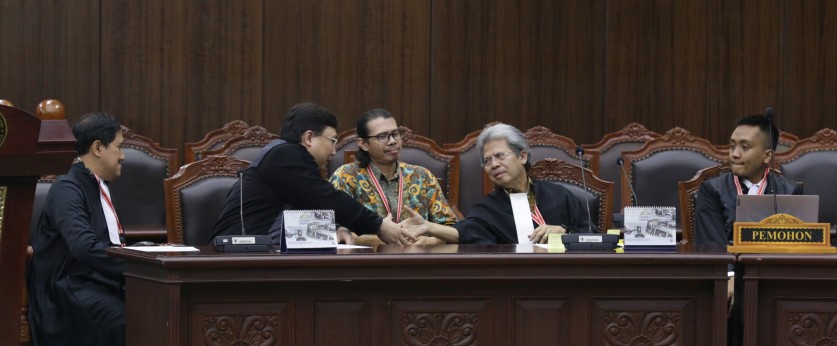
The Petitioners and legal counsels at the ruling hearing for case No. 105/PUU-XXII/2024 on the EIT Law, Tuesday (4/29/2025). Photo by MKRI/Bayu.
JAKARTA (MKRI) — The Constitutional Court (MK) granted part of the petition filed by Karimunjawa resident of Jepara Regency Daniel Frits Maurits Tangkilisan on the material judicial review hearing of Article 27A in conjunction with Article 45 paragraph (4) of Law No. 1 of 2024 on the Second Amendment to Law No. 11 of 2008 on Electronic Information and Transactions (EIT). The ruling hearing for Decision No. 105/PUU-XXII/2024 in the plenary courtroom on Tuesday, April 29, 2025 was presided over by Chief Justice Suhartoyo and the other eight constitutional justices.
In its legal consideration, delivered by Constitutional Justice Arief Hidayat, the Court held that criticism mentioned in Article 27A of Law No. 1 of 2024 is a form of supervision, correction, and advice on matters relating to public interests. Therefore, to apply the article, one must refer to Article 310 paragraph (1) of the Criminal Code (KUHP), which regulates defamation against a person or individual. In other words, the article can only be applied to defamation aimed at individuals.
Any violation mentioned in Article 27A of Law No. 1 of 2024 are a litigated crime that can only be prosecuted after the victims or the defamed individuals report it. In this case, Justice Arief added, even if a legal entity is the victim, it cannot file a complaint electronically, as only an individual suffering defamation can report it to law enforcement. In addition, the report cannot be done by proxy.
Therefore, in order to prevent law enforcement arbitrariness in applying the phrase “other people” in Article 27A of Law No. 1 of 2024, the Court stressed that the phrase means individuals. Therefore, victims of defamation that are not individuals—such as state institutions, groups of people with specific or certain identities, institutions, corporations, professions, or positions—are excluded from the article.
“Therefore, to ensure legal certainty as stipulated in Article 28D paragraph (1) of the 1945 Constitution of the Republic of Indonesia, Article 27A of Law No. 1 of 2024 must be declared conditionally unconstitutional to the extent that the phrase ‘other people’ not be interpreted as ‘except government institutions, groups of people with specific or certain identities, institutions, corporations, professions or positions,” Justice Arief said.
Prohibition Against Attack on Honor
The Court then provided explained the phrase “a matter” in Article 27A of Law No. 1 of 2024, the enforcement of which the Petitioner believed had caused uncertainty or multiple interpretations. The phrase “a matter,” the Court asserted, relates making an allegation with the intention that it becomes public knowledge. The norm regulates the prohibition against any attack on the honor or reputation of “other people” by “alleging a matter” electronically.
However, in Article 27A in conjunction with Article 45 paragraph (4) of Law No. 1 of 2024, the phrase “a matter” is not further explained, which could potentially cause multiple interpretations as a firm normative limitation is not provided. In the Great Indonesian Dictionary, the word “matter” has a very general and diverse meaning, ranging from “event, circumstance, affair, problem,” to “about or concerning.” Therefore, its use of in the context of defamation offenses can lead to confusion between defamation and ordinary insults. If the phrase is interpreted too broadly, there will be a disproportionate blur between two different forms of conduct, which ultimately creates legal uncertainty.
To prevent the interpretation broadening, to ensure fair legal certainty, and to prevent the misuse of criminal law as an instrument to silence freedom of expression, the Court stated, the phrase “other people” in Article 27A and Article 45 of Law No. 1 of 2024 must be declared conditionally unconstitutional to the extent that it is not interpreted as “except government institutions, groups of people with specific or certain identities, institutions, corporations, professions, or positions”.
“Meanwhile, the phrase ‘a matter’ in Article 27A and Article 45 paragraph (4) of Law No. 1 of 2024 must also be declared conditionally unconstitutional as long as it is not interpreted as ‘an act that degrades a person’s honor or reputation.’ However, because the Court’s interpretation is not as requested by the Petitioner, the petition on the unconstitutionality of Article 27A and Article 45 paragraph (4) of Law No. 1 of 2024 is legally grounded in part,” said Constitutional Justice Enny Nurbaningsih continuing the delivery of the Court’s legal considerations.
Protecting Human Rights
Furthermore, the Court provides a firmer explanation on the phrase “without any right” in Article 28 paragraph (2) in conjunction with Article 45A paragraph (2) of Law No. 1 of 2024. In essence, the norm regulates unlawful acts in order to provide legal protection to every person, including their honor or dignity, as specified in Article 28G paragraph (1) of the 1945 Constitution. This means that the phrase in the norm serves to protect human rights, especially certain professions such as the press, researchers, and law enforcement officials, in carrying out their professional activities.
In addition, continued Justice Enny, the inclusion of the phrase “without any right” is in line with the regional and international practice of criminalizing hate speech or xenophobic contents. So, the phrase must be read as an act of distributing and/or transmitting and not about who has the right to commit acts of incitement to hatred as argued by the Petitioner.
Thus, the phrase “without any right” is still needed in the norm to protect people who have legitimate legal interests to distribute or transmit content as referred to in Article 28 paragraph (2) of Law No. 1 of 2024. This is because the phrase is not an instrument that limits freedom of expression with the fulfillment of the right to security for others as guaranteed in Article 28G of the 1945 Constitution. Therefore, if the phrase is eliminated or deleted, it could criminalize certain professions that are protected by law.
Limitation of Electronic Information Content
Next, Justice Enny mentioned that in the absence of restrictions on the form or content of “electronic information and/or electronic documents” in Article 28 paragraph (2) in conjunction with Article 45A paragraph (2) of Law No. 1 of 2024, the norm could potentially to be used to criminalize even neutral expression or speech not intended to incite hatred, if hatred or hostility arises indirectly in a third party. So, in this case, enforcement of the law should be limited to electronic information that substantially contains incitement, recommendation, or hatred based on identity spread intentionally in public and clearly leads to forms of discrimination, hostility, or violence against protected groups.
With such restrictions, Article 28 paragraph (2) of Law No. 1 of 2024 will be in line with the 1945 Constitution and several international laws, such as Article 20 paragraph (2) of the International Covenant on Civil and Political Rights (ICCPR). To provide legal protection to vulnerable groups and ensure that legitimate expression in a democratic society is not subject to arbitrary criminal sanctions, according to the Court, the phrase “distributing and/or transmitting electronic information and/or electronic documents that incite, invite, or influence others to create a sense of hatred or hostility towards certain individuals and/or community groups” Article 28 paragraph (2) of Law No. 1 of 2024 must be declared conditionally unconstitutional if not interpreted as ‘only Electronic Information and/or Electronic Documents that substantively contain acts/spread of hatred based on certain identity carried out intentionally and in public, which creates a real risk of discrimination, hostility, or violence’.
Also read:
Activist Challenges EIT Law for Arrest After Video on Environmental Protection
Environment Activist Revises Arguments Against EIT Law
Govt: Restrictions in EIT Law for Balance of Freedom of Speech
Expert: Failure to Understand Changes Led to Potential Misuse of EIT Law
Expert Explains Constitutionalism of Digital Justice
EIT Law Prevents Dehumanization and Protects Minorities from Discrimination
Read the revised Decision No. 105/PUU-XXII/2024 here.
Author : Sri Pujianti
Editor : N. Rosi
PR : Fauzan F.
Translator : Yuniar Widiastuti (NL)
Disclaimer: The original version of the news is in Indonesian. In case of any differences between the English and the Indonesian versions, the Indonesian version will prevail.
Tuesday, April 29, 2025 | 12:24 WIB 5059