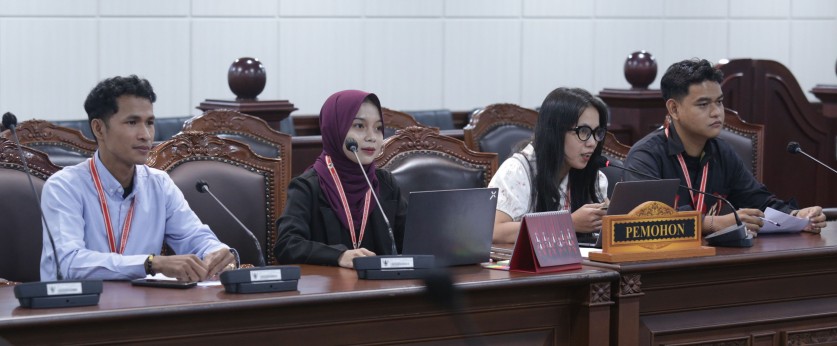
The Petitioners at the petition revision hearing for the judicial review of Law No. 13 of 2022 on Lawmaking for Case No. 257/PUU-XXIII/2025, Wednesday (1/21/2025). Photo by MKRI/Bayu.
JAKARTA (MKRI) — The Petitioners of Law No. 13 of 2022 on Lawmaking contended that Article 96 paragraph (8) could potentially create procedural uncertainty that may violate citizens’ constitutional rights guarantees. They made the statement at the petition revision hearing on Wednesday, January 21, 2026. The Case No. 257/PUU-XXIII/2025 was filed by Bernita Matondang, Muhammad Amyusril Baramirdin, Aisyah Nurul Fajri, Mohammad Farid, Rosalina, Riski Wibowo, Hamid, Sardi, Junanda Arpianto, Parini Meika Sari, and Peberius Gea.
The Petitioners challenge the phrase “may explain” in Article 96 paragraph (8) of the Law on the Lawmaking Law, arguing that it is facultative and fails to provide certainty regarding the obligation of lawmakers to follow up on public input. As a result, members of the public who have formally participated receive no clarity as to whether their views are accepted, considered, or discussed in the legislative process.
This second hearing was presided over by Constitutional Justices Enny Nurbaningsih (chair), Anwar Usman, and Daniel Yusmic P. Foekh. There, Bernita Matondang, one of the Petitioners, informed the Court that the petition had been amended and refined.
She explained that the Petitioners had added new evidence, namely Exhibit P-31, in the form of House of Representatives (DPR) Regulation No. 1 of 2020 on Rules of Procedure, particularly Articles 243 through 246. In addition, the legal basis of the petition was adjusted to align with Constitutional Court Regulation (PMK) No. 7 of 2025. The Petitioners also narrowed the constitutional benchmarks relied upon to Article 28D paragraph (1) and Article 28F of the 1945 Constitution.
Furthermore, the Petitioners reaffirmed the constitutional harm they claim to have suffered as a result of the phrase “may explain” in Article 96 paragraph (8) of the Lawmaking Law. According to the Petitioners, the phrase allows lawmakers not to provide explanations for public input submitted during the legislative process, thereby giving rise to legal uncertainty. The Petitioners also refined and elaborated their posita (reason for the petition) to strengthen their constitutional arguments.
“And we reaffirm the Petitioners’ constitutional harm on pages 7 through 9, where the phrase ‘may explain’ in Article 96 paragraph (8) creates an unconstitutional condition because it allows lawmakers to entirely dispense with any obligation to provide explanations. We have also revised the posita on pages 9 through 25,” Matondang stated.
Also read: Lawmaking Law Tested for Eliminating Feedback Mechanism on Public Input
The Petitioners previously argued that phrase “may explain” is in violation of the principle of fair legal certainty protected under Article 28F of the 1945 Constitution. They argued that legal certainty is not limited to the formal validity of norms, but also clarity, comprehensibility, and predictability of legal procedures, particularly in the implementation of public participation.
Petitioner Aisyah Nurul Fajri has previously claimed that public participation must be meaningful, encompassing the right to be heard, to be considered, and to obtain an explanation regarding the opinions submitted. Without certainty of follow-up, public participation risks becoming merely symbolic.
Furthermore, the Petitioners emphasized that public participation constitutes part of procedural due process in a democratic state governed by the rule of law. In their view, the public’s rights do not end with the submission of opinions, but also include the right for those opinions to be considered and to receive explanations thereof. This standard, they added, has been affirmed by the Constitutional Court in Decision No. 91/PUU-XVIII/2020 concerning meaningful participation.
In their petition, the Petitioners stated that they had exercised their right to public participation by submitting academic studies and policy briefs through official mechanisms to lawmakers. However, the absence of an obligation to respond under Article 96 paragraph (8) of the Lawmaking Law has resulted in a lack of certainty regarding the status and follow-up of those submissions.
In addition to its implications for legal certainty, the Petitioners contended that the norm a quo also weakens the right to collectively advance oneself as guaranteed by Article 28C paragraph (2) of the 1945 Constitution. They believe collective public participation, particularly that based on academic studies, loses its substantive meaning when it is not accompanied by clear and documented feedbacks.
Explore Case No. 257/PUU-XXIII/2025 (in Indonesian).
Author : Utami Argawati
Editor : Lulu Anjarsari P.
PR : Adriana Airlia Yusrin
Translator : Yuniar Widiastuti (NL)
Disclaimer: The original version of the news is in Indonesian. In case of any differences between the English and the Indonesian versions, the Indonesian version will prevail.
Wednesday, January 21, 2026 | 17:19 WIB 62