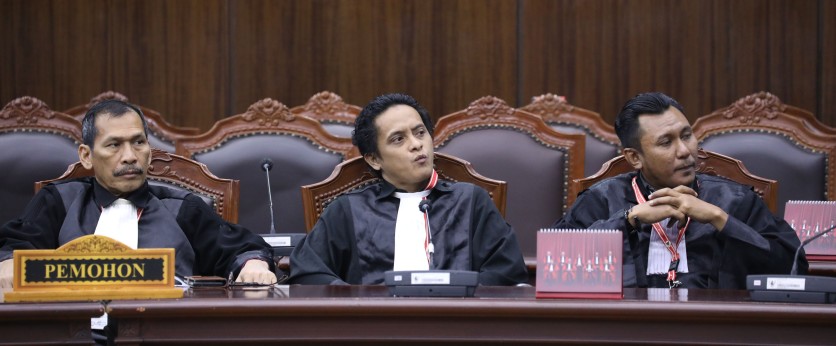
Windu Wijaya (center) as the Petitioner attending the ruling hearing on the Clemency Law. Monday (1/19/2026). Photo by MKRI/Panji.
JAKARTA (MKRI) — The Constitutional Court (MK) ruled that the petition for the material judicial review of Article 2 paragraph (2) of Law of the Republic of Indonesia No. 5 of 2010 on the Amendment to Law No. 22 of 2002 on Clemency (the Clemency Law) against the 1945 Constitution of the Republic of Indonesia was inadmissible.
The ruling for Case No. 252/PUU-XXIII/2025 was delivered at a ruling hearing held on Monday (1/19/2026) in the plenary courtroom of the Constitutional Court. The hearing was presided over by Chief Justice Suhartoyo, accompanied by seven other constitutional justices. The petition was filed by Windu Wijaya, an advocate, who challenged Article 2 paragraph (2) of the Clemency Law, which stipulates that only criminal convictions of death penalty, life imprisonment, or imprisonment of at least two years may be submitted for clemency.
According to the Petitioner, the provision restricts the right to apply for clemency because it applies only to convicts under certain categories of punishment. He argued that such a limitation imposes additional requirements not prescribed by the Constitution.
Delivering the Court’s legal considerations, Deputy Chief Justice Saldi Isra explained that the Petitioner failed to present evidence showing that he had ever acted as legal counsel or advisor for convicts sentenced to imprisonment of less than two years who were unable to seek clemency. Consequently, the alleged constitutional loss, whether potential or actual, could not be substantiated.
The Court further held that the Petitioner was unable to demonstrate a causal relationship between the alleged loss and the enforcement of Article 2 paragraph (2) of Law No. 5 of 2010 under review. As the cumulative requirements for constitutional loss were not fulfilled, the Court declared that the Petitioner lacked legal standing to file the a quo petition.
“Accordingly, the Court finds no grounds to conclude that the Petitioner has suffered a constitutional loss as required in a judicial review,” Saldi stated in the Court’s legal considerations.
Also read:
Petitioner Revises Constitutional Loss in Clemency Law Petition
Clemency Restrictions Deemed Discriminatory
Previously, the Petitioner argued that Article 2 paragraph (1) of the Clemency Law grants every convict the right to submit a clemency request to the President against a court decision with permanent legal force. However, he contended that the limitation set out in paragraph (2) alters the nature of clemency from a right inherent to every convict into a privilege applicable only to certain categories.
The Petitioner further asserted that the provision contradicts Article 14 paragraph (1) of the 1945 Constitution, which stipulates that the President grants clemency with due consideration of the Supreme Court. In his view, the restriction also diminishes the President’s authority as the holder of the clemency prerogative.
In his petition, the Petitioner referred to clemency practices during the administrations of President Susilo Bambang Yudhoyono and President Joko Widodo, including clemency granted to death row inmates, Papuan political prisoners, and former Corruption Eradication Commission chair Antasari Azhar. However, he claimed that since the enactment of Article 2 paragraph (2) of the Clemency Law, there have been no clemency applications or grants for convicts sentenced to less than two years’ imprisonment.
Author : Utami Argawati
Editor : Lulu Anjarsari P.
PR : Raisa Ayuditha Marsaulina
Translator : Yuanna Sisilia
The full ruling: Decision of Case No. 252/PUU-XXIII/2025 (in Bahasa Indonesia)
Disclaimer: The original version of the news is in Indonesian. In case of any differences between the English and the Indonesian versions, the Indonesian version will prevail.
Monday, January 19, 2026 | 11:27 WIB 96