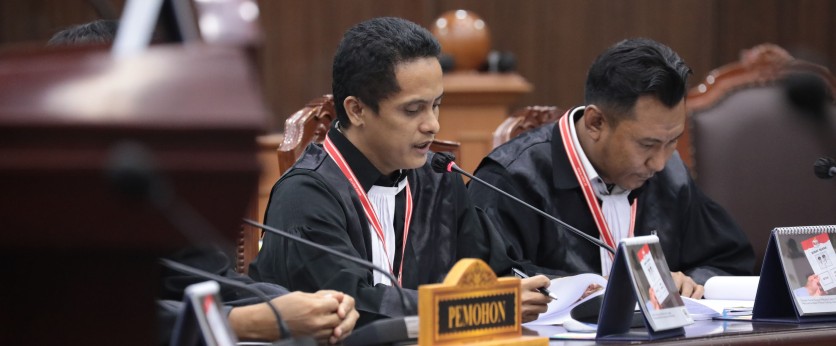
Petitioner Windu Wijaya delivering the main points of his petition during the judicial review hearing of Law No. 22 of 2002 on Pardons, Wednesday (17/12). Photo by MKRI/Panji.
Jakarta (MKRI) – The Constitutional Court (MK) held a material judicial review hearing of Article 2 paragraph (2) of Law No. 5 of 2010 on the Amendment to Law No. 22 of 2002 on Clemency (Clemency Law) against the 1945 Constitution of the Republic of Indonesia on Wednesday, December 17, 2025, at the Plenary Courtroom. Petition No. 252/PUU-XXIII/2025 was filed by Windu Wijaya, an advocate. The hearing was presided over by Chief Justice Suhartoyo.
Article 2 paragraph (2) of the Clemency Law states, “The criminal sentences for which clemency may be requested as referred to in paragraph (1) are the death penalty, life imprisonment, or imprisonment for a minimum of 2 (two) years.” The Petitioner challenges the provisions of Article 2 paragraph (2) of the Clemency Law, which limits clemency petitions to only those convicted of the death penalty, life imprisonment, or imprisonment for a minimum of two years. According to the Petitioner, this provision imposes a requirement not stipulated in the Constitution.
During the hearing, the Petitioner explained that Article 2 paragraph (1) of the Clemency Law grants every convicted person the right to petition the President for clemency regarding a court decision that has permanent legal force. However, the restrictions in paragraph (2) are considered to have changed the nature of clemency from a right inherent to every convicted person to a right that only applies to certain categories of people.
In addition, the Petitioner considers that this restriction causes constitutional harm because it reduces the authority of the President as the holder of the prerogative right of clemency. With the existence of Article 2 paragraph (2) of the Clemency Law, the President is considered to no longer have full authority to consider all clemency petitions, but is limited to certain categories of convicts.
As an advocate, the Petitioner also claims to have suffered direct losses as a result of the enactment of this norm. According to him, this restriction denies prisoners sentenced to less than two years access to clemency, thereby preventing the Petitioner from optimally performing his professional duties in providing legal assistance to all prisoners.
In his petition, the Petitioner also mentioned the practice of granting clemency by the President, which has been used as an instrument of criminal correction. Among others, President Susilo Bambang Yudhoyono granted clemency to Schapelle Leigh Corby in the form of a reduction in her sentence, as well as changing Meirika Franola's death sentence to life imprisonment. During the era of President Joko Widodo, pardons were also granted to a number of death row inmates, Papuan political prisoners, and former KPK Chairman Antasari Azhar.
However, since the enactment of Article 2, paragraph (2), of the Clemency Law, the Petitioner considers that there has never been a request for, or a grant of, clemency to convicts with sentences of less than two years, even though the court's decision has permanent legal force. This condition is considered to constitute unlawful discrimination and to deny access to justice for some citizens.
On that basis, the Petitioner requested that the Constitutional Court declare Article 2 paragraph (2) of the Clemency Law to conflict with the 1945 Constitution of the Republic of Indonesia and therefore not legally binding.
In response to the petition, Justice Daniel Yusmic P. Foekh advised the Petitioner to clarify their legal standing, describe the constitutional violations they experienced in a more systematic manner, and strengthen their constitutional arguments regarding the President's authority to grant clemency.
“Well, later, also provide examples or evidence to strengthen the legal standing,” said Justice Daniel.
Justice Daniel also reminded the Petitioner to resubmit a more focused and structured petition in accordance with the provisions of the Constitutional Court's procedural law.
At the end of the hearing, the Panel of Justices gave the Petitioner 14 days to revise the petition before proceeding to the next stage of the hearing. The revised petition must be received by the Constitutional Court no later than Tuesday, December 30, 2025, at 12:00 noon Western Indonesian Time. (*)
Case tracking: Petition No. 252/PUU-XXIII/2025
Author: Utami Argawati
Editor: Lulu Anjarsari P.
PR: Raisa Ayuditha Marsaulina
Translator: Rizky Kurnia Chaesario
Disclaimer: The original version of the news is in Indonesian. In case of any differences between the English and the Indonesian versions, the Indonesian version will prevail.
Wednesday, December 17, 2025 | 11:38 WIB 360