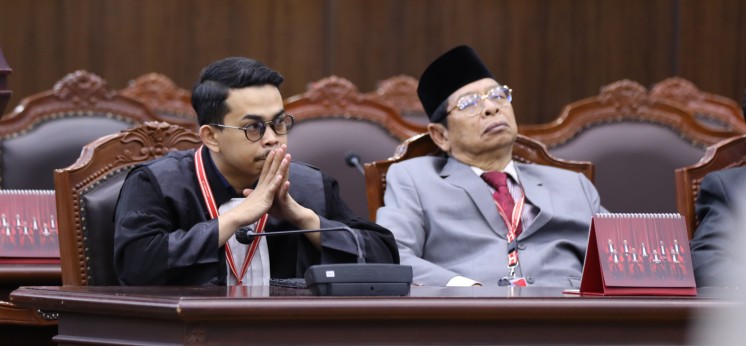
The Petitioners’ counsel Fazri Kurniansyah Hasibuan (left) at the ruling hearing for the judicial review of the National Education System Law and the Higher Education Law, Monday (1/19/2026). Photo by MKRI/Ifa.
JAKARTA (MKRI) — The Constitutional Court partially granted the petition No. 60/PUU-XXIII/2025 on the constitutionality of Article 60 paragraph (2) of Law No. 20 of 2003 on the National Education System (Sisdiknas Law) and Article 55 paragraphs (5), (6), (7), and (8) of Law No. 12 of 2012 on Higher Education (Dikti Law). The Court reinterpreted Article 55 paragraph (5) of the Higher Education Law, which in essence regulates that the establishment of an independent accreditation body (LAM) for study programs that do not yet have one may only be carried out after obtaining a consensus or joint approval from the cooperation board (BKS) of each study program.
“However, since the Court’s interpretation does not entirely follow what the Petitioners requested, the Petitioners’ arguments are legally well-founded in part,” said Constitutional Justice Arsul Sani when reading out the Court’s legal considerations in the decision on Monday, January 19, 2026.
The Petitioners are the cooperation body of law deans of public universities in Indonesia—represented by chairman Dahliana Hasan, secretary Ferry Fathurokhman, and treasurer Erma Rusdiana—along with eight lecturers Aan Eko Widiarto, Prof. Ali Masyhar Mursyid, Prof. Retno Saraswati, Prof. Ferdi, Suherman, Imam Budi Santoso, Simplexius Asa, and Parulian Paidi Aritonang from various universities; as well as three university students Endrianto Bayu Setiawan, Iren Sudarya, and Ahmad Reihan Thoriq.
The Court reinterpreted Article 55 paragraph (5) of the Higher Education Law as “The accreditation of Study Programs as public accountability shall be conducted by an independent accreditation agency, the establishment process of which shall be carried out in accordance with the needs and readiness of each scientific cluster and/or branch of science of the respective study program, after obtaining a consensus or joint approval from the cooperation board (BKS) of each study program.” The Court declared norm previously read “The accreditation of Study Programs as public accountability shall be conducted by an independent accreditation agency” unconstitutional and not legally binding.
Justice Arsul further explained that, based on facts revealed during the hearings, not all study programs currently have independent accreditation bodies, including programs within the field of legal studies. Accordingly, in their petition, the Petitioners expressed concern regarding the continuity of accreditation for such study programs and requested that they continue to be accredited by the National Accreditation Board for Higher Education (BAN-PT).
Previously, Article 55 paragraph (5) of the Higher Education Law merely regulated that accreditation of study programs as a form of public accountability is conducted by independent accreditation bodies. In this regard, as the “umbrella law” for the Higher Education Law, the National Education System Law provides that the accreditation process for educational programs and units may be carried out cumulatively and alternatively by the Government and/or authorized independent bodies.
In this regard, in order to provide legal certainty for all parties, the Court emphasized the need to regulate how study programs that do not yet have an independent accreditation body should proceed—whether such programs are required to seek accreditation from other institutions or must wait for a certain period until one is established for the relevant scientific cluster. Therefore, the Court interpreted Article 55 paragraph (5) of the Higher Education Law to mean that accreditation of study programs as a form of public accountability is conducted by an independent accreditation body in accordance with the needs and readiness of the scientific cluster and/or branch of science of each study program, and thus is not bound by a specific time limit, given that, in fact, Article 55 paragraph (5) does not stipulate a deadline for the establishment of an independent accreditation body. Nevertheless, the establishment of an independent accreditation body for study programs that do not yet have one may only be carried out after obtaining a consensus or joint approval from the cooperation board of each study program.
Since the Court has provided an interpretation of Article 55 paragraph (5) of the Higher Education Law, while Article 55 paragraph (6) concerns the establishment of an independent accreditation body based on a recommendation from BAN-PT, Article 55 paragraph (7) concerns scientific clusters or branches of science and regional considerations as the basis for establishing an independent accreditation body, and Article 55 paragraph (8) concerns further regulation of independent accreditation body —and in principle all of these provisions follow up on Article 55 paragraph (5)—the applicability of Article 55 paragraphs (6), (7), and (8) must accordingly conform to this decision of the Court.
Requirements for Study Program Accreditation by LAM
Nevertheless, given that the accreditation mechanism conducted by independent accreditation bodies is also necessary for the purpose of quality assurance of study programs, and in line with the mandate of Article 34 paragraph (3) of the 1945 Constitution, the Court emphasized that, in relation to the implementation of accreditation of study programs by independent accreditation bodies, several requirements must be observed. These include: the recruitment process of assessors must take into account their credibility, competence, and qualifications in specific fields of science; the ministry responsible for higher education affairs must ensure that assessors are oriented toward quality, integrity, and professionalism in conducting accreditation of study programs; the ministry must ensure that there is no excessive or improper conduct or service from study programs to assessors or vice versa; the ministry must conduct comprehensive supervision, including providing preventive or repressive mechanisms to mitigate risks; and the ministry must provide standardized assessment instruments and uniform evaluation standards, including the imposition of fees that do not unduly burden study programs, such that clear and proportional standards are established as references for all independent accreditation bodies and study programs in the accreditation process.
Also read:
Cooperation Body of Law Deans Challenges Provisions on Accreditation
Council of Law Deans Revises Petition on National Education System Law
Minister Denies Govt Relinquished Responsibility for Study Programs Accreditation
Independent Accreditation Agencies Supervised, Evaluated by Govt
UGM’s Religious and Cross-cultural Studies Has Lost 55 Million for Accreditation
Accreditation Agencies Do Not Diminish State’s Responsibility for Higher Education
The petition was filed by the cooperation board of law deans of public universities in Indonesia, eight lecturers, and three university students. They question the university accreditation program and education units by two entities: the Government and the authorized independent institutions. With two institutions having similar duties but different objects, there is a risk of varying standards, methods, and assessment results that could confuse accredited universities and study programs. This could decrease the effectiveness of the higher education quality assurance system as a whole.
The following are articles that the Petitioners challenged. Article 60 paragraph (2) of the Sisdiknas Law reads, “Accreditation of a program and education unit shall be the responsibility of the Government and/or independent authorities as a form of public accountability.” Meanwhile, Article 55 paragraphs (5), (6), (7), and (8) reads, “(5) The accreditation of Study Programs as public accountability shall be conducted by an independent accreditation agency. (6) The independent accreditation agency as referred to in paragraph (5) shall be established by the Government or by the Community and recognized by the Government on the recommendation of the National Agency for Accreditation of Tertiary Education Institutions. (7) The independent accreditation agency as referred to in paragraph (6) shall be established on the basis of a scientific cluster and/or a scientific branch or geographically. (8) Further provisions on accreditation as referred to in paragraph (1), National Agency for Accreditation of Tertiary Education Institutions as referred to in paragraph (4), and independent accreditation agency as referred to in paragraph (5) shall be set out in a Ministerial Regulation.”
The Petitioners argued that the articles being petitioned are against the fourth paragraph of the Preamble to the 1945 Constitution, which reads, “And then to form a Government of the State of Indonesia that protects all Indonesian people and the entire land of Indonesia and to develop the welfare of the people, the life of the nation…” They also use Article 31 paragraph (3) of the 1945 Constitution to review the articles against.
They explained that the independent accreditation bodies show the inefficiency, ineffectiveness, and disharmony of accreditation institutions because two institutions have similar main tasks and functions, only differentiated by the object of accreditation, i.e. BAN-PT for accreditation of universities, and independent accreditation institutions for study programs.
In addition to the loss of government authority to directly assess the quality of higher education, independent accreditation bodies also could potentially create overlapping authority and uncertainty in the higher education accreditation system in Indonesia. They can also cause problems in terms of independence and accountability.
Accreditation assessments by independent accreditation bodies managed by the community could potentially lead to transactional practices. This can result in the assessment process not being objective, or using indicators that are not aligned with the National Higher Education Standards (SN-Dikti), even though compliance with these standards is mandatory.
The Petitioners also argued that if independent accreditation bodies have such authority, there is a question whether the Government would have a role and responsibility in ensuring the quality and implementation of proper and standardized higher education. This responsibility should not only be limited to the level of higher education institutions, but also includes all existing study programs. Therefore, it is important to emphasize that the authority in granting accreditation should remain in the hands of the Government, not solely by non-governmental institutions.
The lack of government/minister’s responsibility to guarantee the quality of higher education, one of the minister’s responsibilities, i.e. to evaluate the implementation of higher education, has disappeared. Thus, the absence of government responsibility through the minister to evaluate the implementation of higher education through accreditation of study programs is contrary to Article 31 paragraph (3) of the 1945 Constitution, which reads, “The Government shall exert to hold a national educational system to improve the faith and devotions as well as noble morals in the framework of developing the national life, as stipulated by virtue of law.
Explore case No. 60/PUU-XXIII/2025 (in Indonesian).
Author : Mimi Kartika
Editor : Lulu Anjarsari P.
PR : Andhini S.F.
Translator : Yuniar Widiastuti (NL)
Disclaimer: The original version of the news is in Indonesian. In case of any differences between the English and the Indonesian versions, the Indonesian version will prevail.
Monday, January 19, 2026 | 12:10 WIB 442