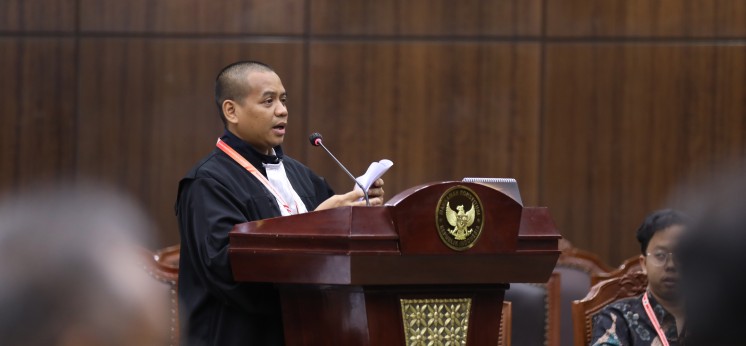
Mukhlish Muhammad Maududi, legal counsel for the Relevant Party, deliver a statement at a judicial review hearing of the National Education System Law and the Higher Education Law, Thursday (7/31/2025). Photo by MKRI/Ifa.
JAKARTA (MKRI) — The Indonesian Accreditation Agency for Higher Education in Health (LAM-PTKes); the Institute of Accreditation for Economics, Management, Business, and Accounting Programs (LAMEMBA); the Independent Accreditation Board for Informatics and Computer Sciences (LAM INFOKOM); and the Independent Accreditation Board for Natural and Formal Sciences (LAMSANA) have joined as Relevant Parties in case No. 60/PUU-XXIII/2025. The case concerns the judicial review of Article 60 paragraph (2) of Law No. 20 of 2003 on the National Education System (Sisdiknas Law) and Article 55 paragraphs (5), (6), (7), and (8) of Law No. 12 of 2012 on Higher Education (Dikti Law).
Legal counsel for LAM-PTKes, Adrianto Dwitomo, stated that independent accreditation bodies play a vital role in enhancing the quality of education and facilitating affordable access to employment through accreditation, while also improving the caliber of graduates from accredited higher education institutions. The regular supervision and evaluation conducted by the National Accreditation Board for Higher Education (BAN-PT) on LAM-PTKes, as an independent accreditation body, serves as an effective oversight mechanism.
“Therefore, the annual evaluations carried out by BAN-PT on LAM-PTKes, as an independent accreditation body, represent a form of government oversight designed to ensure that such institutions continue to operate in accordance with their intended functions and responsibilities, and remain within the framework established by the Government,” Adrianto explained at the fifth hearing in the plenary courtroom on Thursday, July 31, 2025.
The results of accreditation issued by LAM-PTKes from 2015 to 2025 have in fact varied. Accreditation outcomes in the health sector have not always resulted in excellent ratings. Adrianto emphasized that LAMs, as legal entities that may be established either by the Government or by the public, is thus able to ensure that the accreditation granted to educational institutions accurately reflects conditions on the ground.
According to Adrianto, this case does not concern a constitutional issue, but rather pertains to open legal policy, which involves an open delegation of authority granted to the Government and legislature to formulate systems and methods that can ensure and enhance the quality of education on a national scale. At present, the Government, in collaboration with the legislature, is developing the education system by establishing educational institutions across the country, with quality assurance in governance and teaching provided through BAN-PT.
Meanwhile, LAMEMBA, LAM INFOKOM, and LAMSANA were represented by legal counsel Mukhlish Muhammad Maududi. They asserted that the provisions under judicial review do not mandate the use of LAMs as the sole option, but rather provide the state with the flexibility to choose how accreditation is implemented—whether by the Government or by designated independent institutions.
“Since the arrangement is of an alternative nature, the state does not relinquish its responsibilities but instead involves the public in the process of quality assurance in education,” said Mukhlish.
He further explained that the state continues to play a role by exercising oversight over LAMs. The minister and BAN-PT remain responsible for evaluating and supervising LAMs, including taking over their functions should they fail to fulfill their duties in accordance with the applicable regulations.
Also read:
Cooperation Body of Law Deans Challenges Provisions on Accreditation
Council of Law Deans Revises Petition on National Education System Law
Minister Denies Govt Relinquished Responsibility for Study Programs Accreditation
The petition was filed by the cooperation body of law deans of public universities in Indonesia, eight lecturers, and three university students. They question the university accreditation program and education units by two entities: the Government and the authorized independent institutions. With two institutions having similar duties but different objects, there is a risk of varying standards, methods, and assessment results that could confuse accredited universities and study programs. This could decrease the effectiveness of the higher education quality assurance system as a whole.
The Petitioners argued that the articles being petitioned are against the fourth paragraph of the Preamble to the 1945 Constitution, which reads, “And then to form a Government of the State of Indonesia that protects all Indonesian people and the entire land of Indonesia and to develop the welfare of the people, the life of the nation…” They also use Article 31 paragraph (3) of the 1945 Constitution to review the articles against.
They explained that the independent accreditation bodies show the inefficiency, ineffectiveness, and disharmony of accreditation institutions because two institutions have similar main tasks and functions, only differentiated by the object of accreditation, i.e. BAN-PT (National Accreditation Board for Higher Education) for accreditation of universities, and independent accreditation institutions for study programs.
In addition to the loss of government authority to directly assess the quality of higher education, independent accreditation bodies also could potentially create overlapping authority and uncertainty in the higher education accreditation system in Indonesia. They can also cause problems in terms of independence and accountability.
Accreditation assessments by independent accreditation bodies managed by the community could potentially lead to transactional practices. This can result in the assessment process not being objective, or using indicators that are not aligned with the National Higher Education Standards (SN-Dikti), even though compliance with these standards is mandatory.
The Petitioners also argued that if independent accreditation bodies have such authority, there is a question whether the Government would have a role and responsibility in ensuring the quality and implementation of proper and standardized higher education. This responsibility should not only be limited to the level of higher education institutions, but also includes all existing study programs. Therefore, it is important to emphasize that the authority in granting accreditation should remain in the hands of the Government, not solely by non-governmental institutions.
The lack of government/minister’s responsibility to guarantee the quality of higher education, one of the minister’s responsibilities, i.e. to evaluate the implementation of higher education, has disappeared. Thus, the absence of government responsibility through the minister to evaluate the implementation of higher education through accreditation of study programs is contrary to Article 31 paragraph (3) of the 1945 Constitution, which reads, “The Government shall exert to hold a national educational system to improve the faith and devotions as well as noble morals in the framework of developing the national life, as stipulated by virtue of law.
In the petitums, the Petitioners requested the Court to declare Article 60 paragraph (2) of the National Education System Law conditionally unconstitutional if not interpreted as “Accreditation of a program and education unit shall be the responsibility of the Government.” They also requested that Article 55 paragraph (5) of the Higher Education Law be declared conditionally unconstitutional if not interpreted as “The accreditation of Study Programs shall be conducted by the National Accreditation Board for Higher Education.” They wished Article 55 paragraphs (6) and (7) be declared unconstitutional. They also asked that the phrase “independent accreditation agency” in Article 55 paragraph (8) be declared conditionally unconstitutional if not interpreted as “Further provisions on accreditation as referred to in paragraph (1) and the National Accreditation Board for Higher Education as referred to in paragraph (4) shall be set out in a Ministerial Regulation.”
Author : Mimi Kartika
Editor : Lulu Anjarsari P.
PR : Andhini S.F.
Translator : Yuniar Widiastuti (NL)
Disclaimer: The original version of the news is in Indonesian. In case of any differences between the English and the Indonesian versions, the Indonesian version will prevail.
Thursday, July 31, 2025 | 15:39 WIB 429