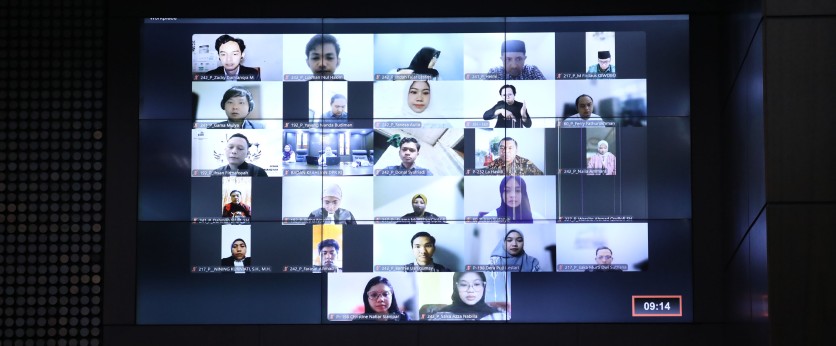
The Petitioners attending the ruling hearing virtually (online). Monday (1/19/2026). Photo by MKRI/Panji.
JAKARTA (MKRI) — The Constitutional Court (the Court) has declared Case No. 242/PUU-XXIII/2025 concerning the material judicial review of Article 188 paragraphs (3) and (4) of Law No. 17 of 2023 on Health (the Health Law) inadmissible. The Court found that the Petitioners failed to meet the formal requirements, as they did not submit stamped documentary evidence or affix their respective signatures to the revised petition, rendering the application procedurally defective.
“Since neither the documentary evidence submitted with the initial petition nor that filed during the petition revision was affixed with stamp duty, and the revised petition was not signed by the Petitioners, the Court has no doubt in declaring that the Petitioners’ application fails to satisfy the formal requirements for filing a judicial review petition before the Constitutional Court,” said Chief Justice Suhartoyo while delivering the ruling at the plenary hearing on Monday (January 19, 2026) at the Court’s Plenary Courtroom in Jakarta.
Also read:
Andalas Law Students Revise Petition on Health Law Judicial Review
Andalas University Law Students Challenge Health Law
The petition was filed by students of the Faculty of Law of Andalas University, namely Petitioner I Naila Ammara, Petitioner II Fanesa Aulia, Petitioner III Ridho Fadilla Razaq, Petitioner IV Donal Syafriadi, Petitioner V Salsa Azza Nabilla, Petitioner VI Indah Fajar Lestari, Petitioner VII Farasat Ahmad, Petitioner VIII Ramayana Putri, Petitioner IX Beni Usri Gumay, Petitioner X Lukman Nul Hakim, and Petitioner XI Zacky Damiansya Monandar. The Petitioners argued that the provisions under review lacked clear standards or parameters, potentially leading to multiple interpretations that could violate the right to legal protection and certainty in health-related matters.
Article 188 paragraph (3) of the Health Law stipulates, “In conducting research as referred to in paragraph (2), hospitals may provide research-based services.” According to the Petitioners, the provision fails to set out clear parameters, limitations, or conditions governing when such actions may be undertaken.
They further contended that the ambiguity of the word “may” opens room for multiple interpretations, allowing research-based services to be carried out under any circumstances, including when patients are not in emergency situations or have not given specific consent. Such uncertainty, they argued, undermines the Petitioners’ right to fair legal certainty as guaranteed under Article 28D paragraph (1) of the 1945 Constitution.
Meanwhile, Article 188 paragraph (4) of the Health Law provides that hospitals conducting research-based services through innovations developed by medical personnel and/or health workers must be granted support and autonomous freedom by the central and regional governments according to their respective authorities. The Petitioners asserted that although the provision refers to services being carried out “responsibly,” it does not specify criteria, mechanisms, ethical standards, oversight arrangements, or forms of legal accountability should such services pose risks or cause harm to patients.
This normative gap, the Petitioners argued, potentially threatens their right to life and to defend their life as guaranteed under Article 28A of the 1945 Constitution, as well as the right to obtain safe and proper health services that ensure physical and mental well-being as enshrined in Article 28H paragraph (1) of the 1945 Constitution. Given the real possibility that they may receive health services in hospitals, the lack of clarity in the contested provisions could directly result in constitutional harm, including uncertainty over their status as patients or research subjects, potential risks to bodily safety, and the absence of legal protection should losses occur.
In their petitum, the Petitioners requested the Court to declare Article 188 paragraph (3) of the Health Law unconstitutional and conditionally non-binding insofar as it is not interpreted to mean that the phrase “hospitals may provide research-based services” applies only in health emergencies that threaten the welfare of individuals or the broader community. They also asked the Court to declare Article 188 paragraph (4) unconstitutional and conditionally non-binding unless the phrase “responsibly” in research-based services is interpreted as actions that: (a) prioritize the interests of research subjects over scientific or societal interests; (b) may only be carried out when potential risks can be anticipated and minimized; (c) require informed consent from research subjects without coercion; and (d) mandate compensation mechanisms for injuries or losses arising from the research.
Author: Mimi Kartika
Editor: Lulu Anjarsari P.
PR: Adriana Airlia Yusrin
Translator: Yuanna Sisilia
Disclaimer: The original version of the news is in Indonesian. In case of any differences between the English and the Indonesian versions, the Indonesian version will prevail.
Monday, January 19, 2026 | 09:37 WIB 82