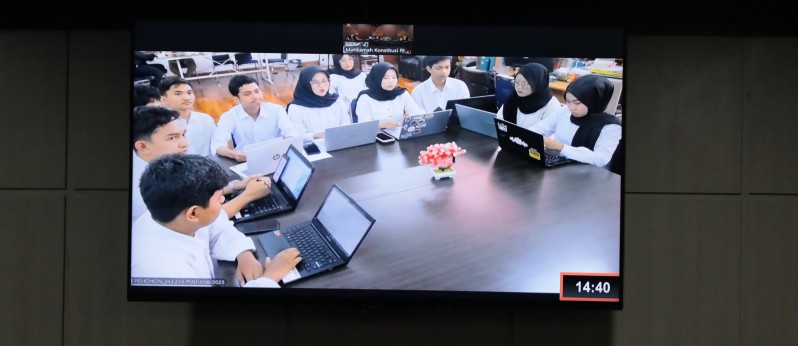
Eleven students of the Faculty of Law, Andalas University, presenting the main points of their petition at a preliminary hearing with the agenda of examining the Petitioners’ application, Tuesday (12/16/2025). Photo by MKRI/IlhamWM.
JAKARTA (MKRI) — Eleven students of the Faculty of Law, Andalas University, filed a petition for a material judicial review of Article 188 paragraphs (3) and (4) of Law No. 17 of 2023 on Health (Health Law) with the Constitutional Court. The Petitioners argue that the provisions lack clear standards or parameters, thereby giving rise to multiple interpretations that may ultimately infringe upon the right to legal protection and certainty in the health sector.
“As citizens who may at any time become patients and receive services from hospitals, the Petitioners are potentially and actually harmed,” said Naila Ammara, Petitioner I, who attended the preliminary hearing for Case No. 242/PUU-XXIII/2025 virtually on Tuesday (12/16/2025).
In addition to Naila, the other Petitioners are Fanesa Aulia (Petitioner II), Ridho Fadilla Razaq (Petitioner III), Donal Syafriadi (Petitioner IV), Salsa Azza Nabilla (Petitioner V), Indah Fajar Lestari (Petitioner VI), Farasat Ahmad (Petitioner VII), Ramayana Putri (Petitioner VIII), Beni Usri Gumay (Petitioner IX), Lukman Nul Hakim (Petitioner X), and Zacky Damiansya Monandar (Petitioner XI). However, Indah Fajar Lestari did not attend the first hearing.
Article 188 paragraph (3) of the Health Law provides that, “In conducting research as referred to in paragraph (2), hospitals may provide research-based services.” According to the Petitioners, the provision does not specify clear parameters, limitations, or conditions as to when such services may be carried out.
The ambiguity of the word “may” allows multiple interpretations, potentially permitting research-based services to be conducted under circumstances that do not meet the criteria for emergency care or that lack specific consent. Such uncertainty, the Petitioners contend, threatens their right to fair legal certainty as guaranteed under Article 28D paragraph (1) of the 1945 Constitution.
Furthermore, Article 188 paragraph (4) of the Health Law states that, “Hospitals providing research-based services as referred to in paragraph (3) through research innovations developed by medical personnel and/or health workers must be granted support and autonomous freedom by the Central Government and Regional Governments in accordance with their respective authorities.” The Petitioners argue that although the provision requires such services to be carried out “responsibly,” it does not set out criteria, mechanisms, ethical standards, oversight arrangements, or forms of legal accountability in the event the services cause risks or harm to patients.
This normative gap, they assert, may jeopardize the right to life and to defend one’s life as guaranteed under Article 28A of the 1945 Constitution, as well as the right to obtain safe and proper health services that ensure physical and mental well-being as protected by Article 28H paragraph (1) of the 1945 Constitution. Given the real possibility that they may receive health services in hospitals, the unclear norms under review could directly result in constitutional harm in the form of uncertainty over their status as patients or research subjects, potential risks to bodily safety, and the absence of legal protection should harm occur.
Accordingly, the Petitioners request that Article 188 paragraphs (3) and (4) of the Health Law be declared conditionally constitutional. They seek an interpretation whereby the word “may” in paragraph (3) is applicable only in medical emergencies or in specific circumstances that genuinely require the use of research-based services. They also ask that the phrase “responsibly” in paragraph (4) be construed as requiring clear, measurable, and supervised accountability that ensures patient safety.
The petition was examined by a panel of constitutional justices chaired by Deputy Chief Justice Saldi Isra, with Constitutional Justices Ridwan Mansyur and Arsul Sani as panel members. During the advisory session, Justice Ridwan emphasized that the Petitioners must clearly contest how the application of the challenged provisions results in constitutional harm and how those provisions contradict the 1945 Constitution as the benchmark for review.
“You must demonstrate that the provisions truly cause harm and are in conflict with the 1945 Constitution,” Justice Ridwan said.
Absent such a detailed explanation, the Court noted, the posita and the petitums may appear unsynchronized. If the Petitioners fail to construct a strong legal argument, the petition risks being declared unclear or obscuur.
Before adjourning the hearing, Deputy Chief Justice Saldi Isra stated that the Petitioners are granted 14 days to revise their petition. The revised documents, in both softcopy and hardcopy, must be received by the Court no later than Monday, December 29, 2025, at 12:00 p.m. local time.
Author: Mimi Kartika
Editor: Lulu Anjarsari P.
PR: Adriana Airlia Yusrin
Translator: Yuanna Sisilia
Disclaimer: The original version of the news is in Indonesian. In case of any differences between the English and the Indonesian versions, the Indonesian version will prevail.
Tuesday, December 16, 2025 | 16:27 WIB 68