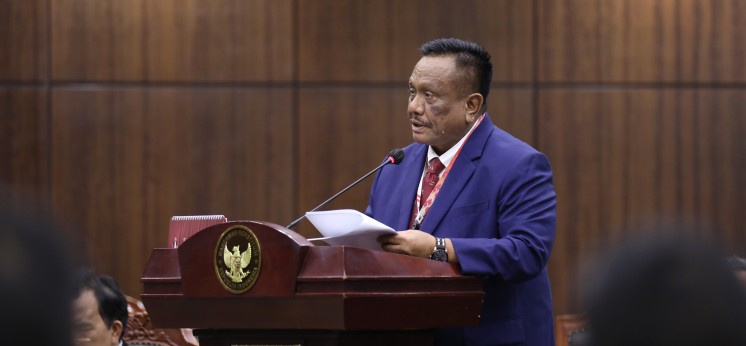
Basuki Rekso Wibowo, Petitioner’s Expert, delivering testimony at the hearing of the judicial review of Law No. 24 of 2009 on the National Flag, Language, and Emblem, as well as the National Anthem, Tuesday (1/13/2026). Photo by MKRI/Ifa.
The Petitioner's Expert and Witness explained the importance of the obligation to use Indonesian in a memorandum of understanding, so sanctions are required in Article 31 paragraph (1) of the BBLNLK Law.
JAKARTA (MKRI) – Professor of Law at the National University, Basuki Rekso Wibowo, explained that the creation of agreements using only a foreign language (English) without being made in bilingual form, or without being accompanied by an official translation cannot be allowed. This situation occurs due to the enactment of Article 31 paragraph (1) of Law No. 24 of 2009 on the Flag, Language, and National Symbol, as well as the National Anthem (UU BBLNLK) which does not contain the threat of sanctions in the event of a violation. He believes that such a situation cannot be allowed to continue, because it undermines the sovereignty of the Indonesian language and has the potential to harm the rights of Indonesian legal subjects when entering into agreements with foreign legal subjects.
Basuki was present as an Expert for the Petitioner for Petition No. 188/PUU-XXIII/2025 which is a material review of Law No. 24 of 2009 on the State Flag, Language, and Symbol, as well as the National Anthem (BBLNLK Law), on Tuesday, January 13, 2026. This hearing was held for two petitions at once, namely Petition No. 173/PUU-XXIII/2025 which was filed by Feri Kurniawan (Petitioner I) and Fatchurozak (Petitioner II) and Petition No. 188/PUU-XXIII/2025 filed by Alfin Ridhano which questions the constitutionality of the norm of Article 31 paragraph (1) of the BBLNLK Law and Article 1320 Point 4 of the Civil Code.
Furthermore, Basuki said that the formulation of the phrase "must be used" in the provisions of Article 31 of Law No. 24 of 2009 and Article 4 paragraph (1) of Presidential Decree No. 63 of 2019 is a provision made in writing, has a fairly clear formulation, and is not open to multiple interpretations. Therefore, it must be interpreted strictly to maintain legal certainty. Simply put, the provisions contained in Article 31 of Law No. 24 of 2009 and Article 4 paragraph (1) of Presidential Decree No. 63 of 2019 are imperative or coercive in nature, so they must be complied with by everyone without exception. This includes in the creation of agreements, both private and public agreements.
In fact, Indonesian became the 10th working language at the UNESCO General Assembly since the adoption of Resolution 42 C/28 in November 2023 and was first used officially in a speech at the 43rd General Assembly in Samarkand, Uzbekistan in November 2025.
It is stated that if in an event or legal action related to the maker of an agreement, it is proven that they have violated the obligation to use Indonesian as regulated in the provisions of Article 31 paragraph (1) of Law No. 24 of 2009, they will be subject to sanctions. That Indonesian is the official language of the state, as well as a symbol of the sovereignty of the Republic of Indonesia.
"However, it seems that the law makers were negligent and careless in their formulation, so they did not include the threat of sanctions if there was a violation of the provisions of Article 31 paragraph (1) of Law No. 24 of 2009. Without including the threat of sanctions for violations of the provisions of Article 31 paragraph (1) of Law No. 24 of 2009, which are imperative, this has created legal uncertainty and opened up opportunities for violations to occur," explained Basuki.
Optional
In addition, Indra Listyo, a sworn translator, provided witness testimony, which was also presented by the Petitioner in Petition No. 188/PUU-XXIII/2025. He explained that since Law No. 24 of 2009 was enacted in 2022, the majority of clients, both domestic and international, who request him to translate agreements from foreign languages into Indonesian, have a shared understanding of this obligation.
At that time, Indra continued, client awareness of translating foreign agreement documents into Indonesian was very high. This was due to an understanding of the legal obligations as stipulated in Article 31 paragraph (1) of Law No. 24 of 2009 and the existence of a number of court decisions that ruled that agreements with Indonesian parties made only in a foreign language were null and void (invalid).
“As time went by, I began to observe and found a change in client perception regarding the meaning of the obligation of Article 31 paragraph (1) of Law No. 24 of 2009 to become optional around 2023. Based on what I know and heard from fellow translators and other related professions, the change in perception among clients is related to the issuance of the Supreme Court Circular (SEMA) No. 3 of 2023. I and many other fellow translators have experienced a very significant decline in requests for agreement translations since around 2023 until now. This downward trend has gradually resulted in significant economic losses for my prospects as a sworn and certified translator and for other fellow translators,” explained Indra.
Also read:
The Risks of Using Foreign Languages in Memorandums of Understanding
Petitioner Adds Comparison of Foreign Language Memorandum of Understanding
Court Postpones Hearing on the Use of Foreign Languages in the Memorandum of Understanding
Petitioners Seek Legal Annulment Sanction for Memorandums of Understanding That Do Not Use Indonesian Language
Petitioners Affirm Legal Basis for Mandatory Use of Indonesian in MoUs
House States the Inclusion of Indonesian is Not a Requirement for MoU Validity
Previously, Case No. 173/PUU-XXIII/2025 filed by a prospective advocate, Petitioner I was prepared to carry out the functions of an advocate professionally, which includes work to prepare and/or review legal documents, such as agreements and memoranda of understanding. However, the existence of Article 31 paragraph (1) of Law No. 24 of 2009 has the potential to cause constitutional losses to the Petitioner in preparing memoranda of understanding and/or agreements for clients who are subjects of Indonesian law. Petitioner I believes that he will be overshadowed by legal risks in the form of the validity of an agreement if the memorandum of understanding and/or agreement only uses a foreign language.
Meanwhile, Petitioner II, who works as a sworn translator, is tasked with providing formal guarantees and certification in the form of documents including agreements and memoranda of understanding in foreign languages that have the same meaning and legal force as the translated version in Indonesian, or vice versa. According to Petitioner II, the lack of clarity regarding sanctions for violations of the obligation to use Indonesian in the preparation of memoranda of understanding and agreements involving Indonesian legal subjects, as stated in Article 31 paragraph (1) of Law No. 24 of 2009, has resulted in the emergence of an interpretation that memorandums of understanding and agreements in foreign languages without an Indonesian version are still valid. Therefore, this has actually resulted in a decrease in demand for translation services for memoranda of understanding and agreements. This is actually one of the main sources of income for Petitioner II, so this has clearly eroded his main source of income.
Meanwhile, in Case No. 188/PUU-XXIII/2025, the Petitioners argued that Article 31 paragraph (1) of the Language Law and Article 1320 Point 4 of the Civil Code. The Petitioners experienced obstacles in carrying out their constitutional law and public policy consultation work program, because they were unable to provide definite legal advice regarding the legal consequences of using foreign languages in agreements made by Indonesian legal subjects. As a result, Petitioner I was unable to fulfill its vision as a research and consulting institution that provides objective and accurate information and analysis. This occurred because legal uncertainty prevented the provision of accurate information regarding the legal consequences of using foreign languages in agreements made by Indonesian legal subjects. Meanwhile, for Petitioner II, the enactment of these articles had an impact on reducing demand for translation services. As a language service provider, Petitioner II experienced legal uncertainty and was unable to obtain decent work and advance himself. (*)
Track case No. 173/PUU-XXIII/2025 and No. 188/PUU-XXIII/2025
Author : Sri Pujiati
Editor : Lulu Anjarsari P.
PR : Fauzan Febriyan
Translator : Donny Yuniarto
Disclaimer: The original version of the news is in Indonesian. In case of any differences between the English and the Indonesian versions, the Indonesian version will prevail.
Tuesday, January 13, 2026 | 16:30 WIB 136