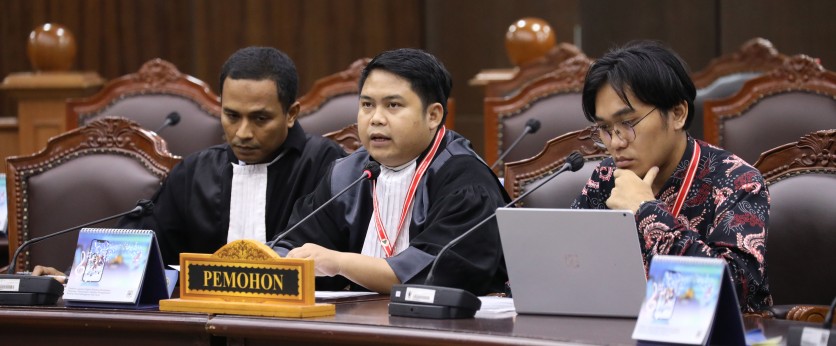
Feri Kurniawan as the petitioner, and his legal counsel Yapiter Marpi and Ramjahif Pahisa Gorya Fiver, presenting the arguments for the revised petition in the MK panel courtroom on Wednesday (10/22/2025).Photo by MKRI/Panji.
JAKARTA (MKRI) – The Constitutional Court (MK) again held a judicial review hearing on Article 31 paragraph (1) of Law No. 24 of 2009 on the State Flag, Language, and Symbols, as well as the National Anthem (UU BBLNLK) on Wednesday, October 22, 2025. The second hearing for Case No. 173/PUU-XXIII/2025 with the agenda of hearing the main points of the revision of the petition from Feri Kurniawan (Petitioner I) and Fatchurozak (Petitioner II) was carried out by a Panel Hearing chaired by Chief Justice Suhartoyo.
The Petitioners, through their legal counsel, Yapiter Marpi, stated that they had added comparative legal analyses from several other countries that had similar problems with the implementation of the norms being challenged regarding the obligation of linguistic aspects, including Belgium, Lithuania, and France.
"From the comparative conclusions of these countries, countries that have mandatory norms regarding the use of language in certain agreements always include clear threats of sanctions and negative legal consequences. No country leaves mandatory norms unsanctioned, as this would create legal uncertainty and inconsistent interpretation," Yapiter stated.
Furthermore, the Petitioners have strengthened their theoretical argument regarding obligations and sanctions by using the theory of legal obligations coupled with sanctions. The Petitioners have even outlined this, citing Hans Kalsen's opinion. He states that positive moral norms are norms that contain obligations but are not accompanied by sanctions that can be enforced by legal authorities. Positive moral norms, on the other hand, stem from social awareness or societal morality, not from the will of the state.
"Therefore, violations of positive moral norms do not result in legal sanctions that can be enforced by judges or state officials, but only result in social sanctions, in the form of moral censure, loss of reputation, or social exclusion. However, according to the Petitioners, it is important to note that not all obligations without sanctions are rationally acceptable. The law if without clear reasons, as emphasized in the Constitutional Court Decision No. 82/PUU-XXI/2023. The word mandatory will have the consequence of sanctions if it is not implemented. This has been expressly stipulated in the UUP3 that to state the existence of an obligation that has been determined for the word mandatory if the obligation is not fulfilled, then the person concerned can be subject to sanctions," explained Yapiter.
Also read:
The Risks of Using Foreign Languages in Memorandums of Understanding
For additional information, Case No. 173/PUU-XXIII/2025 was filed by Feri Kurniawan (Petitioner I) and Fatchurozak (Petitioner II). At the Preliminary Hearing at the Court, Thursday (10/9/2025) Petitioner I as a prospective advocate in conducting due diligence on foreign language agreements for clients who are Indonesian legal subjects, Petitioner I will not be able to provide a definitive conclusion regarding their validity. In addition, when providing legal advice, Petitioner I will not be able to provide a definitive and certain legal opinion to clients who are Indonesian legal subjects regarding the legal consequences of agreements made only in a foreign language. This can then harm Petitioner I's professional integrity. Meanwhile, in the litigation process, Petitioner I and his client will be faced with the risk of different interpretations by judges at various levels of court, which can lead to unpredictable and inconsistent decisions.
Eroding Income Sources
Meanwhile, Petitioner II, a sworn translator, is tasked with providing formal assurance and certification that documents, including agreements and memoranda of understanding (MoUs) in foreign languages, have the same meaning and legal force as their Indonesian translations, or vice versa. According to Petitioner II, the unclear sanctions for violating the obligation to use Indonesian in drafting memoranda of understanding (MoUs) and agreements involving Indonesian legal subjects, as stipulated in Article 31 paragraph (1) of Law No. 24 of 2009, have resulted in the interpretation that foreign-language memoranda of understanding (MoUs) and agreements without an Indonesian version remain valid. Consequently, this has actually resulted in a decline in demand for translation services for memoranda of understanding (MoUs) and agreements. This is actually one of Petitioner II's primary sources of income, thus significantly eroding his primary source of income.
For this reason, the Petitioners request that the Court declare Article 31 paragraph (1) of Law No. 24 of 2009 on the Flag, Language, and State Symbols, as well as the National Anthem to be conditionally unconstitutional against the 1945 Constitution of the Republic of Indonesia and not have binding legal force as long as it is not interpreted as, "Indonesian must be used in memorandums of understanding or agreements involving state institutions, government agencies of the Republic of Indonesia, Indonesian private institutions, or individual Indonesian citizens, which if not fulfilled will make the memorandum of understanding and agreement null and void by law."
Track case No. 173/PUU-XXIII/2025
Author : Sri Pujiati
Editor : N. Rosi.
PR : Fauzan F.
Translator : Donny Yuniarto
Disclaimer: The original version of the news is in Indonesian. In case of any differences between the English and the Indonesian versions, the Indonesian version will prevail.
Wednesday, October 22, 2025 | 15:55 WIB 199